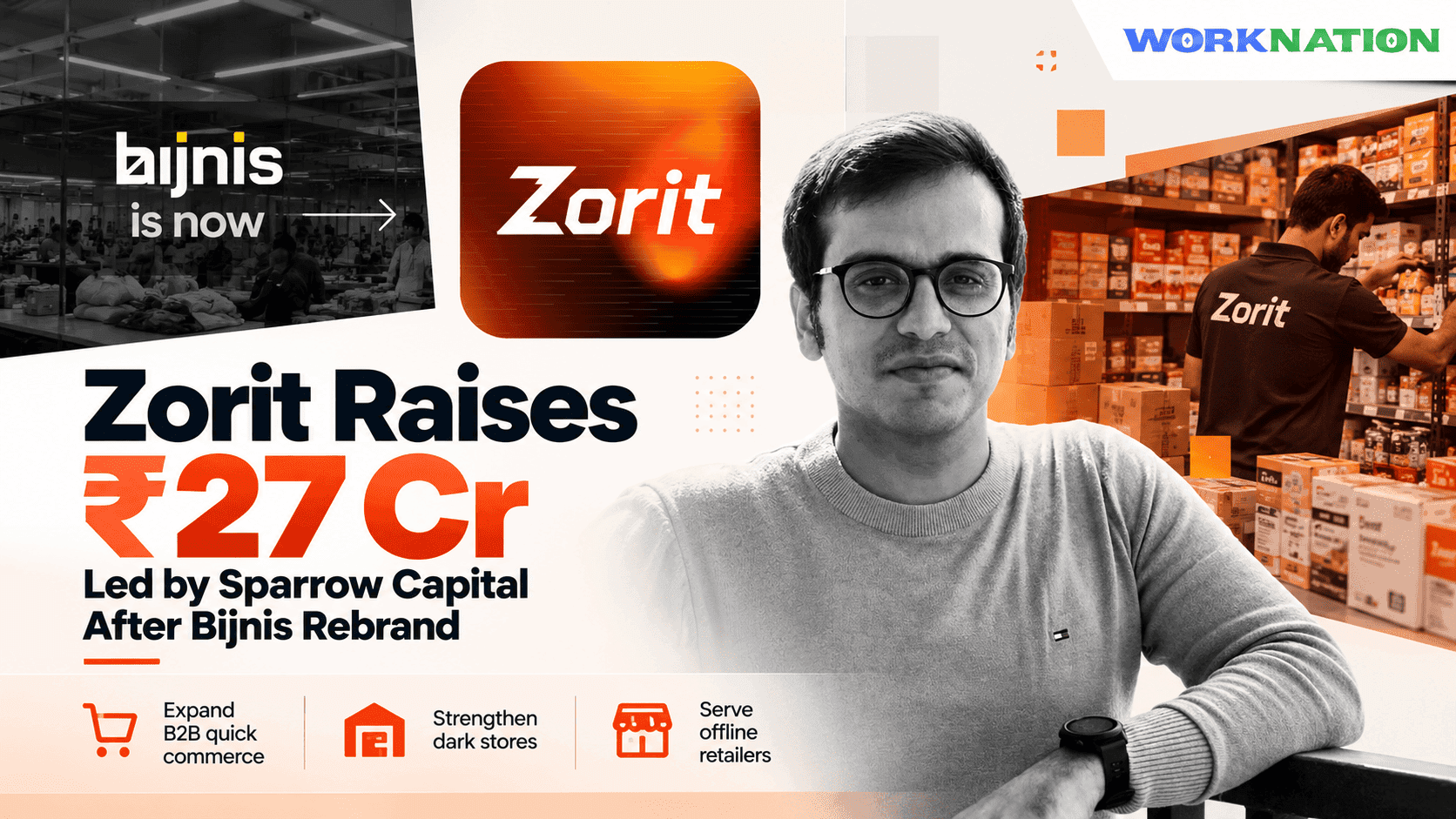
Bijnis Rebrands as Zorit, Raises ₹27 Cr to Expand B2B Quick Commerce
Top Picks
Submit PR
Stay Ahead of the Market
Get the latest startup funding, hiring trends and global opportunities delivered to your inbox every week.
B2B quick commerce startup Zorit, formerly known as Bijnis, has raised nearly ₹27 crore ($2.84 million) in a funding round led by Sparrow Capital. Existing investors Info Edge and WaterBridge participated alongside Better Capital, angel investors and employees.
The angel investors include Anupam Mittal, founder of Shaadi.com, the founders of Shiprocket, Mohit Sardana, CEO of Xpressbees, and Sarthak Misra of SoftBank.
The funding comes as the company continues its transition from a business-to-business marketplace connecting manufacturers with retailers to an inventory-led quick commerce platform. Zorit now enables offline retailers to source products from locally stocked dark stores, with deliveries in as little as 60 minutes.
Founded in 2015, the company plans to use the fresh capital to strengthen its quick commerce infrastructure, expand its product assortment and deepen retailer engagement across its operating markets.
From B2B Marketplace to Quick Commerce
Zorit was originally established as Bijnis by Siddharth Vij, Chaitanya Rathi, Siddharth Rastogi and Sachin Chauhan. Its initial business model focused on connecting manufacturers with retailers through a B2B marketplace.
In late 2024, the company transitioned to an inventory-led quick commerce model. Rather than operating primarily as a marketplace connecting buyers and suppliers, Zorit stocks inventory in local dark stores and fulfils retailer orders from these locations.
The model is designed to help offline retailers replenish inventory quickly, access locally relevant products and order smaller quantities when required.
Traditional inventory sourcing can involve longer procurement cycles and minimum order quantities that may not suit every retailer. By holding inventory closer to retailers, Zorit aims to shorten delivery times and make frequent replenishment more practical.
The company says it currently operates 12 dark stores across 12 cities. Its reported annualised sales have reached ₹120 crore.
This transition represents a significant change in how the business serves retailers. It also introduces inventory management and fulfilment responsibilities alongside the technology and supplier relationships required for a B2B marketplace.
Retailer Retention and Ordering Frequency Improve
Zorit reports improvements in retailer engagement following its transition to the inventory-led model.
According to the company, nearly 60% of its retailers had never previously used an online B2B platform. This suggests that the platform is attracting a substantial proportion of retailers who were not previously active users of digital B2B procurement services.
The company also says retailer retention beyond the sixth month has improved fourfold compared with its earlier model. Monthly ordering frequency has increased fivefold, with retailers placing an average of five to six orders per month. Its top retailer cohorts place more than 10 orders monthly.
These figures point to the importance of repeat purchasing in Zorit's business model. Frequent orders can indicate that retailers are incorporating the platform into their regular inventory replenishment processes rather than using it only for occasional purchases.
However, the reported improvements are company-provided metrics. The source announcement does not disclose the underlying cohort sizes, the exact measurement periods or independently verified retention data.
For an inventory-led quick commerce business, repeat ordering must also translate into sustainable fulfilment economics. The ability to serve retailers frequently while controlling inventory costs, delivery expenses and unsold stock will be important as the company expands.
Dark Stores and Unit Economics
Zorit's operating model depends on maintaining inventory close to its retailer base. Dark stores allow the company to fulfil orders locally, potentially reducing the time between an order being placed and the goods reaching the retailer.
The company reports that nearly 50% of its dark stores have reached break-even, including the cost of liquidating unsold inventory.
Including unsold inventory liquidation costs is relevant because inventory-led businesses face the risk that some products may not sell as expected. Unsold stock can tie up working capital and require discounts or other measures to clear it.
The reported break-even figure provides an early indication of the operating performance of part of Zorit's network. However, the source does not specify the period used to measure break-even, the total costs included beyond inventory liquidation, or the financial performance of individual stores.
As Zorit expands, maintaining store-level economics while entering additional markets and broadening its assortment will be an important test of the model.
Sparrow Capital Leads ₹27 Crore Funding Round
The latest round was led by Sparrow Capital, with participation from existing investors Info Edge and WaterBridge, as well as Better Capital, angel investors and employees.
The round includes prominent individual investors from India's technology and startup ecosystem, including Anupam Mittal, the founder of Shaadi.com, founders of Shiprocket, Mohit Sardana of Xpressbees and Sarthak Misra of SoftBank.
Info Edge's involvement is also notable given its earlier investment history with the company. According to the source report, Info Edge's shareholding in Bijnis will increase to 20.12% on a fully converted and diluted basis following the investment.
In an earlier stock exchange disclosure, Info Edge also said it may acquire additional equity in the company through a secondary transaction.
The source article notes that Info Edge wrote off its entire ₹76.65 crore investment in Bijnis, operated by Bizcrum Infotech Pvt Ltd, in May 2023.
Zorit had previously raised capital from investors including Matrix Partners, now known as Z47, Sequoia Capital, now Peak XV Partners, and WestBridge Capital. It raised $30 million in a Series B round led by WestBridge Capital in September 2021 and had secured more than $40 million in total funding.
The latest round follows the company's change in operating model and its focus on building a quick commerce infrastructure for offline retailers.
Funding to Strengthen Quick Commerce Operations
Zorit plans to use the new capital to improve its quick commerce infrastructure, expand its product assortment and strengthen engagement with retailers across its operating markets.
These priorities are directly connected to its inventory-led model. A broader assortment can help retailers source more products through the platform, while local inventory availability and reliable fulfilment are central to delivering orders quickly.
Deeper retailer engagement may also help the company understand purchasing patterns and stock products that match local demand.
At the same time, expanding an inventory-led network requires careful management of working capital, product availability and unsold stock. Growth in sales alone does not establish profitability, making store-level performance and repeat purchasing important metrics to monitor.
Zorit's reported annualised sales of ₹120 crore and its retailer engagement figures provide a snapshot of its current scale, but the source does not disclose revenue recognition details, gross margins or overall profitability.
What Comes Next for Zorit?
Zorit's rebranding accompanies a broader shift in its business strategy. The company has moved from connecting manufacturers and retailers through a marketplace to holding inventory and delivering products directly through a network of dark stores.
Its latest ₹27 crore funding round will support the infrastructure and assortment required to develop that model further.
The opportunity lies in making inventory replenishment faster and more accessible for offline retailers. Whether Zorit can scale sustainably will depend on continued retailer adoption, repeat orders, inventory discipline and the economics of its expanding dark-store network.
The company's next stage will test whether its reported improvements in retention, ordering frequency and store-level break-even can support a larger operation.
For India's B2B commerce sector, Zorit illustrates a model that combines digital procurement with local inventory and rapid fulfilment. Its performance will offer further evidence of how quick commerce principles can be adapted to serve business customers rather than individual consumers.
Have a Funding Round or Exciting Update to Share?
Submit your press release to get featured on WorkNation and reach founders, investors, and tech leaders.