How to Get Zookeeper and Park Ranger Jobs in the USA: 2026 Requirements, Salaries and Application Guide
Top Picks
Submit PR
Stay Ahead of the Market
Get the latest startup funding, hiring trends and global opportunities delivered to your inbox every week.
Key takeaways
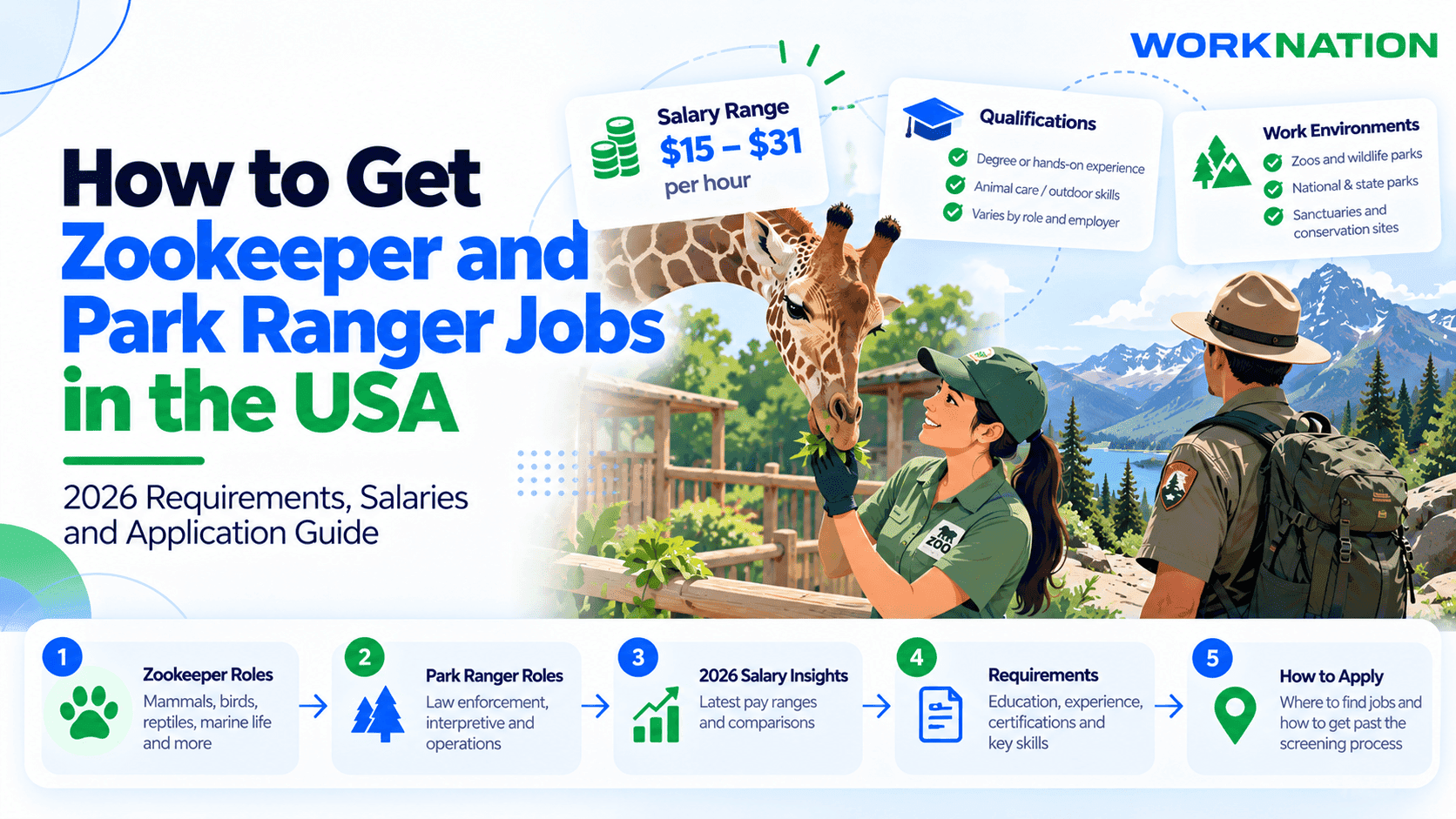
Pay first. Most zookeeper jobs in the US pay $15 to $31 an hour. That's from 2026 job posts. The BLS puts the median for animal caretakers at $35,360 a year.
You don't always need a four-year zoology degree. Most big zoos still want one. But lots of small zoos and farms don't mind. They'll take hands-on work in its place.
Park ranger jobs in the USA come in two kinds. Some rangers keep the law. They keep guests safe. Others teach, lead tours and look after old sites. Each kind has its own way in.
Zoos, AZA-accredited parks and state parks screen hard. They scan each file. They look for the words in the job post. Miss them and you're out.
So check your file against the post in WorkNation's Resume Checker. Then look at real openings on WorkNation Jobs. You'll get past the first screen a lot faster.
Want zookeeper jobs or park ranger jobs in the USA? You need two things. First, real time with animals or out in the field. And proof of it. Second, a job form that fits the post. Match the kinds of beasts it names. Match the safety rules. Match each task it lists. A four-year degree helps. It counts most at big zoos and in the federal parks. Plenty of small zoos don't need one to start. Nor do lots of state parks. Gator farms don't, either. They hire new keepers and rangers on proof of work. An intern spot counts. So does time in a kennel. So does a stint on a farm. So does a full season at a park.
Here's what this guide will show you. First, 2026 salaries and job requirements. In short, what the jobs pay and what they ask for. Next, where they are. Think of Texas and Florida. Or Tennessee and California. Then, how to get past the screens. Zoos and parks both use them. Last, how to shape your resume. The goal is simple. You want the right ones to call you back. Let's start with the kinds of jobs out there.
Current types of zookeeper and wildlife jobs hiring in the USA
There are five main kinds. You'll find all of them on WorkNation Jobs. Each one asks for something a bit different.
Zookeeper I / Associate Zookeeper (Mammals, Birds, Herpetology or Ambassador Animals): This is the core keeper job. Most days start early. You feed them. You clean their homes. You check each one for signs of harm. You plan new things for them to do. You help with vet training. And you keep notes on each one, each day.
Sanctuary & Specialty Wildlife Keeper (Alligator Farms, Aviaries and Marine Parks): Here, safety comes first. You prep food. You care for beasts that can hurt you. Gators are one. You give short talks to guests, too. These sites tend to be small. The teams are tight.
Seasonal & Swing Animal Caretaker: You fill the gaps. That means the busy summer and the big breaks. You might work in a few zones in one week. Or you might help at the farm and the kids' zoo. It's often the fastest paid way in. Lots of full-time keepers start here.
State & Local Park Ranger (Interpretive or Operations): You lead nature talks for guests. You keep trails and land in good shape. You keep folks safe. And you watch the wild things that live in the park. No two days are the same. One day you lead a hike. The next, you clear a trail. Or you help a lost kid find their mom.
Wildlife Biologist & Field Technician: You count birds and herds out in the wild. You check nests. You track birds like bald eagles. And you make sure the work meets the rules. You might work for a state or a tribe. Or for a group that works to save wild land.
Not sure where to start? Look back at what you've done. Then pick the best match. Kennel or farm work points to a keeper role. Trail crew or camp work points to a park role. You can switch tracks later. Lots of people do.
What do zookeeper jobs and park ranger jobs pay in the USA in 2026?
Pay can swing a lot. It comes down to who runs the place. Is it a city or a county? Is it a nonprofit zoo group? Or is it a private park? Here's what 2026 US job posts show.
Entry-Level Zookeeper / Animal Caretaker: $15.00 to $20.50 an hour. That's $31,200 to $42,600 a year.
Zookeeper II / Mid-Level Keeper (3–5 years of experience): $20.00 to $25.50 an hour. That's $41,600 to $53,000 a year.
Senior / Lead Zookeeper & Unionised Municipal Keepers: $24.00 to $31.00+ an hour. That's $50,000 to $64,000+ a year. The best city pay is out west. Think of Oakland, Orange County and San Francisco. Think of Portland, too, and the state of Washington. There, pay can reach $52,000 to $70,000 a year. You get a pension and health care on top.
State & Municipal Park Rangers: $18.00 to $29.00 an hour. That's $37,500 to $60,000+ a year. It turns on your state certs. It turns on one more thing, too. Does the job need police training?
How does that stack up? Look at the Bureau of Labor Statistics. Take animal caretakers. In May 2025, half made more than $35,360. Half made less. The top 10% made more than $50,060. Zoos sit in the BLS arts and recreation group. There, the median was $37,460. And what of jobs with the feds? Take the National Park Service. Its new seasonal rangers start near $24.74 an hour. We saw that on USAJOBS this fall.
Don't look at the wage alone. A city job may pay a bit less at first. But it can come with a pension and health care. It may have set raises, too. A small park may pay more per hour. Yet it may have fewer perks. Add it all up. Then say yes. And if a post shows no pay, ask in the first call. It's a fair thing to ask.
What qualifications do US zoos and wildlife parks actually screen for?
Zoos and parks get stacks of forms. The people who hire read them all. Most say the same thing: "I love animals and the outdoors". That's sweet. But it won't get you in. Proof of real work will.
So what do they want to see? For zookeeper jobs and wildlife jobs, it's four things.
Hands-on husbandry and animal handling hours: Paid or not, it all counts. Think of how you weigh and prep food. Think of how you scrub pens. Think of how you spot signs that one is sick. Time at a vet clinic, kennel or barn counts. So does time at a wildlife rehab site.
Taxa-specific or transferable safety experience: Have you worked near big hoofed stock? What about big cats, snakes or gators? Birds of prey or apes? Say so. Say how you checked locks. Say how you moved them from one pen to the next.
Positive reinforcement and enrichment: Do you know how to train with treats and praise? Think of target work and crate work. Think of how you teach them to step up for vet checks. And show you can plan fun tasks that suit each kind.
Physical and schedule readiness: You'll lift 50 pounds. Not just once, but all day. You'll work in heat, cold and rain. You'll need a valid US driver's license. You'll work weekends and big days off. Late shifts, too.
No hours yet? You can fix that. Call your local shelter. Ask a wildlife rehab site if they need help. Try a farm, a barn or a vet clinic. Look for zoo intern spots, too. Keep a log of each shift. Note the date, the hours and the tasks. That log turns into strong lines on your resume.
Park ranger jobs in the USA have their own checks. Can you talk well with guests? Can you fix trails and huts? Do you hold a first aid card? What about CPR? Some jobs ask for more. Take the federal ones on USAJOBS (GS-0025 or GS-0401). Or state ranger jobs with police work. For those, they want college credits in land and wildlife care. Or a past season of park work.
Regional hotspots: Where wildlife and zookeeper jobs are growing
Big zoos draw a crowd. Those in New York, California and Illinois get huge stacks of forms. But some parts of the US have lots of good jobs. Think zoo, wildlife and park jobs. You can move up faster there, too.
Tennessee (Memphis, Nashville, Chattanooga, Knoxville & Eagleville): It has lots of AZA zoos. It has big homes for elephants and other large beasts. Farms that teach kids hire swing keepers. And the parks hire rangers. Think the Great Smoky Mountains and Tennessee State Parks.
Texas & Oklahoma (Waco, Houston, Dallas, Fort Worth & Tulsa): Cities and zoo groups keep on hiring. They need keepers for birds, small mammals, apes and hoofed stock. The pay goes far there. Rent and costs are low.
Florida & Gulf Coast (St. Augustine, Orlando, Tampa & New Orleans): Jobs here open all year. Look for gator farm jobs. Look for snake and lizard keepers. Look for sea mammal pros and wetland techs, too.
Midwest & Southeast Municipal Zoos (Wichita, Milwaukee, Richmond & Columbia): The city runs these zoos. So you get full city perks and paid overtime. You can see a clear path up, too. It runs from Zookeeper I to Zookeeper III.
Can you move for the right job? That one choice opens a lot of doors. Start in a small town. Build two or three years of keeper work. Then aim for a big zoo. Plenty of keepers start that way. Check the rent before you move, though. A low wage goes far in a cheap town. It won't go far in a big one.
How to build a zookeeper or park ranger resume that passes ATS filters
Here's the hard truth. A bot may read your file first. Most city zoos and county parks use an ATS. So do big wildlife groups. ATS is short for Applicant Tracking System. Some use a civil service checklist. Now, say your file just reads "Volunteer" and that's it. It names no kinds of beasts. It lists no tasks. It gives no hours. The system will toss it. A curator won't ever see your name.
So stick to three rules before you apply.
Quantify your animal and field hours: Give your hours per week. Say how long you did it. Do this for intern and unpaid shifts, too. Here's a good line: "Did 400+ hours of daily care, food prep and pen cleaning for 18 raptors and 40 waterfowl". It's short and plain. And it's full of facts.
Name the exact species and protocols: List the groups you worked with. Big cats and crocs. Parrots and hoofed stock. Small mammals. Name them all. Then name the tools you used to keep records, like ZIMS. Name the safety gear, too.
Check your resume against the job description before applying: Load your PDF into WorkNation's free Resume Checker. You'll get an ATS score right away. It shows the key words you lack. Then add them where they're true. You can make a Digital Resume link, too. It shows off your certs and field work in one spot.
A few more quick tips. Keep it to one page if you can. Two at most. Put your best hands-on work at the top. List your CPR and first aid cards by name. Use the same job titles the post uses. And skip the fancy fonts. A plain file reads best.
How to apply and reach hiring teams directly on WorkNation
Save time. Why check twenty city sites and zoo job pages each day? There's a faster way. You can track and apply for real jobs in one place. Here's how.
1. Browse live Zookeeper Jobs, Park Ranger Jobs and Wildlife & Conservation openings on WorkNation Jobs. Sort them by state and pay. You can sort by years on the job, too.
2. Run your resume through WorkNation Resume Studio. Fix the layout. Then match the exact care or park tasks in the post.
3. Going for a private park or an eco firm? Use HireMail by WorkNation. Send a short, sharp pitch and your Digital Resume link. It goes straight to the one who hires.
Apply soon after a job goes up. Don't wait for the last day. Spots can fill fast. Does the post ask for a cover note? Then write a fresh one. Name the zoo or park. Name one thing you'd love to work on there. It shows you did your homework. And it helps you stand out from the stack. Then wait two weeks. No word back? Send a short, kind note. Ask if the role is still open. Keep it to three lines. Then let it go and keep on applying. Keep a list of where you've sent your file. Note the date and the job name. It helps when they call back. And when they do, be ready for one big question. Tell them about a hard day with animals. What went wrong? What did you do? They want to see how you think.
Ready for the next step? Browse live zookeeper and park ranger jobs on WorkNation. Or test your resume for free in WorkNation Resume Studio.
FAQ
Can you get a zookeeper job in the US without a degree?
Yes, but it's not the norm. The BLS says most zoos want a bachelor's degree. Think biology, animal science or a close field. Still, lots of small zoos will bend. So will wildlife parks and gator farms. They'll take 1 to 2 years of hands-on work. That stands in for the degree. It might be kennel work or vet tech help. It might be farm work or a zoo intern spot.
How much do entry-level zookeeper jobs pay in 2026?
New zookeepers in the US tend to start at $15.00 to $20.50 an hour. That's $31,200 to $42,600 a year. We based that on job posts as of October 2026. Pay is best at union zoos run by West Coast cities. It's high in big metro counties, too. It's lower at small or private sites.
What is the fastest way to get hired as a park ranger in the USA?
Start with a seasonal job. Look for park ranger, park aide or nature intern roles. Don't skip the short ones. Try State Parks or county boards. Try the National Park Service, too. Most of these jobs open in fall and winter. So plan ahead. One season of real park and guest work goes far. It makes you a strong pick for full-time jobs. Do good work and make friends on the crew. Those ties can lead to your next job.
Sources
WorkNation, Wildlife & Conservation Jobs Board (read 28 October 2026): https://worknation.buzz/jobs
WorkNation, Resume Checker & Digital Resume Studio (read 28 October 2026): https://worknation.buzz/
U.S. Bureau of Labor Statistics, Occupational Employment and Wages: Animal Care and Service Workers / Conservation Scientists and Foresters: https://www.bls.gov/oes/
USAJOBS, Park Ranger jobs (read 28 Oct 2026): https://www.usajobs.gov/
Have a Funding Round or Exciting Update to Share?
Submit your press release to get featured on WorkNation and reach founders, investors, and tech leaders.