How to Screen Job Applications Fairly
Top Picks
Submit PR
Stay Ahead of the Market
Get the latest startup funding, hiring trends and global opportunities delivered to your inbox every week.
How to Screen Job Applications Fairly
Ask a few experienced recruiters how to screen job applications fairly and the honest ones give you the same unglamorous answer. Decide what the role needs, and what you'd accept as proof of it, before a single resume is opened. Write that down as a rubric. Then hold every applicant to it, in the same order, and keep "they didn't mention it" apart from "they don't have it". Whatever still needs testing goes in the notes for the interviewers. That is the whole job of application screening: working out who has shown enough relevant evidence to be worth an initial conversation. It does not establish who should ultimately receive the job offer.
What follows is each step of that process as we would run it, plus a reusable application screening rubric and a worked example you can copy. It's the first supporting guide in How to Select the Right Candidate, and it sits between the role definition you did at the start and your first round of interviews.
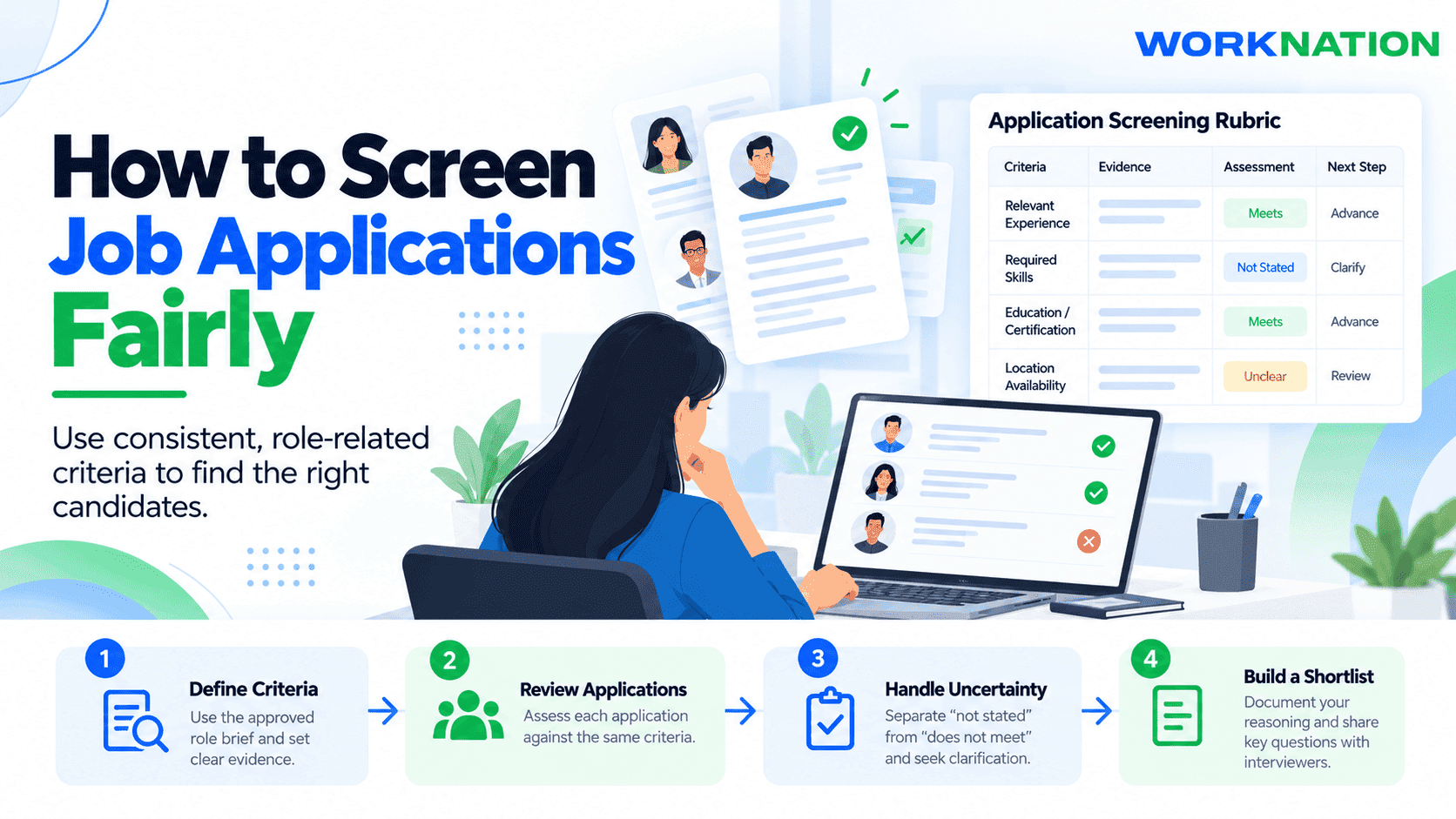
How to screen job applications, step by step
Define: open the approved role brief, not the applicant list, and pull out the essential criteria. Next to each one, write what you'd accept as evidence. A line on a resume? A portfolio piece? Decide now, while nobody's name is attached.
Review: take the applications one at a time, against those criteria, in the order you wrote them. Every time. Write down what you found, and write down what you couldn't tell. Both.
Clarify: a detail that isn't there is not a requirement that's been failed, so the two get different marks. Anything sitting on the line goes to a second reviewer.
Hand over: the interviewers get the application, the criteria you verified and the open questions. Not your verdict on the person.
What should application screening assess?
Only what the application can show, and only where it connects to an essential criterion in the approved role brief. That's a narrower question than "is this person any good?", and deliberately so. What the evidence looks like depends on what you asked for: the work history on a resume, answers to a couple of short application questions, a licence, a portfolio, maybe a work sample.
Take the operations manager hire from the worked example further down. The brief asks for process ownership. One resume says the person "redesigned the order-processing workflow" at a previous employer. Good. That's a claim about a task they owned, and it sits right next to the criterion, so it goes in the rubric as evidence. The same page lists the systems they used and tells us they're based an hour from the office. Also useful, also on paper. The U.S. Office of Personnel Management (OPM) has a name for this kind of first pass, structured resume review, and describes it as a review of resumes to determine which applicants meet the minimum requirements for a position. Minimum requirements. That's the ceiling of what the stage can do, and it's worth saying out loud to a hiring manager who wants more from it.
Now the other column. Will this person stay calm when the fulfilment system falls over at 4pm on a Friday? Can they explain the new workflow to a warehouse lead who didn't want it? Do they get on with people? Can they keep up with how fast your team moves? Not one of those is on the page, and no amount of re-reading puts it there. We've all watched a colleague "read" personality off a resume's layout, or decide what a gap between jobs means, or quietly rate a former employer's name instead of the work. That isn't evidence. It's guesswork wearing a lanyard. So the rule we hold to is this: if you can't observe a criterion on paper, it doesn't belong in application screening. Give it to an interview stage or a work sample, where somebody can actually see it.
Create a screening rubric before opening applications
Rubric first, applicant pool second. Not the other way round. Most of us have done it the wrong way round at least once. You open one resume "just to get a feel for the pool". It happens to be excellent. For the rest of the afternoon everyone else is being measured against that one person, and nobody decided that. The bar got set by whoever arrived first.
Where do the essential requirements come from? The internal brief you wrote in How to Define a Role Before You Start Hiring. Lift them out in the same words. Preferred qualifications get their own column, well away from the essentials, because a nice-to-have ("has used our exact CRM") will crowd out a real requirement the moment the two sit side by side.
Every criterion in the rubric gets the same four fields:
Criterion: an essential requirement from the approved role brief, named in the same words each time.
Why it matters: the actual work in the role that this requirement supports. If you can't name that work, the requirement comes out. Yes, even the one the hiring manager likes.
Acceptable evidence: what you'd take as proof, written as examples rather than a rule. For process ownership that might be a responsibility on a resume, a finished deliverable, or a project the person ran, so that someone coming from a different kind of company isn't failed for describing the same work differently.
How to record uncertainty: what the reviewer actually writes when a detail is missing or the scope is vague. "Budget size not stated" is a note someone can act on later. A shrug and a lower score is not.
Then give reviewers one small set of labels, and have everyone use the same ones:
Meets: clear written evidence matches the essential requirement.
Unclear: something relevant is on the page, or the detail simply isn't there, and it needs a question before it gets a mark either way.
Does not meet: the application tells you, in so many words, that a non-negotiable requirement isn't met.
Review each application against the same criteria
Once the rubric is set, review every application against the same criteria in the same order. Practical eligibility first. Then each essential criterion, one at a time, with the specific evidence from the application written next to the mark you gave it. Not "good fit". The actual line from the resume.
Why keep the order fixed? Because standards drift. Anyone who has read forty applications in an afternoon knows the feeling. In his 2022 interview with Issues in Science and Technology on decision hygiene, Daniel Kahneman made the point that breaking a complex evaluation into separate, predetermined dimensions stops one strong impression from contaminating the rest of the judgment. We see it every hiring round. Three weak resumes in a row, and an average application starts to look rather good. One standout profile, and the next three perfectly qualified people seem a little flat. The written definitions in the rubric are what hold the standard still, from the top of the stack to the bottom.
And write as you go. Not at the end, from memory, at half past five. One short note per criterion will do: the evidence that met it, or the detail that was missing. That note is what keeps three screeners on one role consistent with each other, and it's what you'll be glad of when somebody asks, a month from now, why this person was turned down.
How should you treat missing or unclear information?
Treat it as a question to ask, not a reason to reject. A resume is a short summary of a career, not a transcript of it. People leave out budget figures, team sizes and secondary tools all the time, usually for no better reason than keeping the file to a page or two. Mark "not stated" as "does not meet the requirement" and you will rule out qualified people who did the work and simply described it briefly.
So keep the two apart when you fill in the rubric:
Does not meet means the facts on the page directly contradict a requirement. Say the role is five days a week on site, and the applicant has written "remote only" at the top of the resume. There's nothing to clarify there. That's a "does not meet", and you can write down exactly why.
Not stated (Unclear) means there's relevant experience on the page, but the one detail you're after is missing, or written so broadly you can't tell either way.
Decide before the round starts when your team will ask. A rule we use: follow up whenever a candidate meets the other essential criteria and has one or two "unclear" marks. A short written question, or a question in the initial screening call, clears it up in minutes. Guessing does not, and rejecting outright costs you someone who may have been exactly right.
How can a hiring team review borderline cases?
With a second-review rule, agreed before anybody opened an application. Even a good rubric leaves a few files sitting right on the line. The candidate coming from a company ten times your size, or a tenth of it. The applicant whose title says "coordinator" while the bullet points describe running the whole operation. Those are the ones that get decided by mood if you let them.
The rule itself has three parts:
Park borderline files in a review list: don't make the yes-or-no call halfway through a batch. Write down which criterion is in doubt, put the file in the list, move on.
Get an independent second review: someone else on the hiring team scores the application against the same rubric, before they've seen what the first reviewer decided. Otherwise you don't get two opinions, you get one opinion and an echo.
Record the reason: the two sets of notes go side by side. Is there enough evidence to justify an initial conversation? Decide, then write down why this person advances or doesn't, in a sentence a colleague could read cold.
One more thing. Say the same borderline question keeps turning up, applicant after applicant. "Does running a team's vendors count as budget handling?" By the fourth time, that's the rubric talking, not the applicants. Fix the "acceptable evidence" column and apply the new wording to the rest of the pool, so the files read on Friday get the same rule as the files read on Monday.
Where does AI-assisted screening fit?
At the sorting stage, with a person in charge. Here's the situation it was built for. A role closes on a Friday with a few hundred applications sitting in the system. Two recruiters. Both have other roles open. Nobody is reading all of that by Monday without help, so the software reads first: it lifts the details out of each file, lays them out the same way, and floats the ones that look relevant to the top. Fine. That's sorting. The decision is still ours, and three things don't change because a tool got involved. The criteria still have to be about the job. Somebody still has to be watching. And we need to know, honestly, where this particular tool gets things wrong.
The U.S. Equal Employment Opportunity Commission (EEOC) doesn't give software a pass on any of that. A screening tool is a selection procedure like any other, so an employer using automated systems or AI to screen applicants should check whether the tool's criteria are tied to the actual job duties, and should watch for the ways an automated filter might unfairly screen out qualified people. The classic case is the rigid keyword filter. One applicant wrote "managed vendors". The filter wanted "supplier management". Gone, before a human ever looked. Same work, different words, wrong outcome.
So if your team does use software during screening, we'd ask for three habits. Set the rules around role-related evidence, not around whatever the vendor's demo used. Pull a sample of the rejected applications every so often and read them, properly, the way you'd read the shortlist. And put a named person in charge of that shortlist, so "the system rejected them" is never the end of the conversation. WorkNation's Hiring Solutions page describes that arrangement as it runs in practice: AI-assisted pre-screening paired with human recruiter review, filtering applications against the role requirements. The software sorts what comes in. A recruiter then reads the evidence and the open questions before the shortlist goes anywhere near the hiring team.
Application screening rubric and worked example
Same role as in How to Define a Role Before You Start Hiring and How to Evaluate Candidates After an Interview: a 12-person company, hiring its first operations manager. Candidate A and Candidate B are invented. Don't go looking for them.
Three essential criteria sit in the approved role brief. Process ownership. Vendor and budget handling. Clear communication with non-specialists. Which of those can a resume prove? The first two. Nobody has ever shown clear communication with non-specialists in a bullet point, so the hiring team keeps that one out of the application rubric and tests it in the interview stage, where someone can actually hear it.
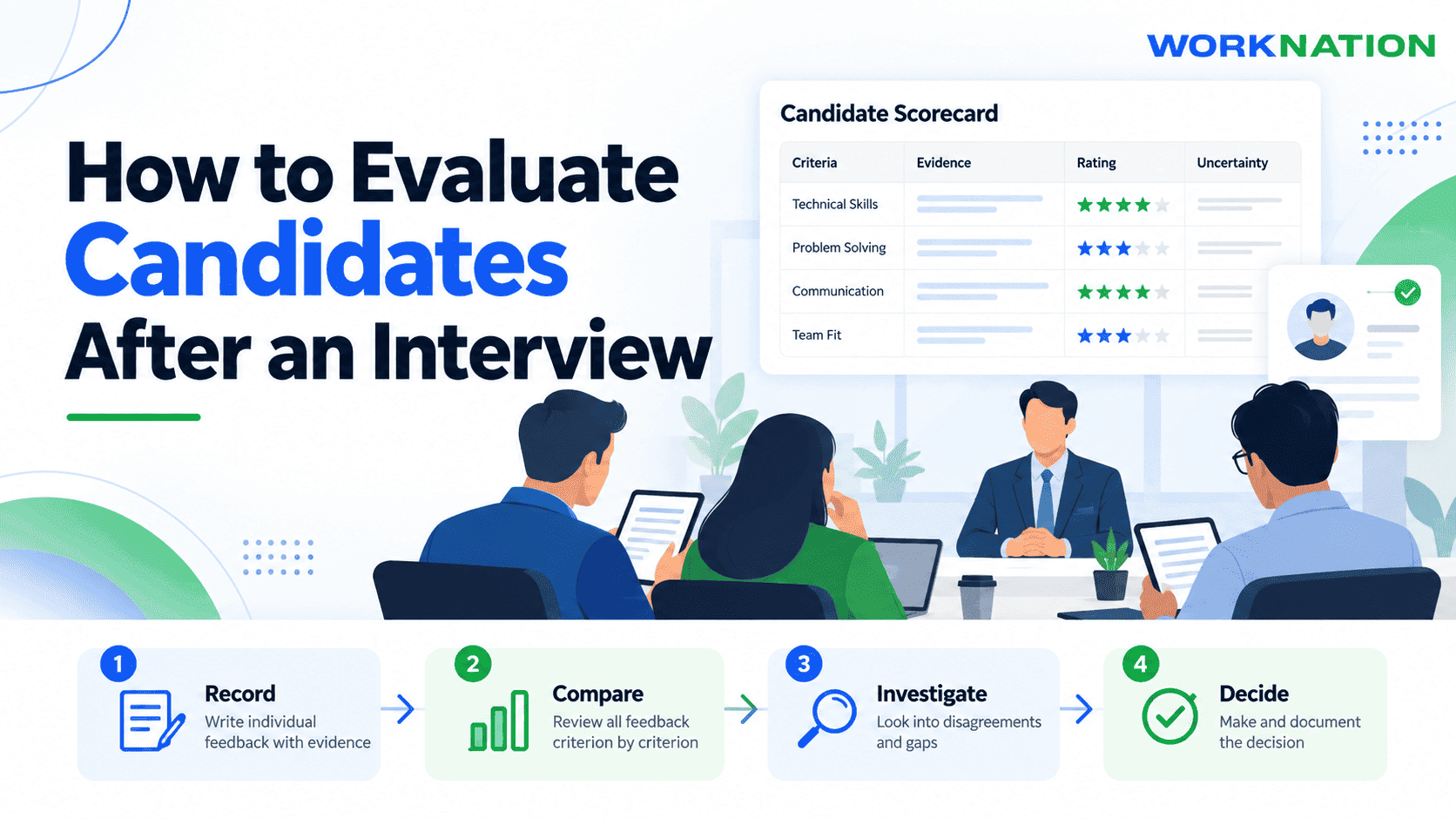
Blank application screening rubric
Essential criterion. The requirement, non-negotiable, copied out in the words the approved role brief uses. Not paraphrased, because the wording is what keeps three reviewers reading the same thing.
Why it matters. Which part of the week's actual work falls over without it. If the honest answer is "none of it", the row shouldn't exist.
Acceptable evidence. The kind of thing on an application you'd point to and say "that's it". A responsibility, a deliverable, a project they ran.
Assessment. Meets, Unclear, or Does not meet. Nothing in between, however tempting a "sort of" feels at four o'clock.
Uncertainty. Whatever the paper record leaves you guessing about. Written down, so somebody can ask about it later, rather than guessed.
Next step. Advance, Clarify, or Reject.
Criterion 1: Process ownership
Why it matters: whoever we hire inherits the internal order and fulfilment workflows, and they're broken.
Candidate A lists order-processing improvements and workflow changes among past responsibilities. That's the evidence we wanted, so the mark is Meets. What we can't tell is the context: all of it happened at a much larger company, and we don't know how much specialist support was around. Advance, and probe in the interview how they handled the change end to end.
Candidate B lists a wider scope of operations and process work across several teams. Meets, on the face of it. The catch is that everything is written in "we" terms, so personal contribution versus team effort isn't clear. Advance, and ask what Candidate B personally owned.
Criterion 2: Vendor and budget handling
Why it matters: the external suppliers and the day-to-day operational spend land on this person's desk.
Candidate A mentions coordinating external suppliers, and there's no budget work anywhere on the resume. So: Unclear. Budget ownership isn't stated one way or the other. We'd advance on the strength of the process evidence and ask in the first conversation whether they handled supplier spend.
Candidate B lists vendor management across three external delivery suppliers. Also Unclear, for a different reason: there's no way to tell whether "vendor management" meant budget decisions or just chasing deliveries. Advance, and verify budget responsibility in the interview stage.
Reading the result: both candidates advance to the interview stage, and neither is rejected for a detail they didn't state. Candidate A left budget work off the resume entirely. A reviewer in a hurry would have marked that as a miss. This one kept "not stated" apart from "does not meet", so it became a question for the interview rather than a reason to stop. And it was worth asking. As How to Evaluate Candidates After an Interview shows, Candidate A had actually renegotiated a supplier contract. Candidate B, it turned out, had only tracked deliveries.
What information should pass to interviewers?
The application, the role criteria for their round, and the open uncertainties recorded in your rubric. That is the whole handover.
What stays behind is the verdict. "Top contender." "Weak on paper, borderline pass." Labels like that travel. Give an interviewer a glowing one and the hour goes on confirming it. Give them a doubtful one and the hour goes on hunting for the catch. We already know what happens when a panel talks before it scores; this is the same thing in miniature, and the independent evidence you wanted from that interview never gets collected.
So the handover note is three facts per candidate:
Criteria with initial evidence: which essential criteria were visible in the application.
Uncertainties to investigate: what the application left unclear. For our two candidates, that means asking Candidate A about supplier budgets and asking Candidate B to separate their personal role from the team's in past process work.
Criteria assigned to the stage: which requirements belong to this interviewer's round. In our example that's communication with non-specialists. Theirs to test, nobody else's.
If you change one thing first, make it this one. Rubric first, evidence column filled in, and only then the first application.
Building a shortlist, or checking one somebody else built? Discuss WorkNation's screening support, post a job with WorkNation, or search WorkNation's talent directory.
FAQ
How do you screen job applicants fairly?
By fixing the standard before you see the people. The essential criteria and the acceptable evidence come out of the approved role brief and get written down first. Only then do the applications get opened. After that it's the same routine for every candidate. Same criteria, same order. "Not stated" is kept apart from "does not meet". Each decision to advance or reject gets a note: here's the evidence, here's what we still don't know.
How can you screen job applicants faster without losing fairness?
Short rubric, knock-outs first. Four essential criteria that a resume can actually show beat eleven that it can't, on speed and on fairness. Practical eligibility goes first because that's where the quick, clean "no" lives. Why score five criteria for someone who can't take the job? And when the pile is big, AI-assisted pre-screening with human recruiter review takes the organising off your hands. The tool works from clear role criteria. A human checks the shortlist. Those two conditions aren't optional.
Should you reject an applicant if an essential requirement is missing from their resume?
Not automatically. "Not stated" and "does not meet the requirement" are different marks, and this is exactly the case they exist for. Picture a candidate who is strong on every other essential criterion and silent on one. That's a quick clarification question, or something to ask in the initial screening call. You find out in a minute whether the experience is there. Ruling them out first means you never do.
Sources
Have a Funding Round or Exciting Update to Share?
Submit your press release to get featured on WorkNation and reach founders, investors, and tech leaders.