How to Evaluate Candidates After an Interview
Top Picks
Submit PR
Stay Ahead of the Market
Get the latest startup funding, hiring trends and global opportunities delivered to your inbox every week.
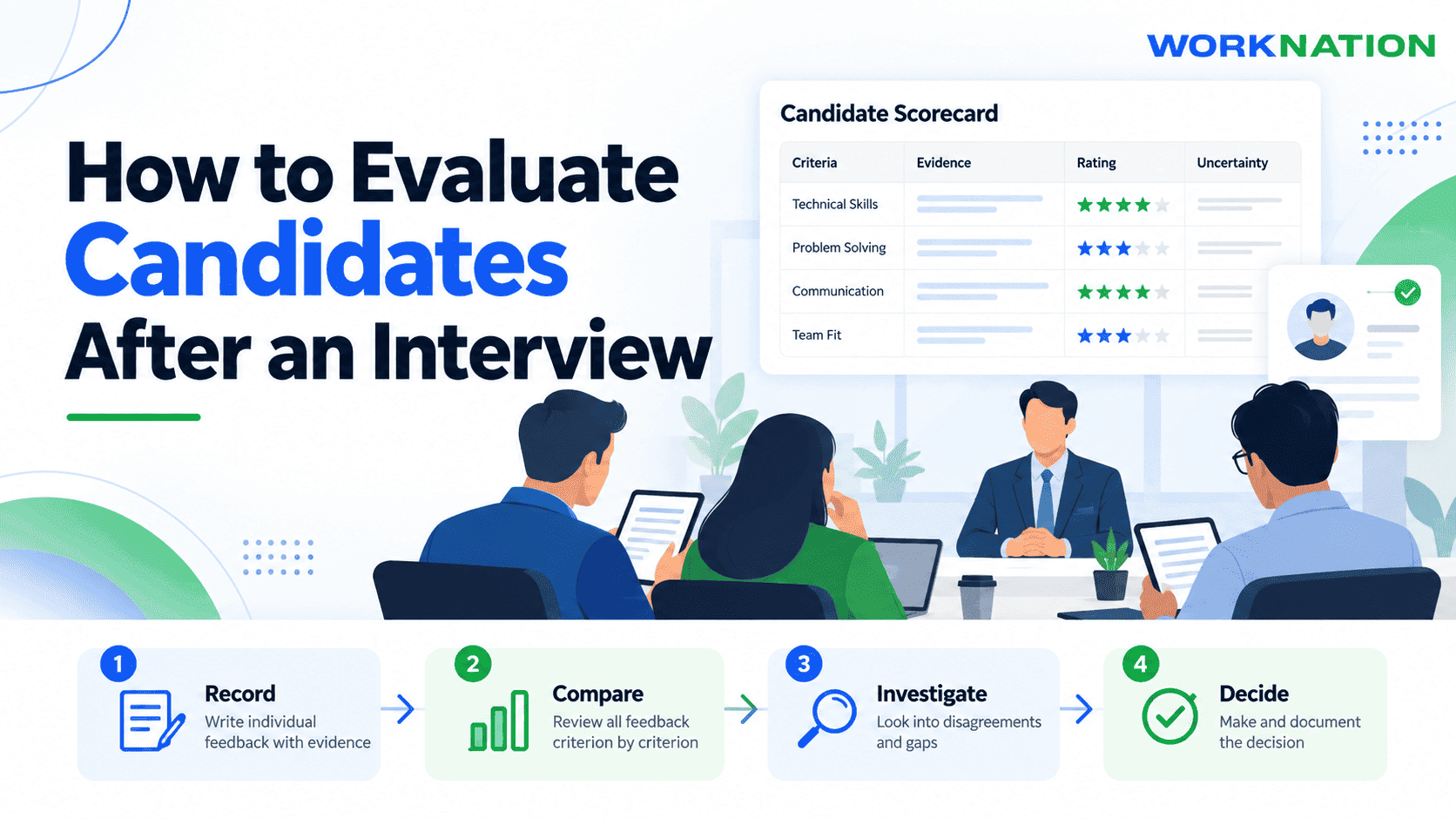
Here's the whole method in one breath. Nobody says a word in the debrief until every interviewer has written up what they saw, and I mean saw, not felt, against one shared list of role criteria. Then you lay the write-ups next to each other and go through them one criterion at a time. Where people can't agree, you dig. The decision comes last, and it goes on paper the moment it's made. Stick to that order and you're hiring on what the candidates actually said and did. Skip it and, well, it rests on whoever sounded surest of themselves at 4pm on a Thursday, and in my experience that's the loudest person in the room far more often than it's the best-informed one.
What follows is each step on its own, a scorecard you're welcome to copy, and an agenda for the decision meeting itself. This is the second supporting guide in How to Select the Right Candidate. Its place is near the end: the interviews are over, nobody has an offer yet.
Key takeaways
Get individual written feedback in before anyone discusses anything.
Same criteria, same rating definitions, for every candidate.
Every rating gets its evidence and its uncertainty written next to it.
Start the comparison with the essentials. One brilliant answer doesn't carry a whole role.
Two interviewers disagree? Before anything else, find out what each one saw that the other didn't.
Nobody clearly fits? Try one short follow-up on the open point before you touch the job description or go back out to market.
Write it all down at the end: the decision, the reasons behind it, and the name next to each next step.
How to evaluate candidates after an interview, step by step
Record: every interviewer, on their own, writes up the evidence they have and what they couldn't tell.
Compare: with the records side by side, work down the criteria one at a time.
Investigate: wherever two people disagree, or nobody has any evidence, go and find out.
Decide: make the call and put the reasons on paper.
What should you evaluate after an interview?
The evidence this particular stage was set up to produce, and not much else. In practice that's the answers to the planned questions and, if you ran one, the outcome of the assessment or work sample. It's tempting to bring in everything you've picked up about the person (the LinkedIn profile, the chat in the lift, a hunch). Resist that. And remember the role will ask things of them in two years' time that no interview could have covered anyway.
Tie each criterion to the stage that was supposed to test it. Say the technical round never went anywhere near stakeholder communication, which happens a lot. Then that criterion stays blank for that round. A blank is an honest record. What's not honest is a low score for something nobody asked about, and that low score will sit in the file for months looking like a weakness when it was only ever a hole in the question list.
Then there's the business of separating what you saw from what you made of it. "She seemed sharp" is a conclusion. "She described changing the approval order on supplier invoices and said the backlog cleared within a month" is an observation, and it's the second kind you want on paper. The U.S. Office of Personnel Management (OPM) tells interviewers to keep notes that summarise what the candidate actually said and to leave out judgments about the candidate or their personality. Most interviewers are sure they already do this. Read their notes back to them and the picture is usually different.
Collect interviewer feedback before the group discussion
Ask every interviewer to write up their record on their own, before the debrief. For each criterion, three things: what the candidate said or did, the rating that evidence supports, and what they couldn't tell. That third one is the item people skip. It's also the most useful line on the whole form, so don't let them.
Why go to the trouble? Independence, basically. Daniel Kahneman, talking to Issues in Science and Technology in 2022, called independence the central principle of what he and his co-authors call decision hygiene; the idea being that pieces of information should be as independent of one another as possible. Think about what happens in a debrief when one interviewer says "I thought she was great" before anyone else has spoken. The other three are no longer witnesses. They're an audience now, nodding or bristling, and either way their own view has been bent. One sentence did that.
OPM's training runs on the same logic, incidentally. Interviewers rate the candidate alone, first. If the ratings line up, there's nothing to discuss; if they don't, there's a consensus conversation, and in it each person explains their rating from their notes. From the notes. Not from memory, and not from how the candidate made them feel.
Use a consistent interview scorecard
One scorecard for every interviewer and every candidate going for the same role. Five fields will do it:
Criterion: one thing the job needs the person to be able to do, in exactly the same words on every form.
Evidence: the specific thing the candidate said or did, taken word for word from the interviewer's notes.
Rating definition: what each number on the scale is supposed to mean for this criterion, not in general.
Uncertainty: what the interviewer couldn't tell.
Interviewer and stage: who recorded it, and in which round.
On the scale itself, OPM's advice is one rating range for all the criteria, usually three to seven levels, at least three of them labelled; it also notes a structured interview typically covers four to six competencies. Most teams I've seen land on four levels, with a separate "not enough evidence" box off to the side:
1, Clear gap: the evidence shows the need is not met.
2, Partly meets: some relevant evidence, with gaps that matter.
3, Meets: the evidence matches what the role needs.
4, Exceeds: the evidence goes beyond what the role needs.
NE, Not enough evidence: the criterion wasn't covered, or the answer was too vague to rate.
Write the meanings down before the first interview, not after. A rating with no definition behind it is a private opinion with a number stuck on, and two interviewers' 3s can mean completely different things.
Even with the definitions, mind you, the number looks more exact than it is. There's a 2022 meta-analysis in the Journal of Applied Psychology that put structured interviews at the top of the list of selection procedures, and the same authors still concluded that many selection methods predict job performance considerably less well than previously thought. Kahneman, in that same interview, made more or less the same point: structured beats unstructured by a clear margin, but neither predicts job success very well. So a rating is a label for the evidence sitting beside it. Treat it as more than that and you'll start trusting decimal points that aren't there.
Some employers bring in specialist interviewers for a round, from inside the company or from outside. Hand them the same scorecard, the same criteria and the same rating definitions, so that whatever comes back is in the same shape as everyone else's and can be compared like for like. WorkNation's Hiring Solutions page describes this kind of arrangement: interviewers who know the role for technical, functional, leadership and culture rounds, with the panels, scheduling, scorecards and feedback loops handled alongside.
Compare candidates against the role requirements
Sort the criteria into essential and desirable before you meet the finalists, while nobody has a favourite yet. Then take the essentials first, one at a time, with every candidate's rating and the evidence behind it laid out next to the others'. Strengths and tradeoffs come later, and it helps to say them bluntly. This person is clearly good at X. If we hire them, the role has to absorb Y.
Watch for the halo effect, which is OPM's term for a rating on one competency bleeding into the others. Kahneman went a step further. Beyond a small core of information, he said, people tend to overweight minor details, with one exception: a real deal-breaker should count. So let the essential criteria do the deciding. The interesting details, the ones that make a candidate fun to talk about afterwards, can wait their turn.
What should you do when interviewers disagree?
Don't start with the numbers. Start with what was said. Get each interviewer to point at the actual thing the candidate said that led them to their view, and you'll find half the disagreement evaporates on the spot. (This is how OPM's consensus step runs too: each person talks the others through a rating from their own notes, not from the gut.)
The other half of the disagreement is usually a mismatch nobody noticed. I've sat in debriefs where one interviewer had scored how the candidate talks to clients and the other had scored how she talks to her own team, and the two of them argued for twenty minutes about a 2 versus a 4 before anyone realised they'd asked different questions. The numbers differed because the questions did. Check that first; it saves a lot of afternoon.
What's left over after those two checks, the stuff genuinely still unknown, gets written down as a follow-up question, and that's the meeting done.
There is one decision to make well before any of this, though, and it's the one teams forget: how does a final rating get fixed when the room is still split? OPM's answer is any of three: you talk it out to a consensus, you go with the majority, or you average the scores. Decide which before you're in the room, put it in writing, and then don't change your mind halfway through a hire. I'd steer away from averaging. It feels fair. But a 4 and a 2 average to a 3, and a 3 describes neither interviewer's evidence, so you've invented a rating nobody gave.
What if no candidate clearly meets the criteria?
The first thing to work out is whether you're looking at evidence you never collected, or a shortfall you did. They look the same from a distance and need completely different responses. If the panel just never got to see anyone handle a budget, that's a gap, and a short follow-up on that one criterion (rated on the same scale as everything else) will close it. But if the finalists were properly tested on something essential and didn't get there, that's a shortfall. No follow-up call fixes that.
Before anyone suggests lowering the bar, back up a step. Were the essentials ever realistic for a role this size, at this salary? And did the right people ever see the advert, or did it go out in the wrong places from day one? Quite often the honest answer is that the role itself was drawn up badly. You're allowed to relax an essential criterion. Plenty of teams do, usually without saying so. Just write down what changed and the reason. The file needs to show the new standard, rather than quietly pretending the old one was met.
Run and document the final decision meeting
Short, and in a set order, with a named owner for each part. Roughly like this. The chair goes first and reads the evidence out, criterion by criterion, each interviewer's rating and their notes, and keeps going until the room is looking at one shared record rather than six private impressions of the candidate. The chair stays on for the gaps too. Anywhere somebody wrote "not enough evidence" turns into a follow-up question, and a named person gets it. Disagreements come next, and they're owned by the people who disagree. Each side gives its evidence. The room either lands on a rating or records that it couldn't. Only now does the hiring manager name the candidate, explain why in terms of the essential criteria, and have somebody write it down. Whoever signs off on hires does so, or says what would need to be true first. And finally the recruiter or HR lead works out who tells the successful candidate, who tells the others and by when, with dates on it, because "we'll let them know" is how candidates end up hearing nothing for three weeks.
Then file everything. Final ratings, the evidence under them, what's still uncertain, any criterion you changed on the way and who gave the approval. OPM has its interviewers sign and date their rating forms and initial anything they change later, which strikes me as sensible whether you're twelve people or twelve thousand. How long the law wants you to hang on to it all is a country-by-country thing, state by state in some places, so look up the rule for wherever the person will be employed.
Post-interview scorecard and worked example
Here's a made-up case to make all of this concrete. A company of 12 people wants its first operations manager. It's down to two, Candidate A and Candidate B. The essentials are process ownership, vendor and budget handling, and being able to explain things clearly to non-specialists. The founder (Interviewer 1) and the finance lead (Interviewer 2) both sat in the same stage 2 interview, and where I give two ratings below they're in that order.
Keep one thing in mind while you read. A candidate's application says one thing. What they can show you when you press for specifics in the room is often another. The gap between those two is, honestly, the most useful thing in the whole file.
Criterion 1: Process ownership. A's application lists order-processing improvements as a past responsibility, and when the founder probed, A laid out the starting problem, what changed and the measured result. Both interviewers gave a 3. The only reservation noted: all of this happened at a much larger company. B's application claims a wider scope of process work, but in the room B kept answering in "we" terms, and however the interviewers probed they couldn't pin down what B personally did. The founder gave a 2; the finance lead wrote NE, with "personal contribution unclear" against it. (OPM's training, for what it's worth, says to ask for the candidate's own role whenever you get a "we did" answer. That's exactly what the probing was for. With B it just never landed.)
Criterion 2: Vendor and budget handling. A's application says nothing about budgets. In the room, though, A talked through renegotiating a supplier contract, reasoning included. The founder scored it a 3 and the finance lead a 4; both added the same caveat, that it was a single example. B's application lists vendor management, and B described tracking three suppliers' deliveries, but no spending decisions came up. Both gave a 2, and both noted that budget ownership never came up.
Criterion 3: Clear communication with non-specialists. Given a made-up customer and a delay to explain, A kept the language plain enough, but wandered a bit before landing the point. A 3 from each of them. B's explanation was short and plain and ended with next steps. Both interviewers gave a 4.
Now, what does the panel do with that? B is obviously the better communicator. A has the better evidence on the other two essentials. On A's budget handling the two interviewers split, 3 against 4, but when they look at their notes there's only the one contract in there, so the panel records a 3 and adds "second budget example?" to the follow-up list. B's process ownership is unresolved, and it's essential, so rather than deciding now the panel books a short follow-up on that single point. What they don't do is hire B on the strength of the communication answer. Do that and one good answer has replaced the entire evaluation, which is the exact thing this whole process exists to prevent.
If you take one thing from this, take the order. No discussion of any candidate until every written record is in.
Need specialist interview support or a more consistent decision process? Explore WorkNation's hiring solutions.
FAQ
How soon after an interview should you evaluate a candidate?
Straight away, while it's fresh. OPM's structured interview training has interviewers go over their notes and rate the candidate immediately after each one, and I can't think of a good reason to wait longer. If your finalists are spread across several days, which they usually are, write each one up the same day you saw them, and hold the comparison meeting once the last one's done.
Should interviewers discuss candidates before scoring them?
No, and this is the one people push back on. Score, then talk. The minute someone says "I liked him" the others stop judging independently, and the review of evidence you'd planned turns into either agreement or an argument, depending on who's in the room. There's a practical bonus to written records handed in beforehand, too: they show who saw what, so if there's a disagreement later you can go back and look.
Can you use the same scorecard for every interview stage?
Yes, with one tweak. Keep the role criteria and the rating definitions the same at every stage, but mark which criteria each stage was actually designed to test. Rate those, and put "not enough evidence" against the rest rather than a low mark. That way a technical round and a leadership round feed the same scorecard, and a gap looks like a gap rather than a weakness.
Sources
U.S. Office of Personnel Management, "Structured Interviews" training presentation (undated): https://www.opm.gov/policy-data-oversight/assessment-and-selection/structured-interviews/structured-interviews.pdf
Daniel Kahneman and Sara Frueh, "Try to Design an Approach to Making a Judgment; Don't Just Go Into It Trusting Your Intuition," Issues in Science and Technology, Spring 2022: https://live-issues-asu.ws.asu.edu/daniel-kahneman-interview-noise-judgment-decisionmaking
Paul R. Sackett, Charlene Zhang, Christopher M. Berry and Filip Lievens, "Revisiting meta-analytic estimates of validity in personnel selection," Journal of Applied Psychology 107(11), 2022: https://doi.org/10.1037/apl0000994
WorkNation, Hiring Solutions page : https://worknation.buzz/hiring-solutions
Have a Funding Round or Exciting Update to Share?
Submit your press release to get featured on WorkNation and reach founders, investors, and tech leaders.