O-ID Raises $1.2M to Build Modular Humanoid Robots for Japanese Factories
Top Picks
Submit PR
Stay Ahead of the Market
Get the latest startup funding, hiring trends and global opportunities delivered to your inbox every week.
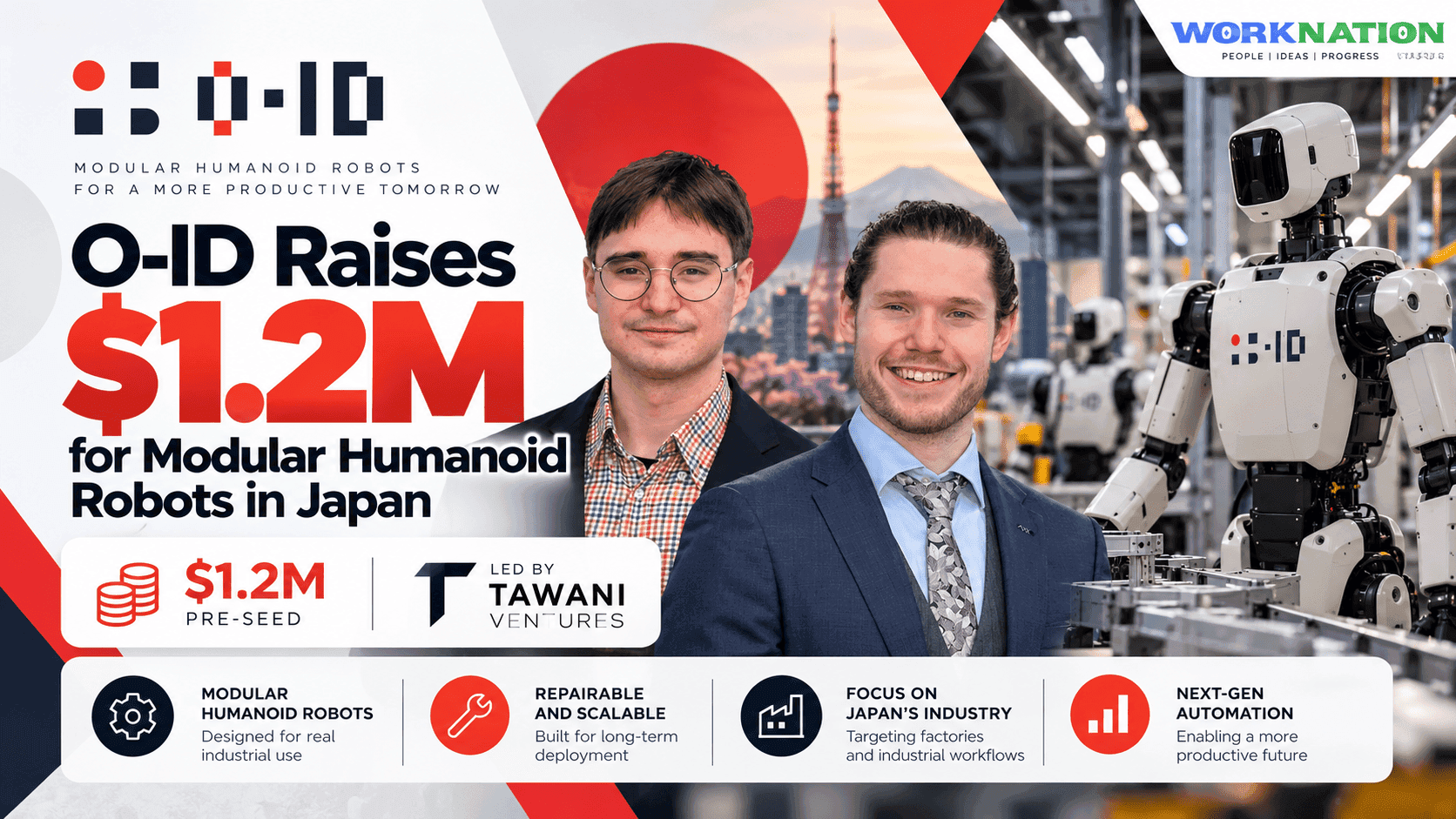
O-ID, a Tokyo-based robotics startup founded by European entrepreneurs, has raised $1.2 million in pre-seed funding to develop modular humanoid robots designed specifically for factory environments in Japan.
The funding round was led by Chicago-based TAWANI Ventures, with participation from Hustle Fund, Techstars Japan and several angel investors.
The eight-person startup is moving from its prototype toward production, with plans to develop a second-generation humanoid robot targeted for launch in the first quarter of 2027.
At the centre of O-ID's approach is a problem that the company believes could become increasingly important as humanoid robots move from demonstrations into real industrial environments: maintenance.
Designing humanoid robots that can be repaired on the factory floor
Most humanoid robots are designed as integrated machines. If a component such as an arm or joint fails, repairs can potentially require the entire robot to be sent back to the manufacturer.
O-ID is taking a different approach.
The company's humanoid robot is built around modular components that can be removed and replaced directly on the factory floor.
According to co-founder and CTO Simon Gormuzov, a worn joint, limb or onboard computer can be unlocked and replaced by a worker in approximately five minutes.
The idea is similar to replacing a component in a vehicle rather than sending the entire vehicle back to the manufacturer.
For industrial customers operating large fleets, maintenance time can have a direct impact on the usefulness of the technology. A robot that spends weeks or months waiting for repairs cannot contribute to production during that period.
O-ID is therefore treating repairability as part of the robot's core design rather than as an after-sales feature.
From robotics demonstrations to factory deployment
Humanoid robotics has attracted significant attention because of increasingly capable demonstrations involving walking, manipulation and interaction with physical environments.
O-ID's founders argue that the bigger challenge is turning those demonstrations into robots that can operate alongside human workers at scale.
Gormuzov says two challenges remain particularly important: producing humanoid robots cost-effectively and maintaining large fleets once they are deployed.
Co-founder and CEO Stian Jakobsen says O-ID is designing its robots to work alongside existing factory staff rather than attempting to completely redesign industrial environments around the machines.
The company is already in advanced discussions with several manufacturing customers in Japan.
Why Japan is the company's first market
Japan provides a particularly relevant environment for O-ID's approach because of the country's demographic challenges.
The source cites estimates that Japan could face a shortage of more than 11 million workers by 2040 as its working-age population declines.
The Japanese government is also pursuing a major robotics and AI investment strategy aimed at deploying AI-equipped robots across areas including factories, hospitals and warehouses.
O-ID believes humanoid robots could eventually help address some of the labour constraints facing industries that depend on large numbers of workers.
The company is targeting an ambitious goal: deploying approximately 11 million robots to match the projected worker shortage.
That makes Japan not simply an initial sales market, but an important part of O-ID's broader manufacturing strategy.
Using Japan's existing automotive supply chain
Rather than attempting to create an entirely new manufacturing ecosystem for humanoid robots, O-ID plans to adapt Japan's established automotive supply chain.
Gormuzov says the company intends to use suppliers and manufacturing capabilities already developed for automobile production and modify them for robotic applications.
The strategy could allow O-ID to manufacture robots domestically while leveraging decades of Japanese expertise in robotics and industrial manufacturing.
This Japan-first approach also differentiates the startup from many humanoid robotics companies that are developing their own manufacturing infrastructure or building new supply chains from scratch.
TAWANI Ventures partner William Pritzker described the opportunity as combining modular humanoid robotics with Japan's existing industrial capabilities.
Techstars Japan managing director Yuki Shirato also highlighted O-ID's focus on modularity, mass production and repairability.
A small funding round in a capital-intensive market
O-ID's $1.2 million pre-seed round is relatively small compared with the amount of capital flowing into humanoid robotics.
The sector has seen some companies raise hundreds of millions of dollars or more as investors attempt to finance hardware development, manufacturing, AI models and large-scale deployment.
Figure AI, for example, has raised billions of dollars, while other humanoid robotics companies have also secured substantial venture financing.
O-ID is taking a different route at an early stage.
Its strategy is based partly on keeping the manufacturing model closely tied to Japan's existing supply chain rather than building every component and capability internally.
The company believes that approach could help it move toward mass production without requiring the same level of capital typically associated with large-scale humanoid robotics development.
Funding to support the next-generation robot
O-ID currently has eight people across full-time employees and contractors.
The new funding will be used to expand the team and continue development of the company's next-generation humanoid robot.
The second-generation machine is planned for launch in the first quarter of 2027.
The company has also filed a provisional patent in the United States covering its modular connector design.
While Japan remains the primary focus, O-ID is already exploring the US market in collaboration with Japanese partners.
That could eventually give the company a pathway from Japanese industrial deployments into other manufacturing markets facing similar labour shortages.
The bigger question for modular humanoids
The fundamental question behind O-ID's approach is not simply whether humanoid robots can perform useful tasks.
It is whether they can remain productive once deployed in real factories.
For industrial customers, uptime, maintenance, repair costs and supply-chain availability can be just as important as the robot's ability to walk, manipulate objects or perform a particular task.
O-ID is betting that modular hardware can address part of that challenge.
With $1.2 million in pre-seed funding, an eight-person team, advanced discussions with Japanese manufacturers and a second-generation robot planned for 2027, the company is now moving from prototype development toward commercial deployment.
The next stage will show whether its modular design and Japan-first manufacturing strategy can translate into reliable factory robots at a scale that industrial customers can support.
Have a Funding Round or Exciting Update to Share?
Submit your press release to get featured on WorkNation and reach founders, investors, and tech leaders.