F13 Raises $5M Pre-Seed to Build AI for Precise Vector Graphics
Top Picks
Submit PR
Stay Ahead of the Market
Get the latest startup funding, hiring trends and global opportunities delivered to your inbox every week.
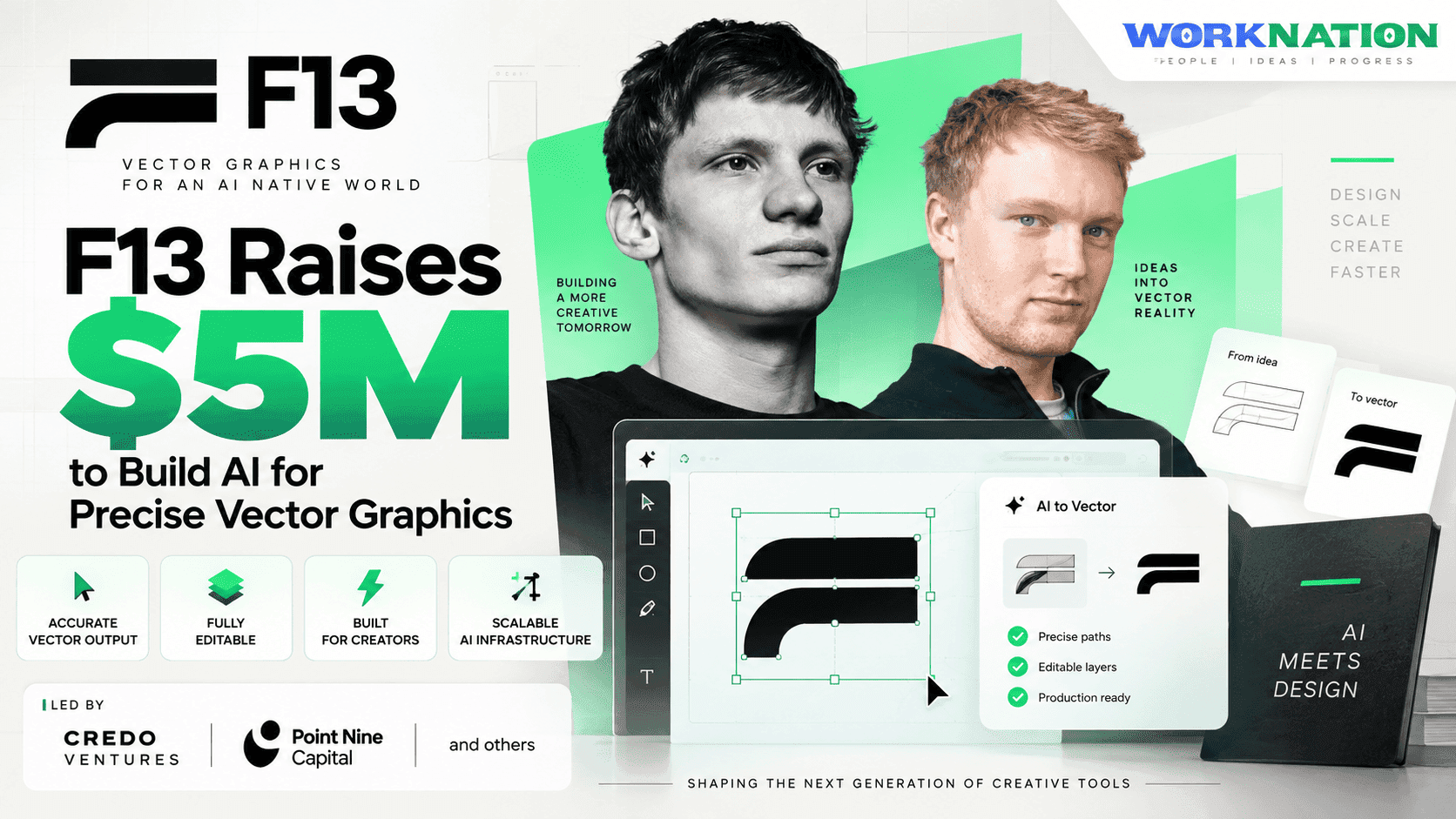
Berlin-based AI startup F13 has raised $5 million in pre-seed funding to develop AI capable of generating precise, editable vector graphics.
The round was led by Credo Ventures and Point Nine Capital, with participation from angel investors including Carles Reina of Baobab Ventures and Jack Richardson of Mainframe.
According to F13 founder Gregory Janik, the entire fundraising process took approximately three weeks, from his first conversation with an angel investor in San Francisco through to the completion of the round. The company also completed the financing without using a traditional pitch deck.
The funding will be used primarily to train and launch F13's first model.
Building AI for Precise Visuals
F13 is focusing on a specific limitation of current generative AI systems: producing visuals that are not merely convincing, but technically accurate and editable.
The company is targeting vector graphics, which are constructed using mathematical descriptions rather than fixed pixels.
Vector graphics are widely used for icons, diagrams, labels, interface elements and other visuals that need to remain sharp regardless of their size.
Examples include labels on consumer products, icons in browser toolbars and graphics used in smartphone operating systems.
Because vector graphics are based on numerical shapes and paths, they can be scaled without losing clarity.
F13 believes this format creates a particularly difficult challenge for today's generative AI systems.
A generated image can look plausible to a human while still containing inaccuracies that make it unsuitable for professional, technical or educational use.
For example, a diagram illustrating a human skeleton needs to represent the underlying structure accurately rather than simply producing an image that resembles a skeleton.
A Different Approach to AI-Generated Graphics
F13 founder Gregory Janik argues that AI-generated visuals currently have a problem with accuracy.
According to Janik, people often reject AI-generated visuals when they need precise information because the systems can produce misleading or technically incorrect results.
The company is therefore concentrating on a specialized problem instead of attempting to build a general-purpose image generation model.
Its goal is to develop AI capable of producing vector graphics that are accurate, structured and editable.
That means the output would not simply be a flat image.
Instead, the graphics would retain the characteristics of vector artwork, allowing them to be manipulated and scaled as required.
The approach could be relevant to applications where visual precision matters more than artistic interpretation.
Founder With Technical and Startup Experience
F13 was founded by Gregory Janik and Ingimar Tomasson.
Janik moved from Poland as a teenager and later lived in London and Milan before settling in Berlin.
He taught himself to code as a child and later pursued work across several technical and entrepreneurial areas.
Janik studied mathematics and physics but ultimately left his university degrees while already working full-time.
His professional experience includes developing flight-control software and onboard intelligence for autonomous drones at a company that was later acquired by Helsing.
He subsequently worked as director of engineering at an edtech company.
It was during that period that Janik met Ingimar Tomasson, a mathematician who studied at University College London and later became his co-founder at F13.
Janik had also previously attempted to build other companies, including a machine-learning infrastructure startup and a venture-backed bank that held a regulatory licence.
These experiences contributed to the technical direction behind F13.
A Small Research-Focused Team
F13 currently has seven team members, with the majority holding PhDs.
The company intends to keep the team relatively small at this stage rather than rapidly expanding its headcount.
The $5 million funding will instead be directed toward research, model training and launching the company's first model.
This reflects F13's strategy of concentrating capital on technical development rather than building a large organization before the product is ready.
The company is attempting to solve a specialized machine-learning problem that requires research into how AI models can generate structured visual information rather than conventional pixel-based images.
Competing With General-Purpose AI Labs
F13 does not consider every company working on AI-generated graphics to be a direct competitor.
Janik points to Quiver as an example of a company focused on more expressive and artistic graphics for illustrators.
F13's focus is different.
Its goal is to produce graphics where precision and structure are important.
The company instead views large frontier AI labs such as OpenAI and Google as a more significant competitive reference point because they have the resources to develop increasingly capable general-purpose models.
Other visual AI companies also operate in adjacent markets.
Recraft has raised $42 million and works on brand-consistent vector and raster graphics, while Ideogram has raised $96.5 million and focuses on raster text-to-image generation.
F13 is pursuing a narrower technical problem within this broader visual AI ecosystem.
The Economics of Specialized AI
One of F13's arguments is that specialized AI models do not necessarily require the enormous infrastructure budgets associated with frontier general-purpose models.
Janik said the company does not believe it needs a $100 million funding round simply to compete on computing resources.
He also highlighted the potential cost difference between frontier model inference and specialized graphics generation.
According to Janik, frontier labs charge between $60 and $70 per million tokens, while F13 aims to eventually provide graphics generation for around a cent or less.
The company's strategy therefore depends on developing a specialized system that can achieve useful results without requiring the scale of compute associated with the largest AI laboratories.
Investors Back Specialized AI Research
Credo Ventures and Point Nine Capital led the $5 million pre-seed round.
Angel investors including Carles Reina of Baobab Ventures and Jack Richardson of Mainframe also participated.
Matěj Míček, tech partner at Credo Ventures, highlighted the founding team's technical background and experience building companies, while also pointing to their combination of machine-learning research with experience in fashion and design.
Pawel Chudzinski, partner at Point Nine, highlighted the importance of visual content across businesses, including graphic design, charts, diagrams and marketing assets.
The investment reflects interest in specialized AI systems targeting workflows where current general-purpose models still face limitations.
Fundraising Without a Pitch Deck
One unusual aspect of F13's funding round was the speed of the process.
Janik said the company completed the financing in approximately three weeks.
The round also did not require a traditional pitch deck.
The process began with a conversation with an angel investor in San Francisco and progressed to the final funding commitments within the three-week period.
For a pre-seed company still developing its first model, the rapid financing provides F13 with capital to concentrate on research rather than spending significant time fundraising.
What Comes Next
F13's immediate objective is to train and launch its first AI model for precise vector graphics.
The seven-member team is currently focused on determining whether its specialized approach can produce sufficiently accurate and editable visual outputs to compete with the capabilities being developed by much larger AI laboratories.
The company is targeting a part of visual AI where plausibility alone is not enough.
A diagram, technical illustration or interface element may need to be structurally correct, editable and scalable rather than simply visually convincing.
That creates a specific technical challenge for generative AI.
F13 is betting that a focused research approach can solve that problem without requiring the massive capital expenditures associated with general-purpose frontier models.
With $5 million in pre-seed funding from Credo Ventures, Point Nine Capital and angel investors, the company now has the resources to train its first model and test that thesis in the market.
Have a Funding Round or Exciting Update to Share?
Submit your press release to get featured on WorkNation and reach founders, investors, and tech leaders.