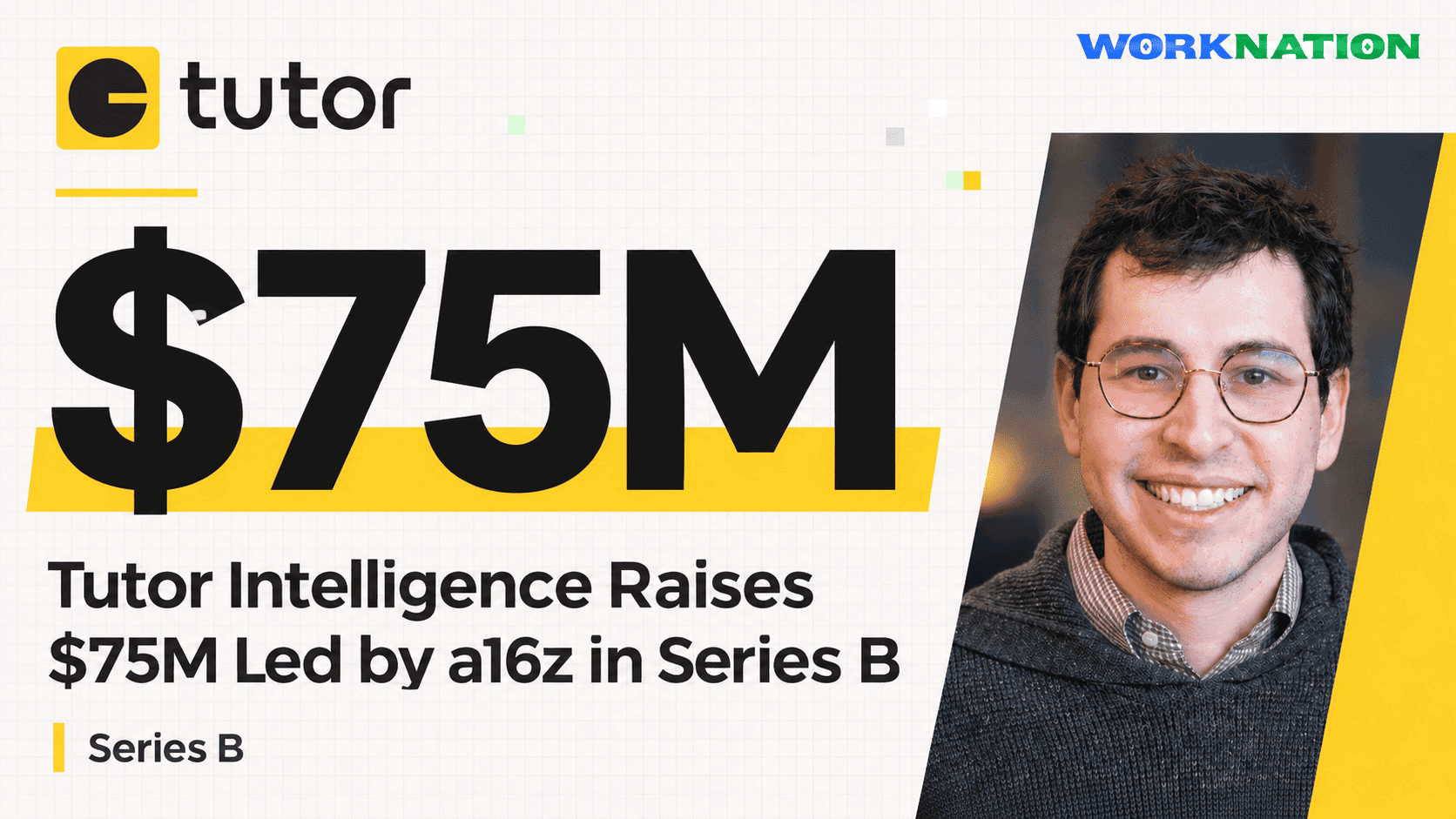
Tutor Intelligence Raises $75 Million in Series B Led by Andreessen Horowitz to Scale Robot Workforce
Top Picks
Submit PR
Stay Ahead of the Market
Get the latest startup funding, hiring trends and global opportunities delivered to your inbox every week.
US-based robotics startup Tutor Intelligence has raised $75 million in a Series B funding round led by Andreessen Horowitz (a16z), as it looks to expand its robot workforce and develop AI systems that learn directly from real-world industrial operations.
Based in Watertown, Massachusetts, Tutor Intelligence develops autonomous robots that businesses can rent by the hour or by the individual task, without purchasing hardware upfront or signing long-term contracts.
The round also included participation from existing investors Union Square Ventures and Neo, which previously led the company's Series A and seed rounds. With the latest investment, Tutor Intelligence has raised approximately $117 million in total funding.
Founded in 2021, the company plans to use the capital to advance its robot foundation models and expand the production and deployment of its Sonny and Cassie robotic systems.
Founded by MIT researchers to solve the robot data problem
Tutor Intelligence was co-founded in 2021 by Josh Gruenstein and Alon Kosowsky-Sachs, who met while studying at the Massachusetts Institute of Technology (MIT).
The founders began working together in an MIT laboratory focused on developing robot intelligence using deep learning.
Rather than viewing robotics primarily as an algorithm challenge, they identified the availability of real-world training data as a major limitation. Unlike computer vision and language AI, robotics has historically lacked large-scale datasets because collecting physical interaction data requires robots to perform tasks in real environments.
Tutor's approach was to build a business that deploys robots for paid work. Each completed task generates additional data that can be used to improve the company's AI models.
The startup spun out of MIT's Computer Science and Artificial Intelligence Laboratory (CSAIL) and has since developed a business model that combines commercial robot deployment with continuous AI training.
Renting robots by the hour instead of selling hardware
Tutor Intelligence offers businesses access to robotic labour through a usage-based model.
Customers can rent robots by the hour or pay based on the number of items picked. They do not need to make large upfront hardware purchases or commit to long-term contracts.
The company handles robot deployment, maintenance and software updates, allowing businesses to introduce automation without managing the underlying robotics infrastructure themselves.
Its robots, named Sonny and Cassie, operate across manufacturing and logistics environments, handling products such as breakfast cereals, snacks, candy, cosmetics, household goods and toys.
Remote operators, known as "tutors", provide assistance when required. Every completed task generates additional training data, which feeds into Tutor's robot foundation models.
This creates a continuous learning cycle in which commercial deployments help improve robot capabilities, potentially making the systems more adaptable to different industrial tasks.
Growing deployments and customer demand
Tutor Intelligence has reported significant growth in its deployment network.
According to the company, its robots now operate in almost four times as many locations as they did a year earlier.
Approximately one-third of organisations that received robots during the past year returned to deploy additional units, indicating repeat demand for its rental model.
The company expects to have more than 1,000 robots under contract by the end of 2027, with all robots built and deployed in the United States.
Tutor had more than 60 employees by December 2025 and has continued expanding its operations as demand for its robotic workforce grows.
a16z backs real-world robot learning
The Series B was led by Andreessen Horowitz, with Union Square Ventures and Neo also participating.
a16z general partner Raghu Raghuram highlighted Tutor's approach of using real-world deployments to improve robotics research and develop more general-purpose capabilities.
The investment reflects a broader debate in the physical AI industry about how robots should learn new skills.
Some companies rely heavily on simulation to generate training data, while others focus on developing general-purpose foundation models for different robot types. Tutor's strategy is to collect data through robots performing paid work in actual industrial environments.
The company believes that an expanding deployment network can create a growing dataset of real-world interactions, helping improve its models over time.
Funding to expand robot production and AI development
The fresh $75 million will support the development of Tutor's advanced robot foundation model and increase production and deployment of its Sonny and Cassie systems.
The company's rental model also allows it to generate revenue from robot deployments while retaining responsibility for hardware, maintenance and software improvements.
With plans to exceed 1,000 robots under contract by the end of 2027, Tutor is now focused on scaling its manufacturing and deployment capabilities.
The next challenge will be demonstrating that its real-world learning approach can support increasingly complex tasks across a wider range of industrial environments.
Have a Funding Round or Exciting Update to Share?
Submit your press release to get featured on WorkNation and reach founders, investors, and tech leaders.