Ryft Raises £20M as Manchester Payments Fintech Targets Europe and US
Top Picks
Submit PR
Stay Ahead of the Market
Get the latest startup funding, hiring trends and global opportunities delivered to your inbox every week.
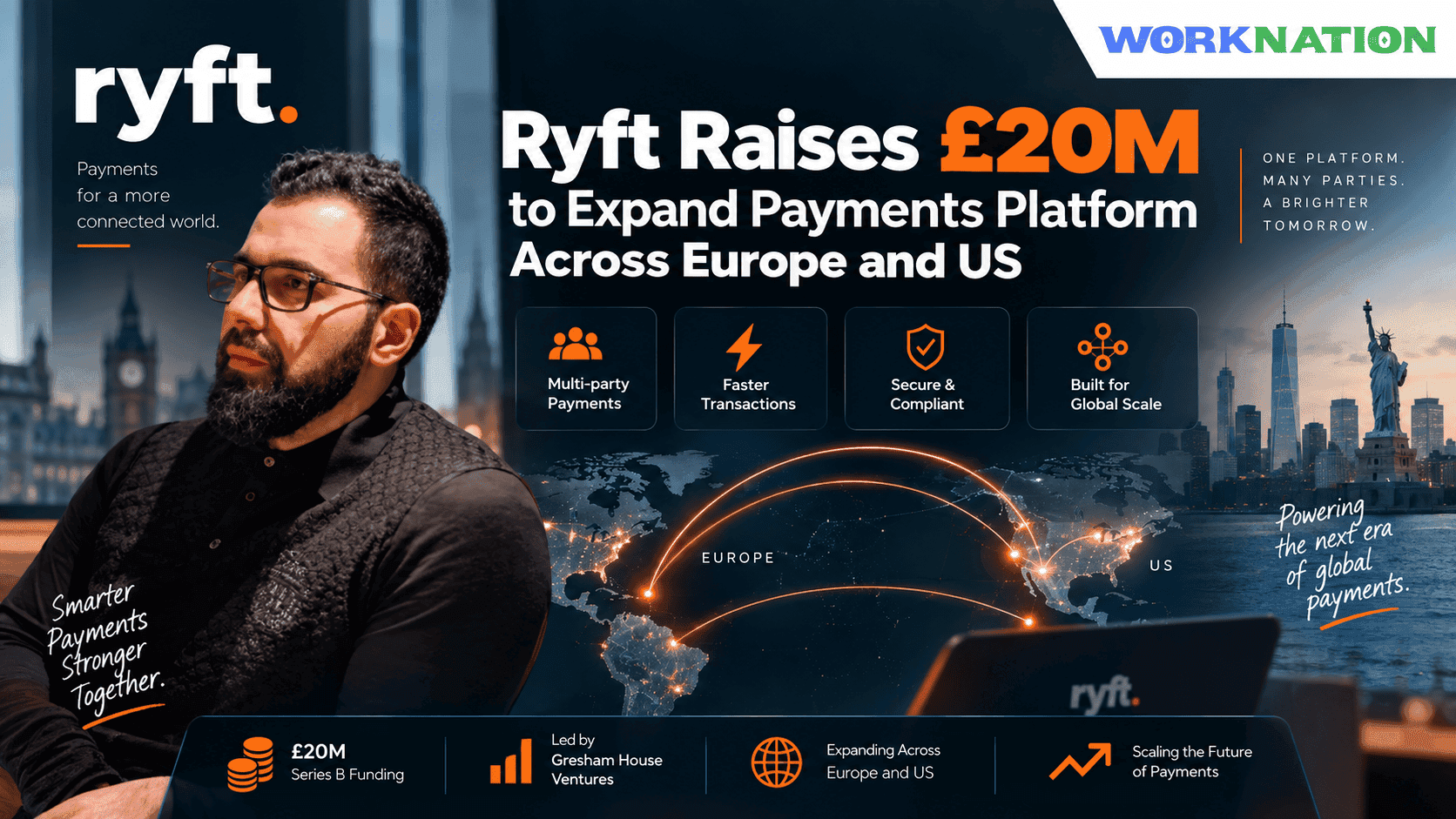
Ryft, a Manchester-based payments fintech focused on multi-party transactions, has raised £20 million in a Series B round led by Gresham House Ventures. The company plans to use the new capital to expand its payments infrastructure across Europe and the United States as it looks to compete in an increasingly global payments market.
The funding comes during a difficult period for the UK's fintech sector. UK fintech investment fell to £1.8 billion in the first half of 2026, the lowest level in a decade. Despite the broader decline in investment, Ryft has continued to expand its processing volume, customer base and overall business.
The latest financing is Ryft's third funding round since it was founded in 2021. Existing investors Pembroke VCT and Ingenii Capital also participated in the Series B. According to Ryft, the £20 million financing represents the largest UK payments Series B of 2026.
Ryft's focus on multi-party payments
Ryft has built its payments infrastructure around a specific challenge faced by marketplaces and other platform businesses: distributing a single customer payment among multiple parties.
Traditional payment transactions generally involve a customer paying a merchant. Platform businesses can have a considerably more complicated structure, with a single transaction potentially involving a marketplace, sellers, service providers, promoters, operators or other participants.
Ryft connects to acquiring banks and provides infrastructure that allows businesses to split payments, hold funds in escrow and distribute money to multiple parties according to different schedules.
The company provides these capabilities through a single integration, allowing businesses to manage complex payment flows without building the underlying infrastructure themselves.
One example is a ticketing marketplace working with hundreds of independent event promoters. When a customer purchases a ticket, the platform could take its commission at checkout, hold the remaining funds until the appropriate point in the event cycle and then distribute the money to individual promoters.
Without infrastructure designed for this type of transaction, businesses can face significant reconciliation and payout requirements when dealing with large numbers of recipients.
Three founders and three funding rounds
Ryft was founded in Manchester in 2021 by Sadra Hosseini, Alex Mackenzie and Richard Kirby.
Hosseini and Mackenzie previously founded Butlr, a mobile-ordering application for pubs and bars. The company was later sold to OrderPay, giving the founders experience in payments and digital commerce before they started Ryft.
Since its founding, Ryft has completed three funding rounds.
The company raised £1.2 million in seed funding in 2022. It followed that with a £5.7 million Series A led by EdenBase in April 2025. The latest £20 million Series B brings Ryft's total funding to approximately £27.4 million.
The new round gives the company significantly more capital to move beyond its UK base and pursue international expansion.
Competing in a market dominated by major payments platforms
Ryft operates in a market where large payments companies such as Stripe and Adyen already provide infrastructure for marketplaces and platforms.
Rather than attempting to compete across every part of the payments stack, Ryft has concentrated on multi-party payment flows. Its platform is designed around payment splitting, escrow and scheduled payouts.
The company is targeting a segment where transactions can become significantly more complicated when money needs to move between several parties.
The wider embedded payments market also represents a significant opportunity. According to Global Market Insights, the global embedded payments market was estimated at $24.7 billion in 2024 and is forecast to grow by more than 30% annually through 2034.
Ryft's strategy is therefore focused on building specialized infrastructure for businesses whose payment requirements extend beyond a straightforward customer-to-merchant transaction.
Growing customer base and processing volume
Ryft says it has tripled both its size and processing volume over the past 12 months.
More than 6,500 businesses currently use the platform. Its customers include Epos Now, the Disasters Emergency Committee and travel platform Daytrip.
The company has also developed partnerships with major payments and financial infrastructure companies, including Visa, Mastercard, American Express and Nuvei.
According to Rohit Mathur, a partner at Gresham House Ventures, some of Ryft's strongest customers are recording platform volume growth of more than 100% annually.
This growth provides the company with an expanding base from which to develop its international business.
Gresham House Ventures leads the £20M Series B
Gresham House Ventures led the latest investment, marking its third investment in Ryft.
The investment firm manages approximately £800 million across its venture and VCT funds and has backed companies across areas including marketing analytics and clinical trials.
Existing investor Pembroke VCT also participated in the round. Pembroke has now backed Ryft three times.
Gresham House Ventures partner Rohit Mathur described the investment in the context of the changing structure of modern commerce. He pointed to marketplaces, franchises, creators and potentially AI agents as examples of business models where payments may increasingly involve multiple parties.
Fred Ursell, head of investments at Pembroke Investment Managers, similarly highlighted the technical and regulatory complexity involved in splitting payments between multiple recipients.
Europe and US expansion
The primary focus of the new capital will be Ryft's international expansion.
The company plans to enter additional European markets and expand into the United States. One of the most important steps in its European strategy is an application for a full EU payments licence through the Malta Financial Services Authority.
If successful, the licence would allow Ryft to operate across the European Economic Area without requiring a separate licence for every individual country.
Obtaining the necessary regulatory permissions will be an important part of the company's European growth strategy, particularly because payments infrastructure operates within a highly regulated financial environment.
The US expansion will give Ryft another major market to pursue as it attempts to scale beyond its existing UK customer base.
Payments infrastructure for platforms
The growth of marketplace and platform-based commerce is creating increasingly complex payment flows.
A marketplace can connect thousands of buyers with independent sellers. A ticketing platform can collect payments from customers while distributing funds to event promoters. A travel platform can coordinate transactions between customers and service providers.
In each case, the payment infrastructure needs to handle more than simply accepting money from a customer and transferring it to a merchant.
Ryft's platform is designed to handle these multi-party relationships through payment splitting, escrow and scheduled payouts.
The company also sees potential applications in emerging business models involving AI agents. As software agents become capable of interacting with businesses and initiating transactions, payments could potentially involve additional layers of authorization, distribution and settlement.
However, the company still operates in a market where established payment infrastructure providers have substantial scale and resources.
A larger international opportunity
The latest funding gives Ryft an opportunity to test whether its specialized approach to multi-party payments can scale beyond the UK.
The company enters this phase with more than 6,500 businesses on its platform, partnerships with major payments companies and processing volume that has tripled over the past year.
Its European licensing application will be one of the next major milestones. At the same time, expansion into the US will test whether the company's payments infrastructure can attract customers in a market with established financial technology providers.
For Ryft, the Series B is therefore not simply about increasing funding. It marks a transition from building and scaling a UK payments platform toward establishing an international business focused on multi-party transactions.
As marketplaces, platforms and other digital businesses continue to develop more complex commercial models, Ryft is betting that specialized payment infrastructure can become an increasingly important part of the financial technology stack.
Have a Funding Round or Exciting Update to Share?
Submit your press release to get featured on WorkNation and reach founders, investors, and tech leaders.