Nevis Raises $70 Million Series B as AI Platform Assets Surge to $700 Billion
Top Picks
Submit PR
Stay Ahead of the Market
Get the latest startup funding, hiring trends and global opportunities delivered to your inbox every week.
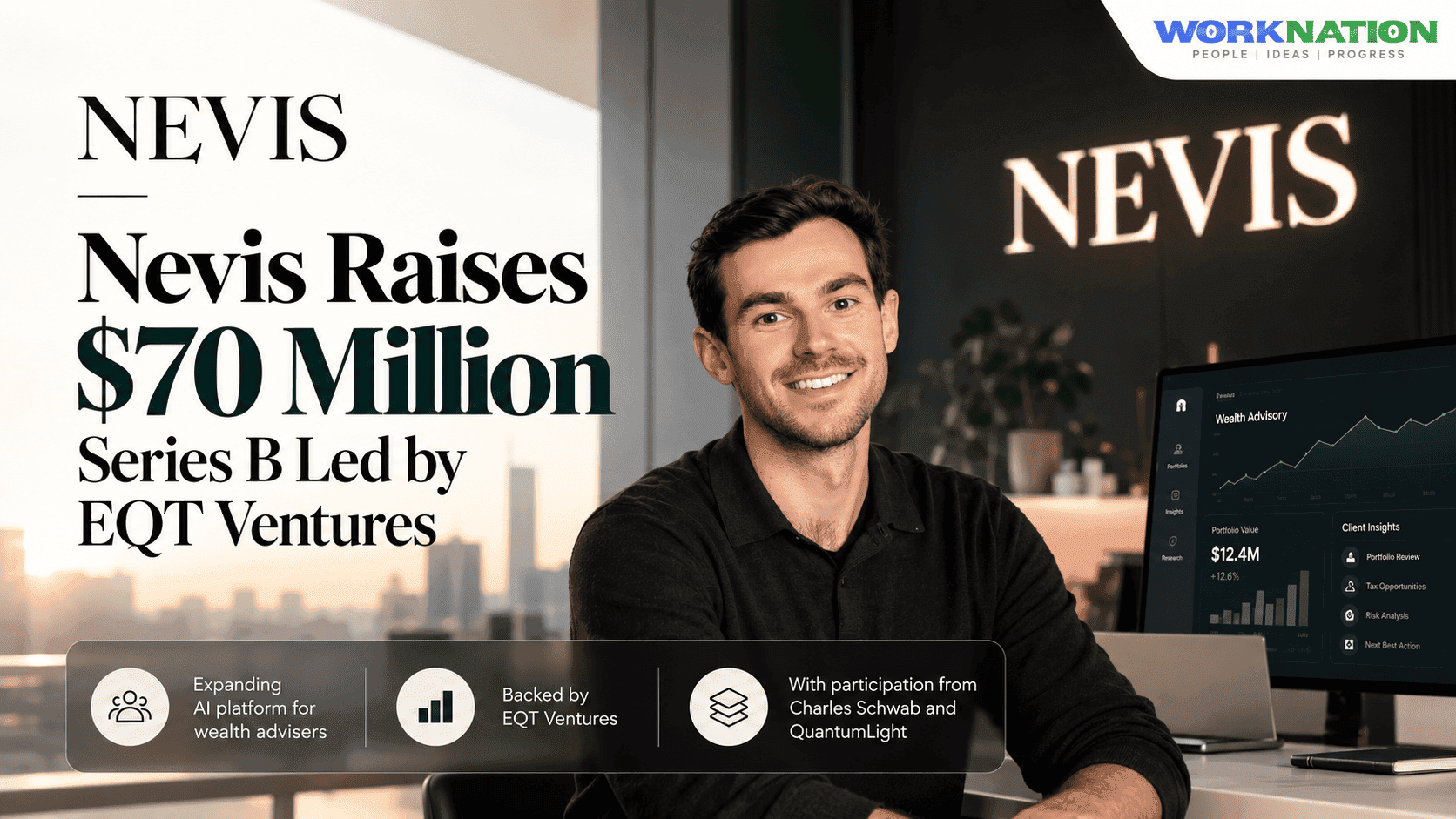
Nevis, an artificial intelligence startup building software for wealth management firms, has raised $70 million in a Series B funding round led by EQT Ventures. Charles Schwab and QuantumLight, the investment firm founded by Revolut CEO Nik Storonsky, joined as new strategic investors, while existing backers Sequoia Capital, ICONIQ, and Ribbit Capital increased their investments.
The round brings Nevis' total funding to $110 million. The company plans to use the capital to enhance its AI agents, integrate with more custodians and wealth management software providers, and expand its product and sales teams.
Founded in 2024 by former Revolut executives Mark Swan, Ivan Chalov, and Philipp Burda, Nevis is building an AI platform that combines customer relationship management (CRM), meeting intelligence, financial planning, and custodial workflows. Its software aims to automate administrative work so financial advisers can spend more time serving clients and growing their businesses.
The company reports that assets represented on its platform grew from $50 billion to $700 billion during 2026, while revenue increased more than 25-fold. These figures point to rapid adoption of its technology among wealth management firms, although the $700 billion represents assets associated with firms using the platform, not assets owned or directly managed by Nevis.
From Revolut Colleagues to WealthTech Founders
Nevis emerged from the experience of three executives who worked together at Revolut, the financial technology company.
Mark Swan led global strategy and operations, Ivan Chalov managed the consumer retail business, and Philipp Burda led AI. Their experience working within a large financial technology business helped shape their view of how automation could improve financial services.
After leaving Revolut, Swan identified an opportunity in wealth management. Financial advisers often work across numerous software systems and spend substantial time on administrative processes, including meeting documentation, client records, financial planning, and account opening.
The founders saw an opportunity to build a unified platform that could do more than assist with individual tasks. Instead of adding another standalone tool, Nevis set out to connect multiple workflows and use AI agents to execute operational tasks from start to finish.
The company initially considered the UK market, but conversations with investors helped direct its attention toward the United States, where the founders saw a larger opportunity in wealth management technology.
Nevis raised its initial seed funding in September 2024, followed by a $35 million Series A led by Sequoia Capital in December 2025, according to the reported funding history.
What Nevis' AI Platform Does
Nevis is developing what it describes as an AI operating system for wealth management firms. The platform brings together several activities that advisers traditionally manage across separate applications.
Its capabilities include:
Customer relationship management: Organising client records and information.
Meeting intelligence: Capturing meeting information and turning it into actionable follow-up work.
Financial planning: Supporting the preparation of personalised financial plans and proposals.
Custodial workflows: Helping coordinate processes related to client accounts and financial operations.
AI agents: Carrying out administrative tasks across connected systems and workflows.
The objective is to reduce the time advisers spend moving between software tools and handling repetitive work. Rather than simply generating meeting notes or suggesting next steps, Nevis aims to execute operational workflows that help firms manage client relationships and account processes more efficiently.
The company says advisers using its platform can save up to 10 hours per week, hold 30% more prospect meetings, and open accounts in days rather than weeks.
These are company-reported outcomes, and actual results may vary across firms and workflows. Nevertheless, they illustrate the productivity gains Nevis is targeting as wealth management firms look for ways to increase their capacity.
From $50 Billion to $700 Billion in Platform Assets
One of Nevis' most notable reported growth metrics is the increase in assets represented on its platform.
The company says this figure rose from $50 billion to $700 billion during 2026, with approximately $75 billion being added each month. Revenue reportedly increased more than 25-fold over the same period.
Nevis also says its AI agents have completed more than 100,000 operational tasks. Its customers include Focus Financial Partners, IEQ Capital, and United Capital.
These figures suggest that the company is gaining traction with wealth management firms that need to coordinate large volumes of client information and operational processes.
However, platform assets should not be confused with assets under Nevis' own management. The company supplies software to firms that already have their own advisers and clients. Its growth therefore reflects adoption of its technology by wealth management businesses and the assets associated with those firms.
The next challenge will be to sustain that adoption while expanding its integrations, product capabilities, and support for enterprise customers.
Addressing the Wealth Adviser Capacity Gap
Nevis is entering a market facing a growing need for financial advice and concerns about the availability of experienced advisers.
The source article cites McKinsey's estimate that approximately 110,000 US financial advisers are expected to retire over the next decade. As experienced professionals leave the industry, firms face pressure to serve clients efficiently while maintaining the personalised service expected in wealth management.
Nevis' approach is to automate the administrative work that consumes advisers' time rather than replace advisers themselves. By handling tasks such as meeting follow-ups, client records, financial planning workflows, and account opening, the platform aims to give advisers more capacity to focus on relationships and advice.
This distinction is central to the company's positioning. Wealth management involves trust, financial decisions, and individual circumstances, so technology must support the adviser-client relationship while helping firms operate more efficiently.
The broader opportunity is not limited to reducing paperwork. If the platform becomes embedded in a firm's everyday workflows, it could also help firms consolidate parts of their technology stack. The extent to which customers replace existing software with Nevis will depend on integrations, reliability, security, and the needs of individual firms.
Why EQT Ventures, Charles Schwab, and QuantumLight Are Investing
The Series B round brings together venture capital investors and strategic financial services players.
EQT Ventures led the financing, while Charles Schwab and QuantumLight joined as new investors. Sequoia Capital, ICONIQ, and Ribbit Capital increased their commitments.
Charles Schwab's participation is particularly relevant because of its position in the US wealth management ecosystem. Its adviser services business supports independent registered investment advisers, creating a potential route for technology partnerships and integrations.
Schwab says its investment in Nevis expands the AI capabilities available to advisers and could help them operate more efficiently, increase capacity, and serve more investors. The investment announcement also describes a deeper partnership involving Schwab's custodial infrastructure.
QuantumLight, founded by Revolut co-founder and CEO Nik Storonsky, adds another connection to the founders' previous professional network. Swan, Chalov, and Burda worked at Revolut before building Nevis.
For EQT Ventures, the opportunity centres on using AI to address the capacity constraints facing wealth management firms. EQT has also highlighted the potential for Nevis to become a foundational technology platform for the industry.
The participation of these investors gives Nevis access to capital and industry relationships, but long-term success will depend on whether the platform continues delivering measurable value to customers.
Competition in AI-Powered Wealth Management
Nevis is operating in a growing category of companies applying AI to financial advisers' workflows.
The source article identifies Jump, which has raised $80 million in a Series B led by Insight Partners, as a competitor seeking to expand beyond meeting assistance toward a broader AI operating system for advisers.
Savvy Wealth is taking a different approach as an AI-focused advisory firm, while Arca has also entered the market with substantial funding. These businesses do not all follow the same model, making direct comparisons dependent on their products and customers.
Nevis differentiates itself by selling software to existing wealth management firms rather than operating primarily as an advisory firm serving investors directly.
That business model places the company in a position to integrate with firms' existing operations and potentially become a central layer connecting their data, applications, and workflows.
The strategic question is who will control the daily workflow of financial advisers as AI becomes more deeply embedded in wealth management. Custodians, established software providers, and AI-native platforms all have incentives to play a larger role.
Plans for the Next Stage of Growth
Nevis has approximately 70 employees and offices in London and New York, according to the source article.
The fresh capital will support further development of its AI agents, integrations with additional custodians and wealth management software, and expansion of its product and sales teams.
The company's ambition extends beyond automating individual tasks. Nevis wants to become a foundational AI platform for wealth management, connecting the systems advisers use and handling more of the operational work required to serve clients.
Achieving that ambition will require reliable execution across complex workflows, strong integration with financial systems, and the trust of firms handling sensitive client and financial information.
Its reported growth in platform assets and revenue provides an early indication of commercial momentum. The next stage will test whether Nevis can sustain that momentum as competition increases and customers expect increasingly sophisticated AI capabilities.
What Nevis' $70 Million Raise Signals
Nevis' Series B highlights investor interest in AI companies that automate work within established industries, rather than simply introducing another assistant or standalone application.
The startup has raised $70 million at a time when wealth management firms are looking for ways to serve more clients amid adviser capacity constraints. Its reported growth from $50 billion to $700 billion in platform assets and more than 25-fold revenue growth during 2026 suggest that its approach is gaining traction.
For founders and investors, the larger lesson is the value of solving an operational problem that customers already experience. Nevis is targeting fragmented software and administrative work within a high-value industry, using AI agents to connect processes that have traditionally been handled across multiple systems.
The company now has additional capital, strategic investors, and a growing customer base to support its next phase. Whether it becomes the foundational AI platform it envisions will depend on customer outcomes, integration depth, and its ability to maintain an advantage as the wealth management technology market evolves.
Have a Funding Round or Exciting Update to Share?
Submit your press release to get featured on WorkNation and reach founders, investors, and tech leaders.