Nova Spectral AI Raises Rs 21.15 Crore to Build Indigenous Infrared Vision Chips
Top Picks
Submit PR
Stay Ahead of the Market
Get the latest startup funding, hiring trends and global opportunities delivered to your inbox every week.
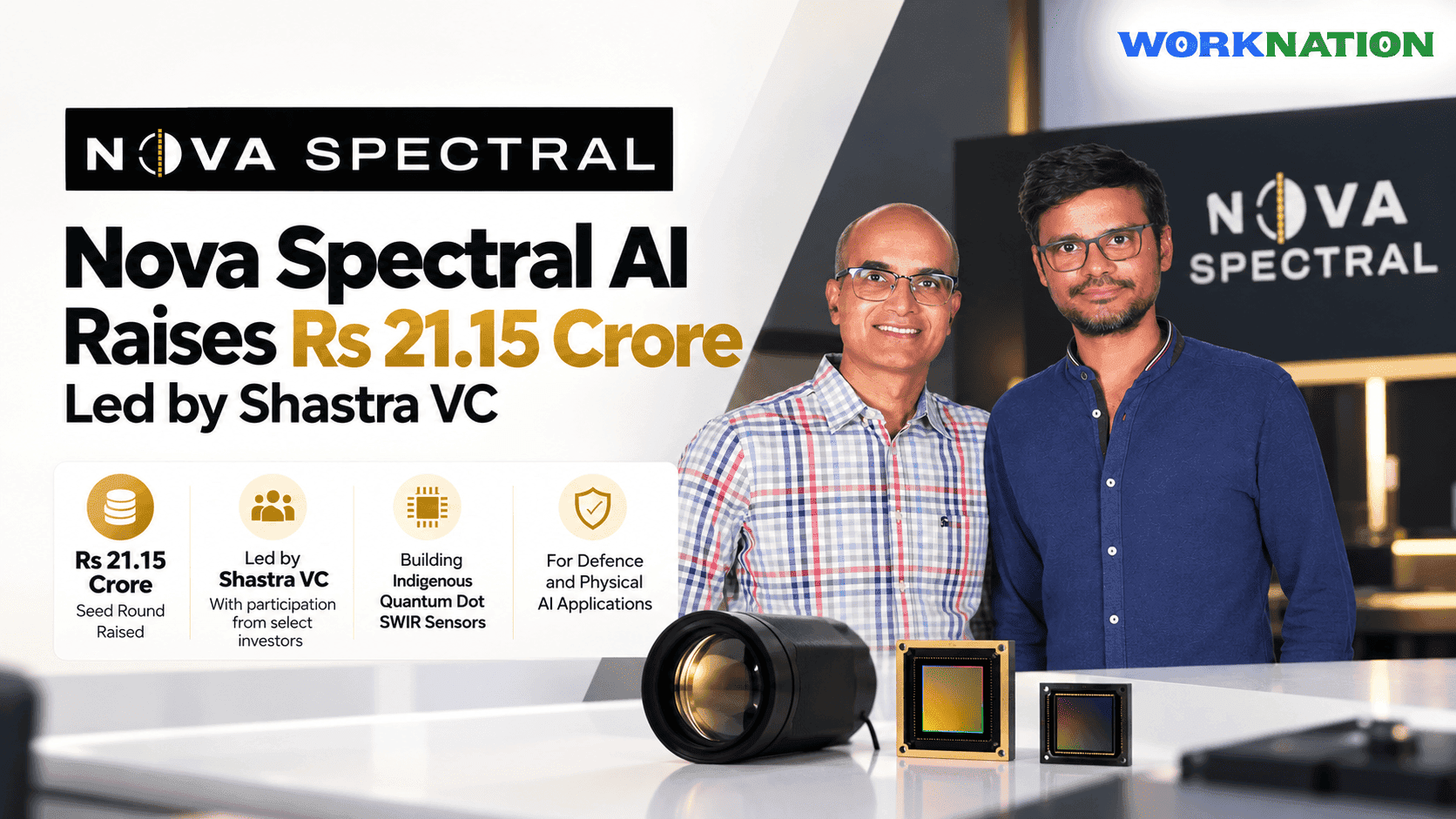
Bengaluru-based Nova Spectral AI has raised Rs 21.15 crore, approximately $2.25 million, in a seed funding round led by Shastra VC. Equirus InnovateX Fund and angel investors also participated in the round.
The startup is developing short-wave infrared (SWIR) image sensor chips designed to help cameras capture images in challenging conditions, including low light, haze, and smoke. Its technology targets defence intelligence, surveillance and reconnaissance (ISR), robotics, autonomous vehicles, and other physical AI applications.
Founded in 2026 by Anish Priyadarshi and Sanjeev Kumar, Nova Spectral AI plans to use the fresh capital to build its team and develop a field-ready prototype within 18 months, according to the company.
Developing Infrared Vision for Challenging Conditions
Conventional cameras can struggle when visibility deteriorates. Nova Spectral AI is working on image sensors that use short-wave infrared technology to extend imaging capabilities in conditions where conventional cameras may have limitations.
SWIR imaging captures light in the short-wave infrared portion of the electromagnetic spectrum. Depending on the sensor and operating conditions, this can help imaging systems detect information that may be difficult to capture using conventional visible-light cameras.
The technology has potential applications in drones, surveillance equipment, robots, and autonomous vehicles. In defence, these capabilities could support intelligence, surveillance and reconnaissance systems operating in demanding environments.
Nova Spectral AI is developing what it describes as an indigenous, lead-free colloidal quantum dot (cQD) SWIR image sensor chip built on standard silicon complementary metal-oxide-semiconductor (CMOS) technology.
Using Quantum Dots and Silicon CMOS
The startup's approach combines indium arsenide (InAs) colloidal quantum dots with CMOS-compatible manufacturing processes.
Colloidal quantum dots are semiconductor nanocrystals whose optical properties can be engineered for particular applications. In imaging, they are being explored as a way to build sensors that detect wavelengths beyond the visible spectrum.
CMOS technology is widely used in conventional semiconductor manufacturing and image sensors. Building SWIR sensors around standard silicon CMOS processes could offer a route toward more scalable production, depending on manufacturing yields, performance, and integration requirements.
Nova Spectral AI aims to reduce sensor costs by up to 100 times compared with conventional indium gallium arsenide (InGaAs) technology. This is a company target, not a demonstrated industry-wide cost reduction. Achieving it will depend on technical performance, production scale, reliability, and the final cost of manufacturing.
If the approach proves viable, lower-cost SWIR sensors could make infrared imaging more accessible across applications that currently face cost or deployment constraints.
Defence and Physical AI Applications
Defence is one of Nova Spectral AI's primary target markets. The company intends to develop technology for ISR platforms, including drones and surveillance systems.
Infrared imaging can provide additional information in environments where visible-light imaging is less effective. For defence operators, this capability could support monitoring and situational awareness in difficult conditions.
The startup also sees opportunities beyond defence. Its target applications include robots, autonomous vehicles, smartphones, wearables, and automotive systems.
These applications form part of the broader physical AI market, where artificial intelligence interacts with the real world through machines, sensors, and autonomous systems. Such systems need reliable perception to interpret their surroundings and respond to changing conditions.
More affordable infrared sensing could expand the range of machines capable of using SWIR imaging. However, integration into consumer electronics, vehicles, and other products will depend on sensor performance, size, power consumption, manufacturing readiness, and product-specific requirements.
Funding to Build a Field-Ready Prototype
The seed round will support Nova Spectral AI's team expansion and development of a field-ready prototype over the next 18 months.
That milestone will be important in moving the company's technology from development toward practical deployment. Prototype testing can help establish whether the sensor meets requirements for image quality, operating conditions, reliability, and integration into target systems.
For a semiconductor startup, progress also depends on manufacturing repeatability and the ability to translate laboratory results into products that can be produced consistently.
The company has outlined an ambitious cost-reduction target and a broad range of intended applications. The next stage will be about demonstrating the technology in real-world conditions and establishing whether it can meet the needs of customers in defence and other markets.
India's Push for Indigenous Infrared Sensors
Nova Spectral AI is entering a space where Indian startups are working to develop domestic infrared sensing and imaging capabilities.
Reducing reliance on imported sensors could create opportunities for local semiconductor and defence technology development. At the same time, establishing a competitive alternative requires more than a lower target price: performance, reliability, manufacturing capacity, and customer qualification will all matter.
Another company operating in the broader space, SpectraGaze Systems, previously raised Rs 3.7 crore in seed funding led by GVFL to develop indigenous infrared detectors, optical imaging sensors, and electro-optical payloads for space and defence applications.
While the two companies' specific technologies and product roadmaps may differ, both illustrate startup activity around locally developed infrared and optical sensing systems.
What Comes Next for Nova Spectral AI?
With Rs 21.15 crore in seed funding, Nova Spectral AI plans to build its team and work toward a field-ready prototype within 18 months.
Its longer-term opportunity rests on whether colloidal quantum dot technology and CMOS-compatible manufacturing can deliver reliable SWIR sensors at substantially lower costs. If successful, the technology could support wider use of infrared imaging in defence, robotics, autonomous vehicles, and other physical AI applications.
For now, the company's next major milestone is proving its technology outside the development environment. Prototype performance, manufacturability, and customer adoption will help determine whether its cost ambitions can translate into a commercially viable product.
Have a Funding Round or Exciting Update to Share?
Submit your press release to get featured on WorkNation and reach founders, investors, and tech leaders.