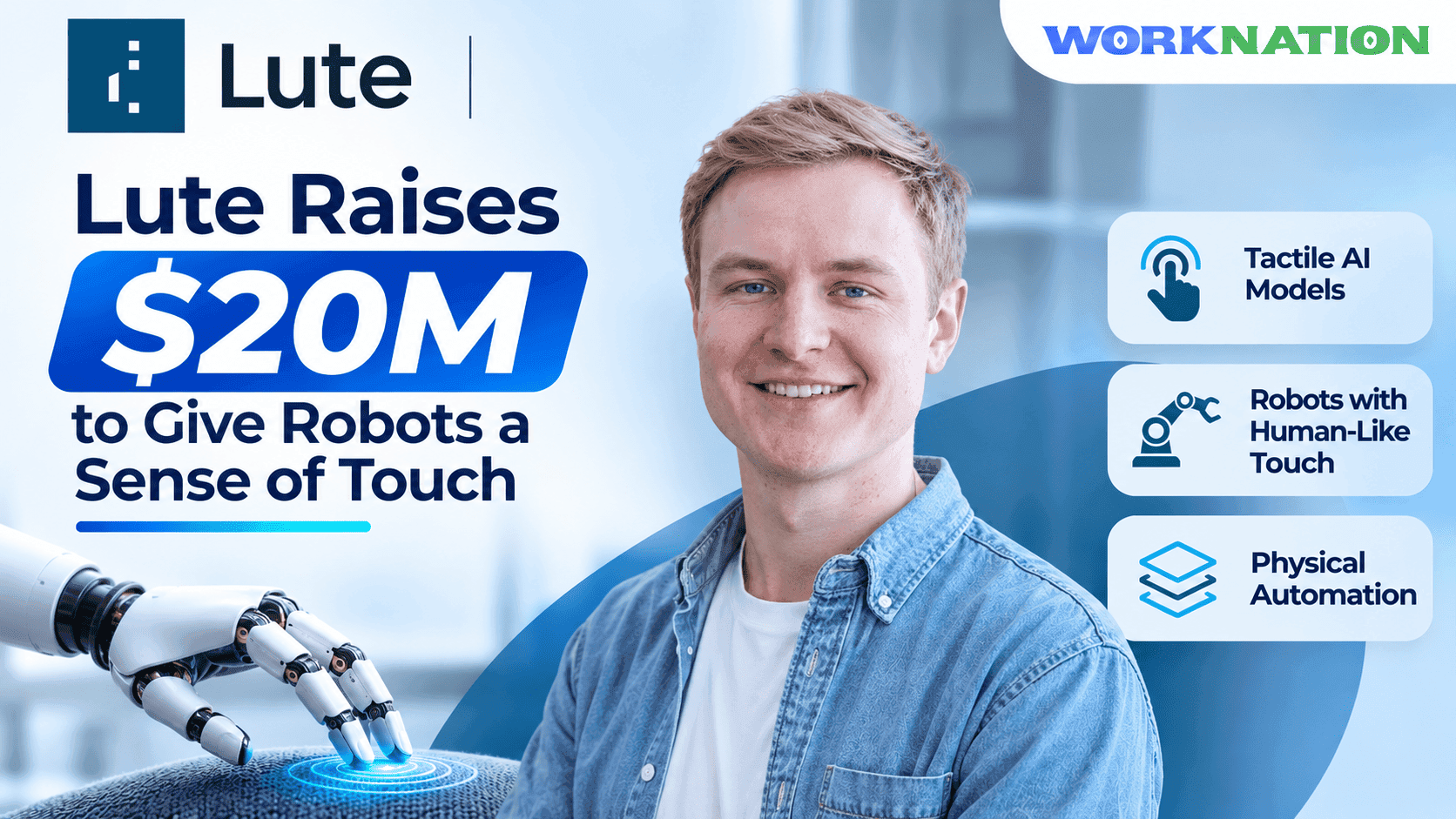
Lute Raises $20M to Give Robots a Sense of Touch
Top Picks
Submit PR
Stay Ahead of the Market
Get the latest startup funding, hiring trends and global opportunities delivered to your inbox every week.
Warsaw-based physical AI startup Lute has raised $20 million in combined pre-seed and seed funding to develop foundation models that help robots understand and interact with the physical world through touch.
OTB Ventures and FORWARD.one co-led the seed round, while Seedcamp and Credo Ventures co-led the pre-seed. Other investors include Inovo VC, ff Venture Capital, Borusan Ventures and Naval Ravikant, founder of AngelList and an early investor in companies including Twitter, Uber and Notion.
Founded in January 2026 by Paweł Budzianowski and Krzysztof Walas, Lute is developing tactile AI models designed to help robots handle objects more reliably in retail stores, warehouses and third-party logistics facilities.
The company says its technology is already deployed at a European automotive retail distributor with $6 billion in annual revenue. It also reports that its models are being used in hospital corridors and that it is working with major retailers at their sites.
Why Robots Need a Sense of Touch
Most robotics systems rely heavily on cameras and visual information to understand their surroundings. Vision can help a robot identify an object, locate it and estimate how to approach it. But it does not always provide enough information about physical contact.
A robot may recognise a glass on a shelf, for example, but still struggle to determine how firmly to grip it, whether it is slipping or how much pressure is safe to apply.
Human hands solve these problems through touch. Tactile feedback helps people adjust their grip, detect surface changes and handle objects with different levels of fragility.
Lute believes this missing sensory input is a major limitation in physical AI.
Its approach focuses on collecting tactile data and training foundation models that can translate physical interactions into useful robot actions. The company is also working with system integrators to bring these models into real-world deployments.
Building Tactile Sensors and Real-World Data
Lute and one of its partners have co-designed compact, elastomer-based tactile sensors and integrated them into a portable data-collection system.
The goal is to gather touch-rich information at scale, giving models more examples of how objects respond to pressure, movement and contact.
This matters because robots operating in warehouses, retail environments and logistics facilities encounter a wide range of objects, materials and physical conditions.
Training on real-world interactions could help models move beyond controlled laboratory demonstrations. However, the ability to generalise across different robots, objects and environments remains a key technical challenge for the broader physical AI sector.
Introducing Lute-0: Its First Video-Action Model
Alongside the funding announcement, Lute introduced Lute-0, its first video-action model.
The model learns from video how scenes change and uses that information to generate robot actions. It is part of the company's wider effort to build physical intelligence systems that connect perception with interaction.
Lute claims that Lute-0 was pre-trained using substantially less data than the open-source robotics model π0.5 and required only one-quarter of its training steps while matching its performance on dexterous tasks.
These results are company-reported and have not been independently validated in the supplied coverage.
The announcement is significant because it shows Lute is working beyond tactile sensors alone. It wants to build models that can use different forms of physical information to guide robot behaviour.
Already Deployed in Retail and Logistics
Lute says its technology is already deployed at what it describes as Europe's largest automotive retail distributor, a business with approximately $6 billion in annual revenue.
The company also reports that its models work in hospital corridors and that it is collaborating with some of the world's largest retailers at their sites.
Its business model includes more than supplying AI models. Lute says it supports system integrators with hardware selection, task definition, on-site robot retraining, monitoring and remote support.
This approach is intended to help integrators deploy physical AI without needing to build large in-house machine learning teams.
The reported deployments are an early commercial signal, although the company has not disclosed the distributor's identity, deployment scale, contract value or measurable productivity outcomes.
Who Founded Lute?
Lute was founded in January 2026 by Paweł Budzianowski and Krzysztof Walas.
Budzianowski is the company's co-founder and CEO. He previously co-founded K-Scale Labs, which worked on affordable open-source humanoid robots, and led the machine learning team at PolyAI. He holds a PhD from the University of Cambridge, where he researched long-term conversational agents.
Walas is co-founder and CTO. He previously served as an associate professor at Poznań University of Technology and led the Physical Interaction Robotics team at IDEAS NCBR. He has also advised robotics startup Nomagic and served on the board of the European AI-Data-Robotics Association.
The company says its team has 16 people, including four PhD holders, combining expertise across robotics, machine learning and physical interaction.
Who Is Competing in Physical AI and Robotic Touch?
Lute is entering a growing market focused on giving robots greater physical intelligence and dexterity.
Some of the companies working on related problems include:
Enact Intelligence: The Zurich-based startup emerged from stealth in October 2026 with $30 million in pre-seed funding to develop robots that sense force and touch.
mimic: The Zurich-based company develops AI models for robotic hands trained using data from skilled human workers. It raised $16 million in November 2025.
Sereact: The Stuttgart-based robotics company develops AI systems for warehouse automation and raised a $110 million Series B in April 2026.
UNIT AI: The Boston-based company is building modular warehouse automation for retailers and third-party logistics providers.
Adaptronics: The Italian startup develops electrostatic robotic grippers that combine adhesion technology with tactile sensing.
Lute's focus is on tactile foundation models and making them accessible to system integrators. Rather than concentrating only on robotic hardware, it is building the intelligence layer that helps robots interact with objects in real environments.
How Lute Plans to Use the $20 Million
Lute plans to use the funding to expand its data collection, improve its models and scale customer deployments.
The company is also hiring across research, engineering and deployment roles, with operations in Warsaw and San Mateo, California.
Its next phase will involve improving the quality and scale of tactile training data, developing more capable models and expanding deployments across retail, warehousing and logistics.
A central challenge will be proving that its models can transfer reliably between different robot platforms and physical environments without requiring extensive retraining for every new task.
Editorial Analysis: What Lute's Funding Signals
1. Physical AI needs more than better cameras.
Robots can use vision to recognise objects, but reliable manipulation also requires information about pressure, grip and contact. Tactile sensing could become an important layer in making robots useful outside controlled environments.
2. Real-world data may become a competitive advantage.
Collecting tactile data is more difficult than gathering ordinary images or video. Lute's portable sensor system and reported customer deployments could help it build a specialised dataset, provided it can collect enough varied and high-quality interactions.
3. Lute is targeting the intelligence layer, not just robot hardware.
Its model-and-integrator approach could let the company work across different robot platforms. That could broaden its market, but it also makes compatibility and reliable deployment across hardware systems essential.
4. The reported enterprise deployment is promising, but details matter.
A deployment at a distributor with $6 billion in annual revenue is a useful commercial signal. It does not mean Lute has a $6 billion customer contract or that its technology is deployed across the distributor's entire operation. Deployment scale and measurable results have not been disclosed.
5. Lute-0's benchmark claims need independent scrutiny.
Matching π0.5 on dexterous tasks with fewer training steps would be notable if independently reproduced. Until then, the result should be treated as a company claim rather than established evidence of technical superiority.
Frequently Asked Questions
How much funding has Lute raised?
Lute has raised $20 million in combined pre-seed and seed funding. OTB Ventures and FORWARD.one co-led the seed round, while Seedcamp and Credo Ventures co-led the pre-seed.
Who founded Lute?
Lute was founded in January 2026 by Paweł Budzianowski and Krzysztof Walas. Budzianowski is CEO and Walas is CTO.
What does Lute develop?
Lute develops tactile foundation models and physical AI systems designed to help robots understand contact, pressure and object interaction.
What is Lute-0?
Lute-0 is Lute's first video-action model. It learns from video how scenes change and uses that information to generate robot actions.
Where is Lute's technology being deployed?
Lute reports deployments at a European automotive retail distributor with $6 billion in annual revenue, as well as applications in hospital corridors and work with major retailers.
Who invested in Lute?
The investors include OTB Ventures, FORWARD.one, Seedcamp, Credo Ventures, Inovo VC, ff Venture Capital, Borusan Ventures and Naval Ravikant.
Why is tactile sensing important for robots?
Tactile sensing gives robots information about physical contact, including grip, pressure and slippage. This can help them handle objects more reliably than systems relying on vision alone.
Conclusion
Lute's $20 million funding round gives the Warsaw-based startup resources to develop tactile foundation models and expand its physical AI deployments. Its central bet is that robots need more than visual intelligence to work reliably in the real world.
By combining tactile sensors, video-action models and support for system integrators, Lute is attempting to build an intelligence layer for robotic interaction. The next test is whether its models can generalise across different machines and environments and deliver measurable results beyond early deployments.
Have a Funding Round or Exciting Update to Share?
Submit your press release to get featured on WorkNation and reach founders, investors, and tech leaders.