Lampsy Raises €1.1M to Bring Its AI Seizure-Monitoring Lamp to Europe
Top Picks
Submit PR
Stay Ahead of the Market
Get the latest startup funding, hiring trends and global opportunities delivered to your inbox every week.
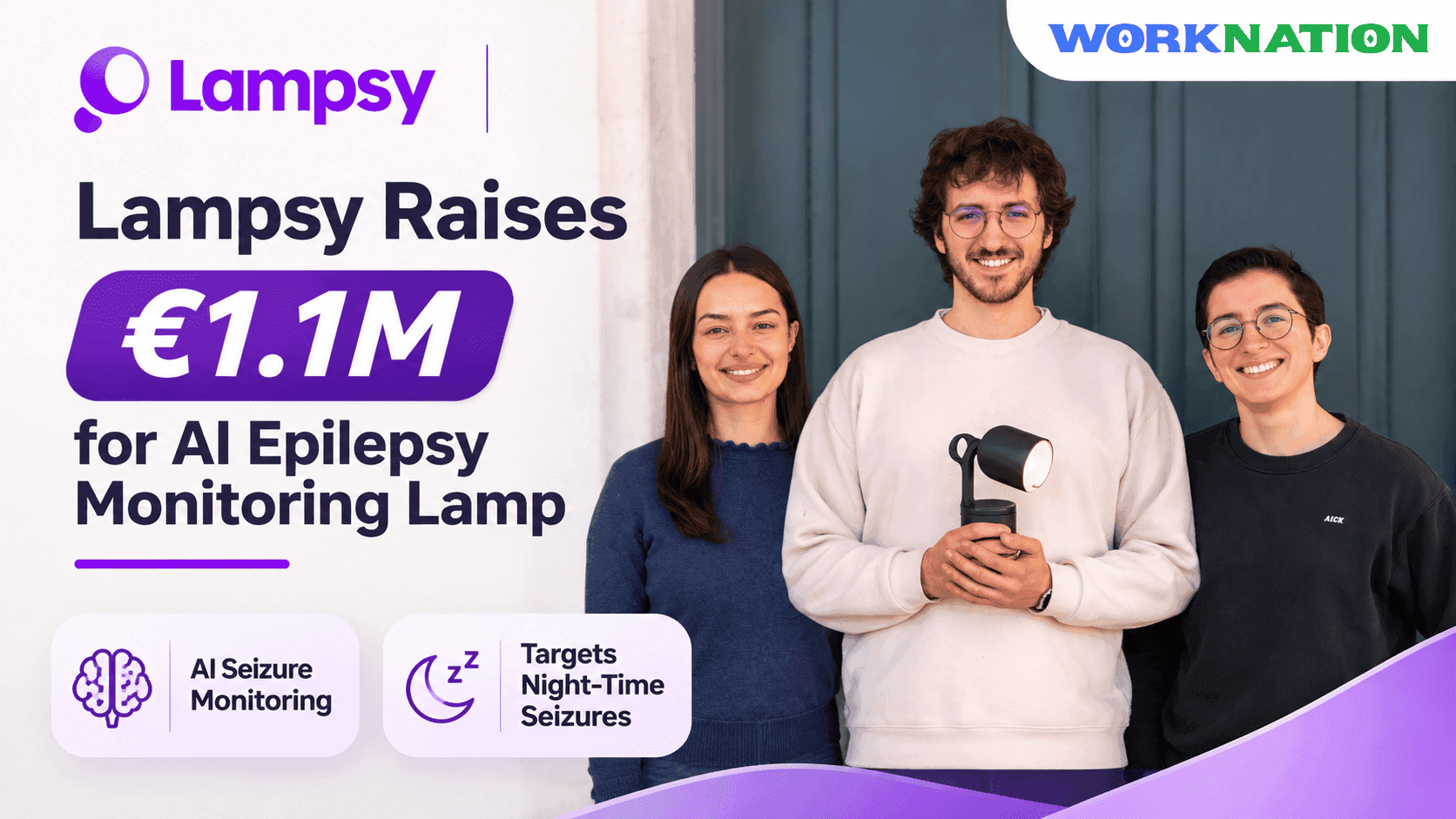
Portuguese healthtech startup Lampsy Health has raised €1.1 million to launch its AI-powered seizure-monitoring lamp across Europe and the UK. The round was led by the Ageas Foundation and Portugal Ventures, with participation from Angels Way, Phira Ventures and strategic business angels. It also includes support from the European Innovation Council's Pre-Accelerator programme.
Founded by Vicente Mayer Garção, Leonor Pereira and Joana Pinto, Lampsy has developed a bedside lamp that uses a small camera, infrared illumination and artificial intelligence to monitor movements during sleep. When it identifies movement patterns that may indicate a tonic-clonic seizure, it can alert contacts selected by the user.
The company plans to begin its commercial launch in the first quarter of 2027. It says more than 7,500 people across 20 countries are already on its waiting list.
Why Night-Time Seizures Can Go Unnoticed
Epilepsy affects around 50 million people worldwide, according to the World Health Organization. For people living with epilepsy and their families, seizures during sleep can create particular concern because they may happen when nobody is awake to notice them.
Lampsy's funding announcement cites estimates that 86% of night-time seizures go unnoticed. The problem is especially relevant for families who cannot continuously observe someone while they sleep.
In Portugal, the EpiPort study published in September 2025 by the Portuguese League Against Epilepsy estimated that around 100,000 people live with epilepsy in the country. It reported a prevalence of 9.76 cases per 1,000 inhabitants and found that 43.7% of people with epilepsy received no medical follow-up.
These figures highlight the need for better monitoring and access to care. They also explain why contact-free monitoring technology is attracting interest from healthcare researchers and families.
How Lampsy's AI Seizure-Monitoring Lamp Works
Lampsy integrates a small camera and infrared lighting into a bedside lamp. Its computer-vision system processes movement patterns on the device and looks for movements associated with tonic-clonic seizures.
The system is designed to work in darkness without requiring a person to wear sensors or attach equipment to their body.
When it detects a potential seizure, Lampsy can automatically contact people selected by the user and send an alert through its app.
Its key features include:
Contact-free monitoring: No wearable sensor needs to be attached to the person.
Infrared illumination: Allows movement monitoring in dark sleeping environments.
On-device AI processing: The system analyses movement locally rather than relying on continuous cloud processing.
Automatic alerts: Selected emergency contacts can receive calls and app notifications when a potential seizure is detected.
Privacy controls: The company says its system can process movement without storing identifiable images when its privacy settings are enabled.
The product is designed to fit into an ordinary bedroom environment rather than look like a conventional medical monitoring device.
Importantly, the system focuses on movements associated with specific convulsive seizures. It should not be interpreted as a tool that detects every seizure type or diagnoses epilepsy.
What the Clinical Testing Shows
Lampsy says its technology has been tested on more than 9,200 hours of hospital video data.
The company reports more than 97% accuracy in detecting movements associated with tonic-clonic seizures and 18 times fewer false alarms than existing alternatives.
Its research has involved epilepsy monitoring units at Hospital de Santa Maria and Egas Moniz Hospital in Lisbon. A study involving more than 2,200 hours of video was published in the scientific journal IEEE Access.
A separate peer-reviewed research paper on the Lampsy system examined real-time video-based seizure detection on affordable edge hardware. The research reported sensitivity and specificity results from a dataset containing 21 tonic-clonic seizures. These study metrics should not be treated as interchangeable with the company's broader accuracy claim.
The distinction matters because seizure-monitoring performance depends on the data, seizure types, testing conditions and evaluation methods used.
Hospital video testing is an important development step, but performance in people's homes will also need to be demonstrated across different bedrooms, lighting conditions, sleeping positions and everyday environments.
From Hospital Research to Home Monitoring
Lampsy originated from a request by a medical team at Lisbon's Hospital de Santa Maria. The team wanted a way to monitor patients during sleep without requiring them to remain connected to monitoring equipment.
The startup emerged from research and development at Instituto de Telecomunicações and Instituto Superior Técnico in Portugal.
Its development has involved collaboration with epilepsy monitoring units in Lisbon, helping move the technology from a research setting towards a product intended for families.
The next step is commercial deployment beyond hospital environments. Lampsy plans to use its funding to support its European and UK launch, beginning with people already on its waiting list.
The company is also considering the United States as a medium-term market.
Who Founded Lampsy Health?
Lampsy Health was founded by Vicente Mayer Garção, Leonor Pereira and Joana Pinto, who previously co-founded Clynx Health.
Vicente Mayer Garção is the company's co-founder and CEO. He has led the development of the seizure-monitoring product, which began with research into contact-free monitoring during sleep.
Leonor Pereira and Joana Pinto bring experience from their earlier work at Clynx Health, alongside the team's engineering, telecommunications and AI capabilities.
The startup is a spin-off of Instituto de Telecomunicações and Instituto Superior Técnico, drawing on research and technical expertise developed in Portugal.
Who Invested in Lampsy's €1.1 Million Round?
The €1.1 million funding round was led by:
Ageas Foundation
Portugal Ventures
Other participants include Angels Way, Phira Ventures and strategic business angels with experience across medicine, logistics, marketing and consumer experience.
The round also includes support from the European Union through the European Innovation Council's Pre-Accelerator programme.
The latest funding follows an earlier €230,000 investment round in April 2025, also led by the Ageas Foundation.
The new capital is intended to support commercial launch and distribution across Europe and the UK, helping Lampsy move from hospital-based testing towards home monitoring.
Competition in Seizure and Sleep Monitoring
Lampsy is entering a broader market for technologies that monitor neurological activity and health conditions during sleep.
Two companies operating in related areas include:
BioSerenity: The French medtech company develops connected medical devices, smart clothing and AI-powered analysis tools for monitoring chronic conditions, including epilepsy.
NextSense: The US-based company is developing wireless earbuds with EEG sensors to monitor brain activity and sleep. Its initial focus is on sleep quality and cognitive health rather than the same camera-based seizure-alert approach used by Lampsy.
Lampsy's differentiation is its contact-free bedside format. Instead of requiring a wearable device or EEG sensor, it uses a camera integrated into a lamp to identify movement patterns that may indicate specific seizures.
How Lampsy Plans to Use the Funding
The €1.1 million will support Lampsy's commercial launch and distribution in Europe and the UK.
Its immediate priorities include:
Bringing the product to families already on its waiting list.
Supporting distribution across European markets and the UK.
Expanding commercial operations.
Continuing product development and validation.
Preparing for potential entry into the US market over the medium term.
The company also sees opportunities to adapt its contact-free monitoring technology to other chronic conditions, including sleep apnoea. These are potential future applications rather than established product capabilities.
Editorial Analysis: What Lampsy's Funding Signals
1. Health monitoring is moving beyond wearable devices.
Lampsy's approach shows how familiar household objects could become part of health-monitoring systems. A bedside lamp may be easier for some families to incorporate into a nightly routine than a device that needs to be worn.
2. Contact-free monitoring addresses a real usability problem.
Wearable sensors can be uncomfortable or difficult for some people to tolerate during sleep. A camera-based system removes the need for body contact, although it introduces its own considerations around privacy, positioning and reliable detection.
3. Clinical evidence and home performance are two different milestones.
Testing on hospital video is a meaningful research achievement. But a product intended for home use must also demonstrate reliable performance in varied everyday environments. That is an important milestone for Lampsy as it moves towards commercial launch.
4. The product has a focused initial use case.
Lampsy is targeting movements associated with tonic-clonic seizures rather than claiming to monitor every form of epilepsy. Keeping the initial application focused makes its technical proposition clearer and helps avoid overstating what the device can do.
5. Regulatory status will matter as much as technology.
A healthcare product entering European and UK markets must meet applicable medical-device requirements. Commercial availability, certification and the precise intended medical use should be clearly distinguished. The company will need to communicate these details transparently as it launches.
Frequently Asked Questions
How much funding has Lampsy Health raised?
Lampsy Health has raised €1.1 million in a round led by the Ageas Foundation and Portugal Ventures, with participation from Angels Way, Phira Ventures, strategic business angels and EU programme support.
What does Lampsy Health develop?
Lampsy develops an AI-powered bedside lamp that monitors movements during sleep and identifies patterns that may indicate tonic-clonic seizures.
How does the Lampsy seizure-monitoring lamp work?
It uses a built-in camera, infrared illumination and computer vision to analyse movement. When it detects a potential seizure, it can alert contacts selected by the user.
Who founded Lampsy Health?
Lampsy Health was founded by Vicente Mayer Garção, Leonor Pereira and Joana Pinto in Portugal.
How accurate is Lampsy's technology?
The company reports more than 97% accuracy in detecting movements associated with tonic-clonic seizures. Its reported results are based on hospital video testing and should not be interpreted as a guarantee of performance in every home environment.
When will Lampsy launch commercially?
The company plans to begin commercial operations in the first quarter of 2027, initially targeting Europe and the UK.
Does Lampsy replace medical supervision or epilepsy treatment?
No. Lampsy is a monitoring and alerting product. It does not diagnose epilepsy, replace medical supervision or substitute for prescribed treatment.
Conclusion
Lampsy's €1.1 million funding round gives the Portuguese healthtech startup resources to bring its AI-powered seizure-monitoring lamp to families across Europe and the UK. Its contact-free approach combines computer vision, infrared monitoring and on-device AI to identify movements that may indicate tonic-clonic seizures during sleep.
The next challenge is demonstrating reliable performance in home environments and scaling distribution while meeting the requirements for a healthcare product. If it succeeds, Lampsy could make night-time monitoring more accessible for families looking for alternatives to wearable devices.
Have a Funding Round or Exciting Update to Share?
Submit your press release to get featured on WorkNation and reach founders, investors, and tech leaders.