UK Fitness Startup Magic AI Raises $11M for US Expansion
Top Picks
Submit PR
Stay Ahead of the Market
Get the latest startup funding, hiring trends and global opportunities delivered to your inbox every week.
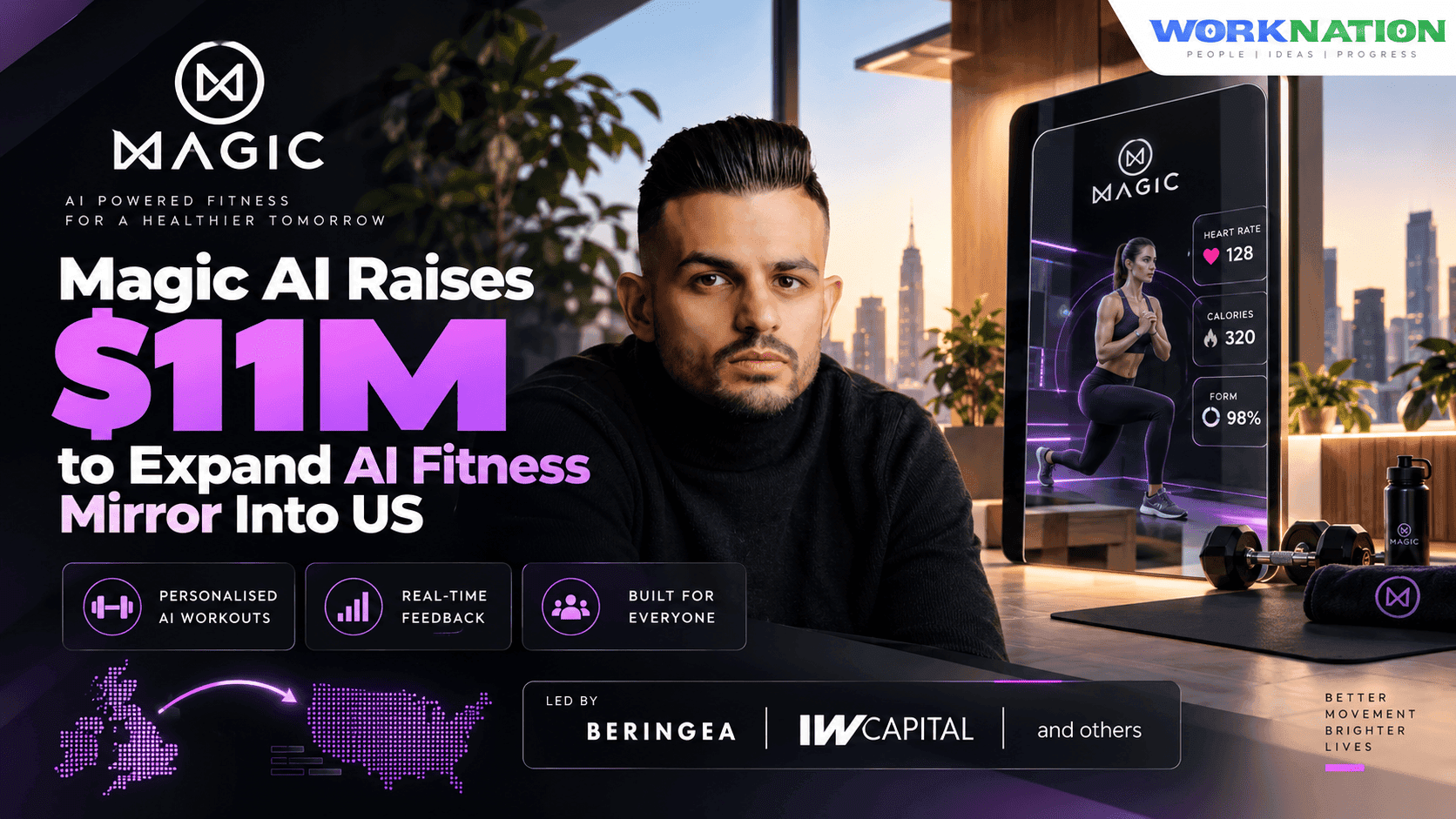
London-based fitness technology startup Magic AI has raised $11 million in new funding as it prepares to expand its AI-powered fitness mirror into the US market.
The latest round was co-led by Beringea and IW Capital. Existing investors PXN Group, Accelerate Ventures, and Ventures Together also participated, while Active Partners joined as a new investor.
The funding brings Magic AI's total capital raised since 2023 to approximately $20 million.
Founded by Varun Bhanot and built around the idea of making personalised fitness coaching more accessible, Magic AI combines computer vision, AI coaching, and connected hardware through its Magic AI Mirror.
The company is now preparing for a major expansion into the US, entering a market where several connected-fitness hardware companies have struggled to achieve sustainable growth.
From personal experience to AI-powered fitness
Magic AI's origins came from Bhanot's own experience with personal training.
After losing approximately a quarter of his body weight with the help of a personal trainer, Bhanot saw how expensive personalised coaching could be.
That experience helped shape the idea behind Magic AI: bringing some of the capabilities of a personal trainer into a more accessible home fitness system.
The company's flagship Magic AI Mirror is a wall-mounted screen designed to combine exercise guidance with computer vision.
The system can analyse a user's movements, provide feedback on exercise form, count repetitions, and project a virtual trainer into the room.
Rather than relying exclusively on pre-recorded workout videos, Magic AI's technology is designed around real-time interaction and movement analysis.
The company has also incorporated recognisable sporting personalities into its platform.
Former England cricket captain Sir Alastair Cook and former Manchester United winger Jesse Lingard are among the trainers associated with Magic AI.
Their involvement gives the company a combination of AI technology and celebrity-led fitness content as it attempts to establish itself in a competitive consumer market.
$11M funding round led by Beringea and IW Capital
The new investment was co-led by Beringea and IW Capital.
PXN Group, Accelerate Ventures, and Ventures Together, which previously invested in the company, returned for the latest round.
Active Partners is joining the investor group for the first time.
The investment brings Magic AI's total funding to roughly $20 million.
The company's previous financing history includes a $9 million seed round in 2023, a $5 million funding round in 2024, and an angel investment round in October involving Cook and Lingard.
The latest capital will primarily support the company's international expansion, with the US becoming its main new target market.
Magic AI has also hired a former managing director of Peloton International to help with its US expansion strategy.
Entering a difficult US fitness hardware market
Magic AI is entering the US at a challenging time for connected fitness hardware.
The category experienced a major boom during the pandemic as consumers purchased home exercise equipment and subscription-based digital fitness products.
However, several prominent companies have since faced difficulties.
Lululemon shut down its Mirror business, while Tonal's valuation reportedly declined from $1.9 billion to $500 million.
Tempo, another major US connected-fitness company, has raised almost $300 million but has yet to establish steady recurring revenue according to the source.
These developments create a difficult environment for Magic AI.
The company is effectively entering a market where consumers have already seen several versions of the connected fitness mirror concept.
Its challenge will therefore be to demonstrate why its product is different enough to justify adoption.
ReflectAI and the company's data advantage
Magic AI's technology strategy is centred around its computer-vision system, ReflectAI.
The company says the model has been trained using data from more than 500,000 AI-coached workouts and approximately 150,000 hours of user data.
That dataset is intended to improve the system's ability to understand exercise movements and provide coaching feedback.
Computer vision is particularly important for Magic AI because its product needs to interpret physical movement rather than simply play instructional content.
The system needs to identify repetitions and evaluate exercise form while a person is working out.
Magic AI argues that its technology is also cheaper to build and operate than some of its US competitors.
Whether that translates into a meaningful competitive advantage will depend on how effectively the company can convert its technology and data into a compelling consumer product.
Celebrity trainers as part of the strategy
Magic AI's approach also places considerable emphasis on celebrity and professional-athlete involvement.
Sir Alastair Cook and Jesse Lingard are already associated with the platform, giving the company recognisable names that can be incorporated into its fitness experience.
This differs from a pure software approach in which an AI coach operates without a strong personality or public identity.
For Magic AI, the combination of computer vision, AI coaching, hardware, and celebrity trainers is part of its attempt to make the product feel more like an interactive fitness experience.
The company will now have to determine whether that combination resonates with US consumers.
A growing AI fitness market
Magic AI is entering a wider market where artificial intelligence is increasingly being incorporated into fitness and wellness products.
AI can be used across areas including exercise tracking, personalised coaching, wearable technology, nutrition, movement analysis, and wellness recommendations.
According to market figures cited by the source, InsightAce Analytics projects the global AI fitness and wellness market could reach $34.7 billion by 2031.
That growth is attracting companies across both hardware and software.
Fitness equipment manufacturers can use AI to provide personalised feedback, while wearable companies can combine biometric information with coaching systems.
For Magic AI, the opportunity lies in connecting these trends through a dedicated physical product.
The company's mirror provides the hardware interface, while ReflectAI provides the computer-vision capabilities and AI coaching layer.
The US expansion test
The latest $11 million investment gives Magic AI the resources to test its model in the US.
The company has already established a product around AI-powered exercise coaching and has built a growing dataset through hundreds of thousands of workouts.
Its next challenge is distribution.
Entering the US means competing against established fitness brands, connected hardware companies, digital fitness platforms, and increasingly sophisticated AI-powered wellness applications.
The company's pricing, customer acquisition strategy, hardware economics, subscription model, and ability to retain users will all become important factors in determining how the business performs.
Magic AI's existing technology may provide the foundation, but the US expansion will test whether that technology can translate into a scalable consumer business.
From UK startup to global fitness platform
Magic AI's latest round marks another stage in the company's development since its launch.
The startup has now raised approximately $20 million and secured backing from investors including Beringea, IW Capital, Active Partners, PXN Group, Accelerate Ventures, and Ventures Together.
Its product combines computer vision, AI coaching, connected hardware, and celebrity trainers.
The company is now taking that model into the US, where the connected fitness category has already experienced both major investment and significant setbacks.
The outcome could provide an important test for AI-powered fitness hardware.
Magic AI believes its lower-cost technology and growing training dataset can help differentiate it from previous fitness mirror products.
The company now has to prove that consumers see enough value in that difference to make the product a lasting part of their fitness routines.
Have a Funding Round or Exciting Update to Share?
Submit your press release to get featured on WorkNation and reach founders, investors, and tech leaders.