Heidi Raises $340M to Expand AI Scribe into Full Clinical AI Partner
Top Picks
Submit PR
Stay Ahead of the Market
Get the latest startup funding, hiring trends and global opportunities delivered to your inbox every week.
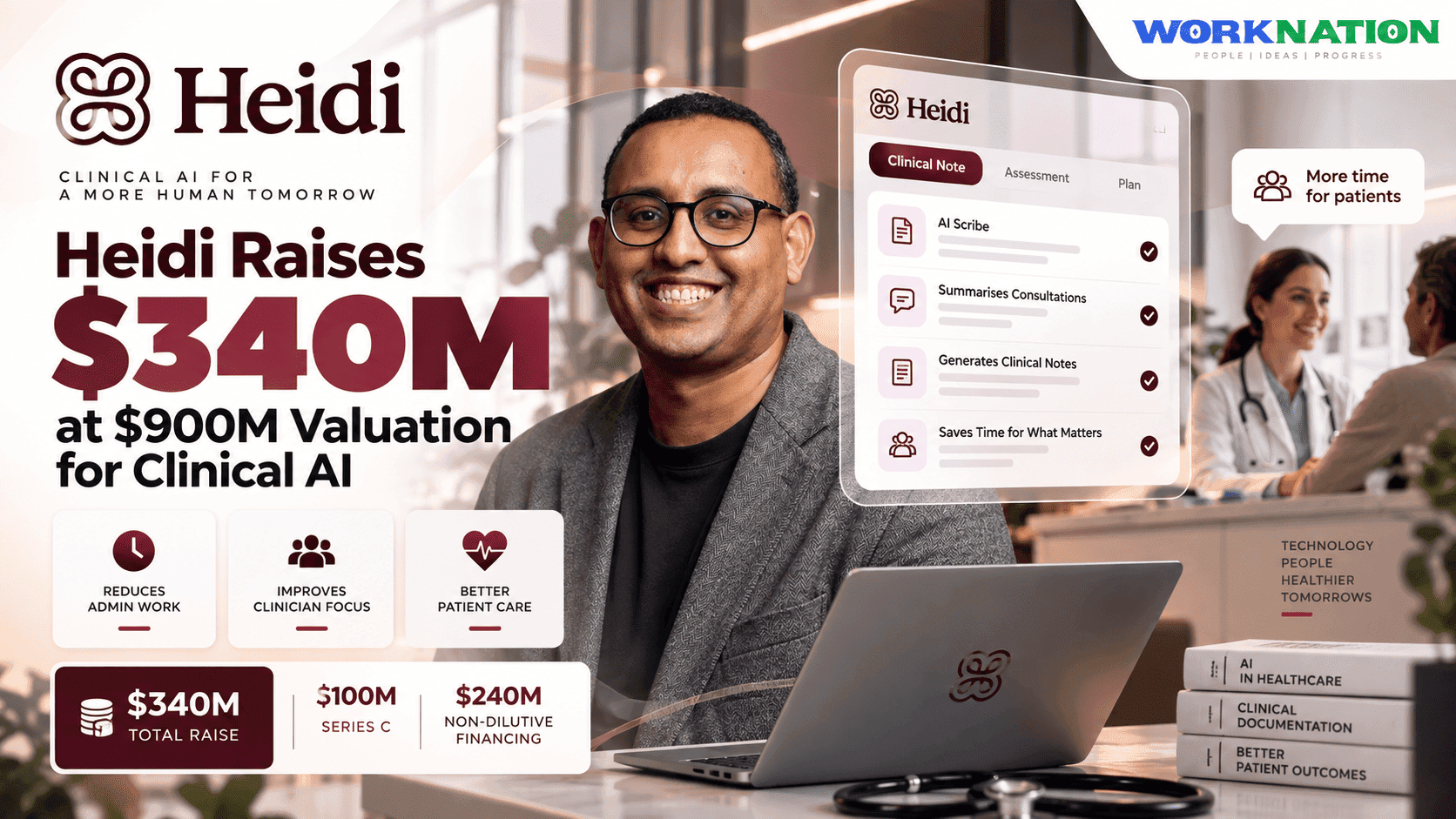
Australian healthtech company Heidi has raised $340 million as it expands its AI-powered clinical documentation platform into a broader clinical AI partner designed to support healthcare professionals across more parts of their daily workflow.
The financing consists of two separate components: a $100 million Series C equity round and $240 million in non-dilutive growth financing from General Catalyst's Customer Value Fund.
The $100 million Series C was led by Blackbird, with existing investors Phoenix Court, Point72 Private Investments, and Headline also participating. The separate $240 million growth investment from General Catalyst does not involve equity dilution.
The Series C values Heidi at $900 million, nearly twice the $465 million valuation the company carried eight months earlier.
Founded in Melbourne in 2021, Heidi was created by Dr Thomas Kelly, Waleed Mussa, and Yu Liu. Kelly serves as co-founder and chief executive officer.
The company's initial product focused on ambient clinical documentation, using AI to capture and structure conversations between clinicians and patients. Heidi is now expanding that platform into a broader suite of clinical tools.
From AI scribe to clinical AI partner
Heidi's core product is an AI scribe designed to reduce the administrative burden associated with clinical documentation.
The company says its platform now supports 2.8 million patient interactions every week across 190 countries.
Its product portfolio has also expanded beyond transcription.
Heidi Evidence provides point-of-care clinical guidance and has answered more than 10 million clinician queries since launching in March. The company has also introduced Remote, a wearable microphone, and Dictate, a voice-to-text capability.
The broader strategy is to place AI alongside clinicians throughout their working day rather than limiting it to the documentation stage of a patient consultation.
According to CEO Thomas Kelly, the company's ambition has always extended beyond writing medical notes.
That shift puts Heidi into a broader category of clinical AI platforms where AI can potentially support documentation, information retrieval, clinical workflows, and other tasks that follow a patient interaction.
The company's growth also reflects how quickly AI scribes have moved from a niche documentation technology toward becoming a larger healthcare software category.
NHS expansion becomes a major growth driver
The United Kingdom has become an important market for Heidi's expansion.
Earlier in 2026, Heidi was selected as the sole supplier for NHS England Midlands' clinical AI documentation framework.
The framework covers 15 acute and community trusts, every integrated care board in the region, and 1,239 GP practices.
Heidi describes the procurement as the largest clinical AI documentation deal in NHS history.
The company says its UK deployment has returned several million hours of clinical capacity to frontline teams. Its latest published UK impact report cited in the source put the figure at just over four million hours.
The NHS contract provides Heidi with a large-scale healthcare environment in which its AI documentation technology can be deployed across different clinical settings.
It also gives the company exposure to one of the world's largest publicly funded healthcare systems as it attempts to expand beyond documentation.
A rapidly expanding AI healthcare market
Heidi is operating in an increasingly competitive AI healthcare environment.
Other companies are also moving beyond basic transcription.
Stockholm-based Tandem Health, for example, recently raised $100 million in Series B funding to expand its AI clinical platform, combining AI scribing with coding assistance and clinical decision support.
Another company, Mindoo, raised €5 million to develop configurable AI agents for hospital intake and follow-up communications.
The broader direction across these companies is a move from simply recording clinical conversations toward supporting the tasks that happen before, during, and after patient interactions.
For Heidi, this means building a platform that can potentially become part of a clinician's broader workflow rather than operating as a standalone transcription tool.
Building its own AI models
One of Heidi's technology strategies is to develop much of the compute-intensive infrastructure behind transcription and note generation internally.
The company says it relies primarily on its own models for these workloads rather than licensing frontier AI models.
This approach allows Heidi to tune its systems around specific healthcare requirements such as accuracy, latency, and cost.
Healthcare presents particular challenges for AI systems because clinical documentation contains sensitive information and mistakes can have consequences beyond those found in ordinary business applications.
For Heidi, controlling more of the underlying technology could allow it to optimise its systems specifically for clinical use cases as its product portfolio expands.
The company is now attempting to apply that infrastructure to more healthcare workflows.
Strong revenue growth
Heidi's latest funding comes alongside significant growth in its recurring revenue.
The company's annual recurring revenue increased from approximately $1 million to $50 million over two years.
That represents a substantial expansion as healthcare organisations increasingly adopt AI tools designed to reduce administrative work.
The company also says its platform now handles 2.8 million patient interactions every week across 190 countries.
Those figures give Heidi a much larger operating base as it moves into the next phase of product development.
The company is no longer positioning itself simply as an AI documentation provider. Its stated ambition is to build a broader AI Care Partner capable of supporting clinicians throughout their workflows.
The General Catalyst financing structure
A notable aspect of the latest financing is the $240 million growth investment from General Catalyst's Customer Value Fund.
Unlike the $100 million Series C, this capital is non-dilutive.
That means Heidi can access significant growth capital without issuing an equivalent amount of new equity.
For a fast-growing software company, non-dilutive capital can provide additional funding for expansion while allowing existing shareholders and founders to retain their equity positions.
The structure also reflects the increasing range of financing models available to technology companies with significant recurring revenue and established customer demand.
Heidi's ability to secure both conventional equity funding and a large non-dilutive growth investment provides it with additional capital as it expands its product and international footprint.
What comes next for Heidi
The new capital will support Heidi's push from AI documentation toward a broader clinical AI platform.
The company already has several products covering documentation, clinical evidence, dictation, and wearable audio capture.
Its next challenge is integrating these capabilities into a coherent clinical workflow that can provide value beyond generating notes.
The NHS will remain an important part of that expansion, particularly as Heidi continues deploying its technology across healthcare organisations in the UK.
At the same time, its presence across 190 countries gives the company an international base from which to expand.
Heidi's $900 million valuation also reflects the rapid growth investors have seen in the company. The valuation has nearly doubled from $465 million eight months earlier.
With $340 million of new capital and reported ARR growth from $1 million to $50 million over two years, Heidi is entering its next phase with a significantly larger financial and commercial base.
The company's long-term opportunity now depends on whether clinicians and healthcare organisations adopt AI for a wider range of clinical and administrative workflows, moving the technology from an AI scribe into a more comprehensive clinical AI partner.
Have a Funding Round or Exciting Update to Share?
Submit your press release to get featured on WorkNation and reach founders, investors, and tech leaders.