REGENT Raises $240M to Scale Its Flying Seaglider Technology
Top Picks
Submit PR
Stay Ahead of the Market
Get the latest startup funding, hiring trends and global opportunities delivered to your inbox every week.
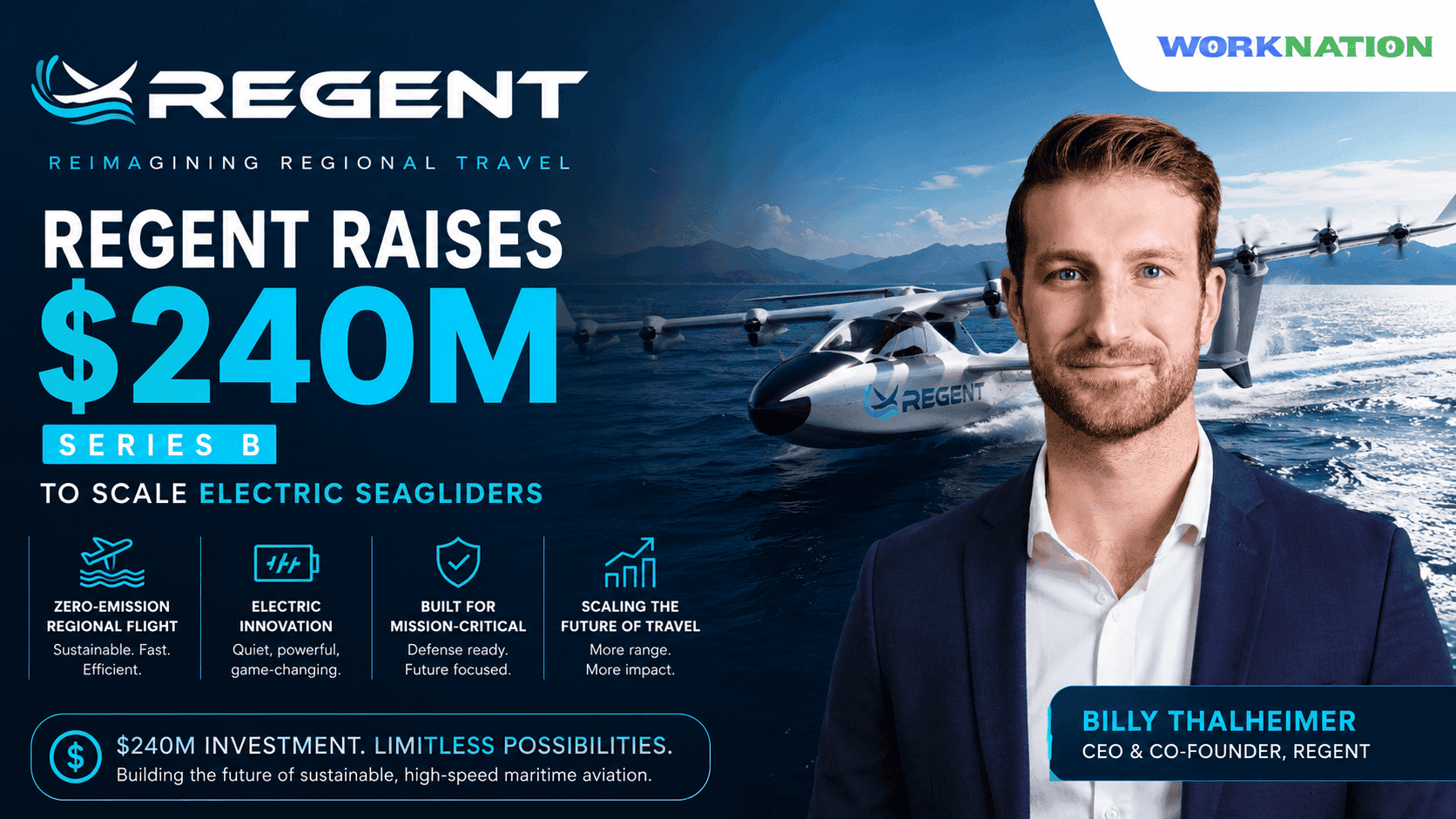
REGENT Craft has raised $240 million in a Series B funding round to scale production of its electric seaglider technology and expand its presence in both commercial transportation and maritime defense.
The round is split equally between equity and debt, with Mare Liberum and AE Ventures serving as co-lead investors. Erebor Bank, co-founded by Palmer Luckey, provided half of the debt financing. DCVC also joined the round alongside existing investors including Founders Fund, Caffeinated Capital, Lockheed Martin Ventures, Japan Airlines and Giant Step Capital.
The latest financing brings REGENT's total funding to approximately $340 million and arrives as the company prepares for the first full airborne flight of its Viceroy Seaglider and ramps up manufacturing at a new facility in Rhode Island.
Two MIT Engineers Founded REGENT After Leaving Boeing
REGENT was founded in 2020 by aerospace engineers Billy Thalheimer and Mike Klinker, who met while studying aerospace engineering at MIT.
Thalheimer previously worked at Blue Origin and Virgin Galactic before joining Aurora Flight Sciences, where he led flight physics for Boeing's electric air taxi program. Klinker worked on autonomous vehicle control software at MIT Lincoln Laboratory and Aurora Flight Sciences.
The two left the aerospace industry to build a new type of electric transportation system designed to operate primarily over water.
Their approach led to the development of the Seaglider, a vehicle that combines characteristics of a boat, hydrofoil and aircraft.
How REGENT's Seaglider Works
REGENT's Seaglider is designed to operate from coastal waterways while providing faster transportation than conventional ferries.
The vehicle operates as a boat while leaving the dock, then deploys retractable hydrofoils as it gains speed. Once it reaches the appropriate conditions, the Seaglider transitions into flight and travels just above the surface of the water.
REGENT says its Seagliders can reach speeds of up to 180 mph.
Because the vehicles operate within a few metres of the water rather than entering conventional controlled airspace, REGENT is pursuing a regulatory pathway based primarily on maritime rules.
The company believes this approach could allow Seagliders to avoid some of the lengthy certification processes associated with conventional electric aircraft.
From Commercial Transportation to Defense
REGENT originally focused on developing an alternative to short-haul flights and traditional ferry services.
The company has accumulated more than $9 billion in reported pre-orders from airlines and ferry operators across six continents, providing a commercial pipeline for its technology.
However, defense has become an increasingly important part of REGENT's growth strategy.
The company has expanded its relationship with Abu Dhabi's Strategic Development Fund and the EDGE Group around Seaglider operations and manufacturing in the United Arab Emirates.
REGENT has also established REGENT Defense to develop maritime systems for military applications.
Building Autonomous Maritime Defense Systems
REGENT has expanded its Viceroy platform for defense applications and developed an autonomous military variant called Squire.
The company has extended its contract with the U.S. Marine Corps for the Viceroy platform, with the contract now valued at $15 million.
Squire is designed as an autonomous maritime vehicle, broadening REGENT's potential applications beyond passenger transportation.
The company's defense expansion comes as governments increasingly invest in autonomous systems and new maritime technologies designed to improve speed, reach and operational flexibility.
REGENT is also expanding its international relationships. New agreements with Poland's Balnord and Greece's iGrow are aimed at supporting operations in the Baltic Sea and Aegean regions.
A New Manufacturing Facility in Rhode Island
The new funding will help REGENT scale production at its recently completed 255,000-square-foot manufacturing facility in Rhode Island.
The company relocated to North Kingstown from the Boston area, in part to benefit from Rhode Island's coastal testing infrastructure and expertise in maritime composites.
The facility represents an important step in REGENT's transition from aircraft development toward commercial-scale manufacturing.
The company plans to use the new capital to increase production capacity and support certification milestones ahead of the Viceroy's first full airborne flight.
Growing Commercial and Defense Pipeline
REGENT's business now spans both commercial transportation and defense applications.
On the commercial side, the company is targeting airlines and ferry operators looking for faster coastal transportation options.
On the defense side, it is developing platforms that can support maritime missions while potentially offering greater speed and range than conventional vessels.
This dual-market strategy gives REGENT access to a broader customer base while allowing the company to apply its underlying seaglider technology across different use cases.
Competition in Electric Maritime Transportation
REGENT operates in an emerging market that includes electric hydrofoil and surface-effect transportation companies.
Swedish companies such as Candela and X Shore are developing smaller electric hydrofoil vessels, while other companies are exploring wing-in-ground-effect transportation concepts.
REGENT differentiates itself through the scale of its vehicles and its focus on defense applications alongside commercial transportation.
The company is also competing for attention in a rapidly expanding defense technology market, where venture investment has increased substantially in recent years.
What Comes Next for REGENT
The immediate milestone for REGENT is the first fully airborne flight of its Viceroy Seaglider.
The company is preparing for the flight while continuing certification work and increasing manufacturing capacity at its Rhode Island facility.
The $240 million Series B gives REGENT substantial capital to move from development toward production and commercial deployment.
With approximately $340 million in total funding, a large manufacturing facility, billions of dollars in reported pre-orders and an expanding defense business, REGENT is entering a critical stage where successful testing and certification will determine how quickly its seaglider technology can move into real-world operations.
Have a Funding Round or Exciting Update to Share?
Submit your press release to get featured on WorkNation and reach founders, investors, and tech leaders.