Project Omega Raises $80M Series A to Recycle America’s Used Nuclear Fuel
Top Picks
Submit PR
Stay Ahead of the Market
Get the latest startup funding, hiring trends and global opportunities delivered to your inbox every week.
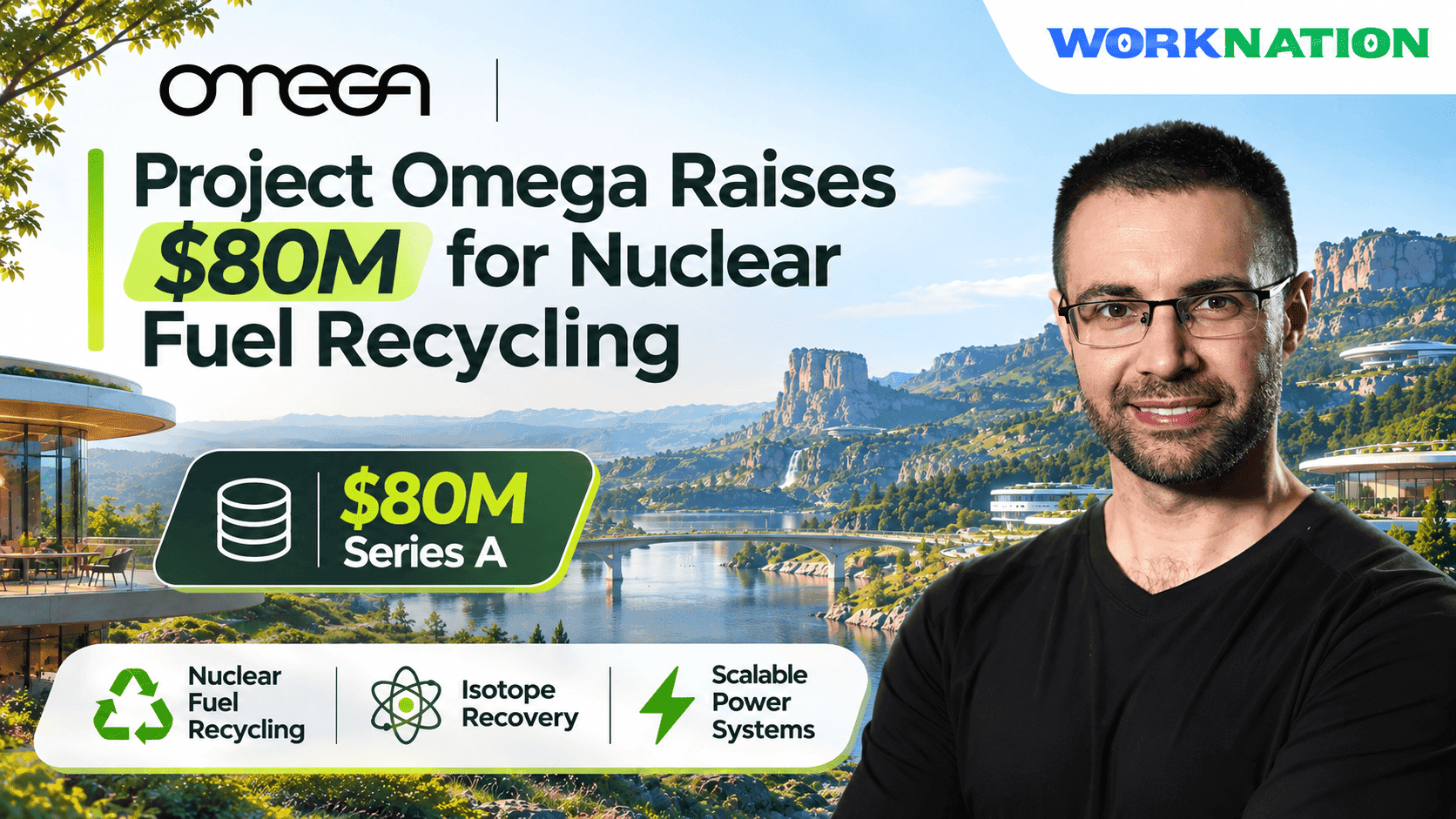
Project Omega has raised $80 million in Series A funding to advance its nuclear fuel recycling technology and develop power systems designed for military, remote and other hard-to-reach applications. The round was led by B Capital, with participation from new and existing investors.
The Newport, Rhode Island-based company plans to use the capital to develop the first stage of a nuclear fuel recycling facility and scale its X Series power systems. Its approach targets a major challenge in the US nuclear industry: finding ways to extract additional value from used nuclear fuel rather than leaving it in long-term storage.
The round included noa VC, 645 Ventures and existing investors Starship Ventures, Mantis Ventures, Decisive Point, Virta Ventures, Pace Ventures, Essential Capital and Washington Harbour Partners. B Capital general partner Jeff Johnson will join the company's board.
Project Omega previously disclosed a $12 million seed round in February 2026, led by Starship Ventures. The latest investment brings its disclosed funding to $92 million.
What does Project Omega do?
Project Omega is developing technology to recycle used nuclear fuel and recover materials that could serve as inputs for energy systems and other strategic applications.
The company is pursuing a non-aqueous recycling process based on pyroprocessing, a high-temperature method that does not rely on water. According to Project Omega, its process can reduce nuclear waste volume by up to 90% while recovering useful isotopes, including strontium-90.
The company also says its process does not separate pure plutonium. That distinction is relevant because nuclear fuel recycling technologies face scrutiny around safety, security and the potential proliferation of nuclear materials.
The wider opportunity is significant. The United States has accumulated tens of thousands of metric tonnes of used nuclear fuel, much of which remains in storage. Project Omega wants to develop a way to recover useful materials from this stockpile and create products for energy and industrial applications.
However, reducing waste volume is not the same as eliminating radioactive waste. The recovered materials, remaining waste streams and eventual disposal requirements will still need to be managed under applicable safety and regulatory standards.
How its X Series power systems work
Project Omega is developing radiovoltaic systems that convert energy from radioactive decay directly into electricity. These systems are intended for applications where conventional batteries are difficult to recharge or replace.
Potential use cases include:
Remote monitoring sensors
Autonomous systems
Spacecraft
Undersea platforms
Military equipment operating in isolated environments
The company's X Series currently combines batteries, generators and intelligent controls. It is designed to work with energy sources such as solar and wind, while isotope-based power is planned for future integration.
This staged approach matters. The company is developing power systems that can support existing energy sources while working toward the integration of radioisotope power. The article does not establish that its isotope-powered X Series products are already commercially available.
From carbon technology to nuclear fuel innovation
Project Omega was founded by Staff Sheehan, a chemical physicist who previously co-founded Air Company, a business developing synthetic fuels from atmospheric carbon dioxide, and Catalytic Innovations, a spin-out from his research at Yale.
Sheehan is applying his background in materials science and energy technology to the nuclear fuel cycle.
Since emerging from stealth approximately eight months before the funding announcement, Project Omega has reported several research and development milestones. These include work with Idaho National Laboratory through the Department of Energy's ARPA-E CURIE programme, producing stable electrical current from strontium-90 at Pacific Northwest National Laboratory, and developing radioisotope power systems under DARPA's Rads to Watts programme.
These collaborations provide evidence of technical development and engagement with US research programmes. They should not, however, be interpreted as proof that the company has completed commercial-scale fuel recycling or secured regulatory approval for a commercial facility.
Why nuclear fuel recycling is attracting investment
Project Omega is entering a nuclear technology market that has attracted substantial investment, particularly as governments and businesses look for reliable sources of electricity and stronger domestic energy supply chains.
Several companies are approaching the opportunity from different directions. Antares is developing nuclear power systems for military applications, while X-energy is scaling advanced reactor and fuel production. Last Energy is pursuing small modular reactors for applications that include data centres.
Project Omega's focus is different. Rather than primarily developing a new reactor, it is targeting the fuel cycle: recovering materials from used nuclear fuel and developing systems that could turn certain radioactive materials into long-duration power sources.
That distinction could give the company several potential product markets:
Recovered nuclear materials: Isotopes and other materials could become inputs for specialised industrial and energy applications.
Long-duration power: Radioisotope systems could serve equipment that needs electricity for extended periods without routine maintenance or recharging.
Military and remote applications: Compact power systems could be useful in environments where conventional energy infrastructure is unavailable or unreliable.
Nuclear fuel supply chains: Recovered materials may have value as feedstock, depending on their properties, processing requirements and regulatory approval.
These are potential commercial pathways, not established revenue streams. Project Omega will need to demonstrate that its recovered materials can be produced consistently, meet customer requirements and compete economically with existing alternatives.
Five important challenges Project Omega must overcome
The $80 million investment gives Project Omega capital to advance its technology, but several hurdles will determine whether it can become a commercially viable nuclear fuel recycling business.
1. Scaling beyond laboratory demonstrations
Producing electricity from strontium-90 in a research environment is different from manufacturing reliable power systems at scale. The company must demonstrate repeatable performance, durability and practical operating economics.
2. Building and licensing a recycling facility
Nuclear facilities face demanding requirements covering site selection, construction, radiation protection, environmental impact, security and licensing. Funding the first stage of a facility does not mean that construction or commercial operations are already approved.
3. Establishing a market for recovered isotopes
Recovering useful materials is only one part of the business model. Project Omega must identify customers, demonstrate product quality and establish reliable demand at prices that justify the cost of processing.
4. Managing the remaining radioactive waste
The company's stated potential to reduce waste volume by up to 90% is significant, but it does not mean that all radioactive waste disappears. The remaining materials will still require appropriate treatment, storage or disposal.
5. Competing with conventional power technologies
Radioisotope power systems could be valuable where long operating life and limited maintenance matter more than low upfront cost. For applications with easy access to batteries, solar power or generators, the economics may be less compelling.
What the $80M funding means for Project Omega
The Series A round gives Project Omega resources to advance two connected parts of its strategy: developing its X Series power systems and beginning the first stage of its nuclear fuel recycling facility.
The company's long-term opportunity depends on whether it can connect those activities into a workable commercial model. It needs to prove that used nuclear fuel can be processed safely and economically, that recovered materials have dependable buyers, and that its power systems can deliver advantages in applications where conventional alternatives are difficult to use.
For investors, the proposition is broader than another nuclear power startup. Project Omega is attempting to build a business around the materials contained in America's used nuclear fuel stockpile.
Project Omega's nuclear fuel recycling strategy now has $80 million behind it. The next test is whether the company can turn its technical progress into a licensed facility, reliable products and a sustainable commercial market.
Have a Funding Round or Exciting Update to Share?
Submit your press release to get featured on WorkNation and reach founders, investors, and tech leaders.