Motion Raises $2M to Bring Robots-as-a-Service to European Factories
Top Picks
Submit PR
Stay Ahead of the Market
Get the latest startup funding, hiring trends and global opportunities delivered to your inbox every week.
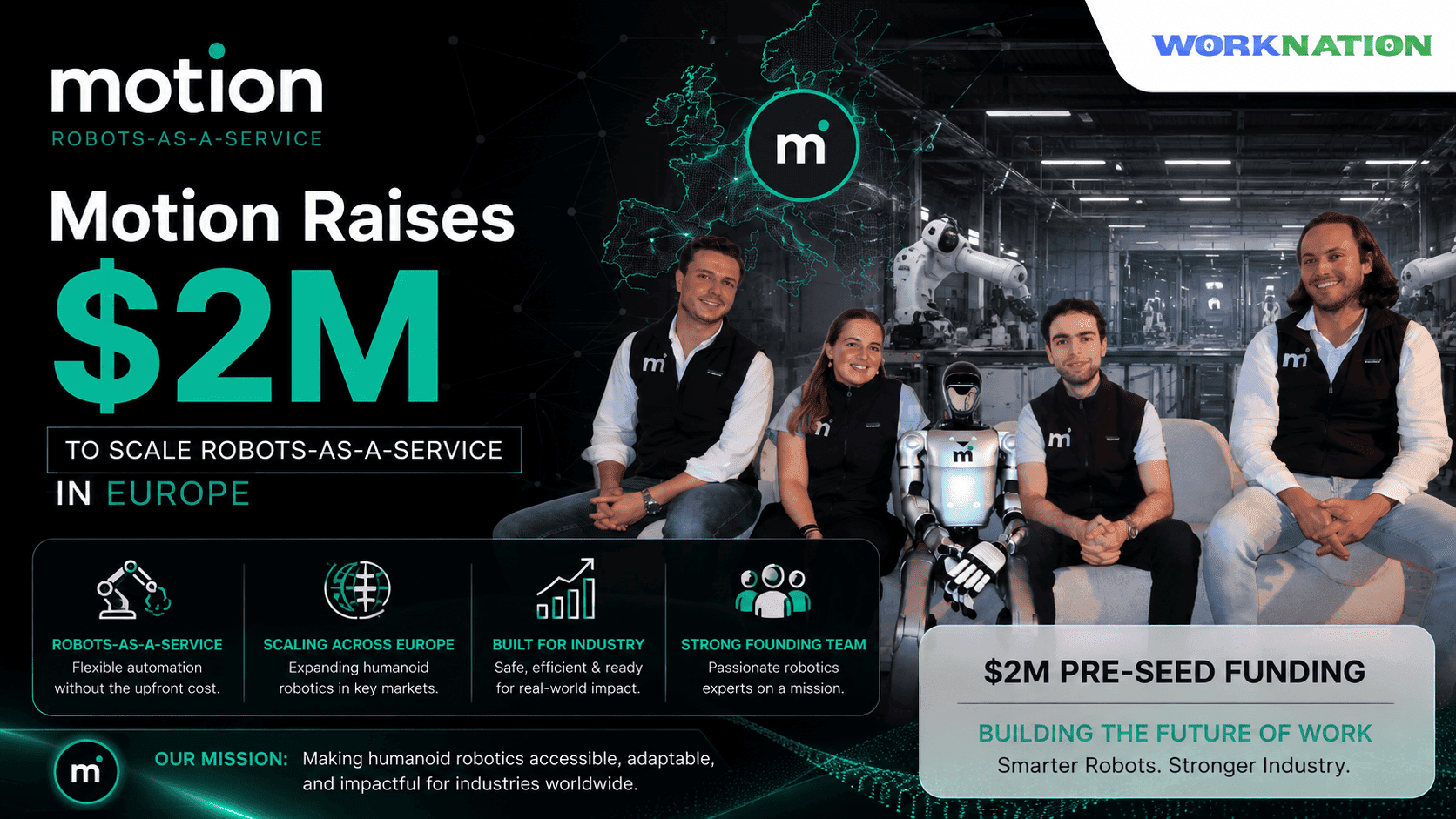
Brussels-based robotics startup Motion has raised $2 million in pre-seed funding to expand its robots-as-a-service model across European factories.
The round was led by Extantia Capital, with participation from Norrsken Evolve. Motion plans to use the funding to scale its robot fleet and turn its existing factory pilot programs into full-scale deployments, initially focusing on the Benelux region.
Bringing Humanoid Robots to European Factories
Motion is building what it describes as a Humanoids-as-a-Service platform, allowing factories to use humanoid robots without having to purchase and manage the machines themselves.
The company currently operates five paid pilot programs with industrial, warehouse and logistics customers in Belgium.
Its humanoid robots are being used for tasks such as loading goods into crates, packing containers and placing parts onto conveyor belts while working alongside human employees.
Motion's approach is designed to remove some of the financial and operational barriers that can prevent factories from adopting robotics.
A Monthly Fee Instead of a Large Upfront Investment
Rather than requiring customers to purchase robots, Motion offers its technology through a monthly payment model.
The service covers several parts of the deployment process, including data collection, selecting the appropriate robot, training, IT setup, fleet management, financing, insurance, compliance and maintenance.
This allows manufacturers to treat robotics more like an operating expense than a major upfront capital investment.
Motion also takes a brand-neutral approach. Instead of manufacturing its own humanoid robots, the company selects the robot it believes is best suited for a particular task.
The startup then manages the technology and deployment through its software platform.
Addressing Europe's Manufacturing Labor Shortage
Motion is entering the market as European manufacturers face persistent labor shortages.
A 2026 ManpowerGroup survey of 39,000 employers found that 72% of manufacturers were experiencing difficulties filling positions, particularly roles involving machine and plant operators.
For Motion, the shortage creates an opportunity to use humanoid robotics to supplement human workers and increase production capacity.
The company argues that labor shortages could become an even bigger challenge as Europe attempts to expand domestic manufacturing and increase production of technologies such as batteries, heat pumps and grid equipment.
The Growing Humanoid Robotics Market
Investment in humanoid robotics has accelerated rapidly.
Global humanoid robotics startups raised approximately $8.6 billion in 2026, almost twice the amount raised in 2025, according to Dealroom.
Goldman Sachs has also projected that the global humanoid robotics market could reach $38 billion by 2035.
Much of the investment and development in the sector has been concentrated in the United States and China, while European companies are still developing their position in the market.
Motion is targeting this gap by focusing on deployment and financing rather than building humanoid hardware itself.
A Founder With Previous Startup Experience
Motion was founded by Alexander Stevens, who previously founded Greenomy, a Brussels-based software company focused on ESG and CSRD compliance.
Greenomy was acquired by Position Green in September 2025.
With Motion, Stevens is applying a similar software-driven approach to a different problem: helping European manufacturers address labor shortages through robotics.
The company's goal is to make adopting a robot as simple for a factory as hiring an additional worker.
Competing Without Manufacturing Its Own Robots
Motion competes in a market that includes companies such as Agility Robotics, Figure AI, Apptronik and Germany's NEURA Robotics.
Unlike many of these companies, Motion does not manufacture its own humanoid hardware.
Agility Robotics, for example, develops its Digit humanoid robot and offers it to businesses for industrial and logistics applications. NEURA Robotics develops and manufactures its own humanoid robots in Germany.
Motion instead positions itself as a Europe-based, hardware-neutral robotics operator.
Its platform combines robot selection, financing, insurance, compliance, deployment and maintenance into a single service.
Scaling Across the Benelux Region
The new funding will help Motion move its five existing paid pilots toward larger-scale deployments and expand its fleet.
The company aims to have hundreds of robots operating across the Benelux region within the next year.
Motion is initially concentrating on Belgium and nearby European markets before expanding further across the continent.
The Challenge Ahead
Motion's model could make robotics more accessible to manufacturers that cannot justify the cost and complexity of purchasing their own machines.
However, the company faces competition from heavily funded robotics companies that control their own hardware and technology.
Motion's strategy is therefore centered on becoming the infrastructure layer between factories and humanoid robot manufacturers.
If the company can successfully reduce the financial, operational and compliance barriers to adopting humanoid robots, its robots-as-a-service model could provide a new path for European manufacturers dealing with persistent labor shortages.
Have a Funding Round or Exciting Update to Share?
Submit your press release to get featured on WorkNation and reach founders, investors, and tech leaders.