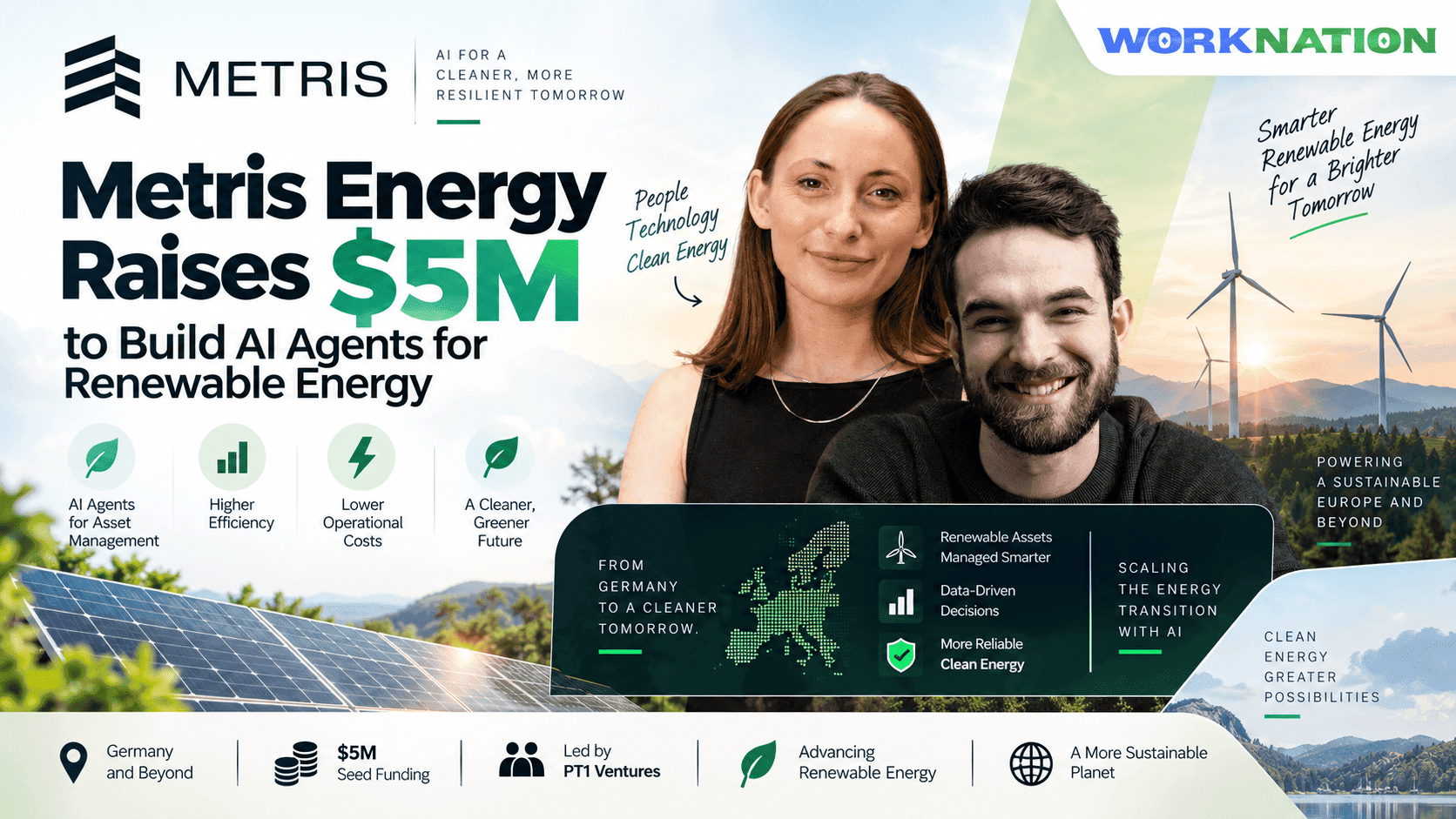
Metris Energy Raises $5M to Bring AI Agents to Renewable Energy
Top Picks
Submit PR
Stay Ahead of the Market
Get the latest startup funding, hiring trends and global opportunities delivered to your inbox every week.
Metris Energy, a London-based energy technology company building AI-powered infrastructure for renewable energy assets, has raised $5 million in a seed funding round as it works to automate the management of distributed energy infrastructure.
The round was led by Berlin-based PT1 Ventures, with participation from existing investors Octopus Ventures and AENU, alongside new investors Blackfinch Ventures, Plug and Play and Love Ventures. The latest financing brings Metris Energy's total funding to $7.5 million.
The company was founded by Natasha Jones and William Whatley in 2023 with a focus on helping commercial landlords install and manage solar energy systems. Since then, Metris has expanded its ambitions from solar installation and asset management toward an AI-powered operating layer for renewable energy infrastructure.
Metris says its platform now manages more than 10,000 solar plants representing approximately 500 megawatts of capacity. The company also reports that its revenue has grown eightfold year-over-year.
From energy investing to building Metris
Metris co-founder and CEO Natasha Jones previously spent three years working at Octopus Ventures, where she evaluated energy technology startups and investment opportunities.
Her experience as an investor eventually led her toward building a company herself.
Jones says she entered the energy sector after becoming interested in distributed renewable energy and the role it could play in bringing electricity to communities without extensive grid infrastructure.
Before moving into venture capital, Jones had also founded a sustainable goods company while at university and worked in algorithmic trading.
Her experience in financial markets influenced her view of how technology could be applied to energy infrastructure. She became increasingly interested in the gap between the growing complexity of renewable assets and the relatively manual systems used to manage them.
According to Jones, many energy asset operators still rely heavily on spreadsheets and fragmented software systems to manage their portfolios.
That creates a problem as renewable energy infrastructure becomes more distributed and increasingly complex.
A unified platform for renewable assets
Metris is building a software platform designed to bring technical and financial information about renewable assets into one system.
The platform connects data from sources including inverters, meters, SCADA systems, CRM platforms and billing systems.
Instead of treating these systems separately, Metris creates a unified record for each asset.
That allows operators to see not only whether a renewable energy asset is experiencing a technical problem, but also the potential financial impact of that problem.
For example, identifying that a solar installation is underperforming is only part of the challenge. Operators also need to understand how much revenue is being lost, what caused the underperformance and what action should be taken.
Metris is attempting to connect those pieces of information so that asset managers can make decisions using both technical and financial data.
This becomes increasingly important as energy systems incorporate more distributed assets, including batteries, heat pumps, community energy projects and corporate power-purchase agreements.
Metria brings AI agents into energy asset management
At the centre of Metris' strategy is Metria, its AI agent for renewable energy asset management.
Rather than functioning only as a monitoring or analytics tool, Metria is designed to take action based on the information it receives.
The system can identify faults, detect underperformance and assist with scheduling.
Metris' longer-term objective is to move Metria from an AI system that recommends actions toward an agent that operators are comfortable allowing to execute those actions.
That transition could represent a significant change in how renewable energy assets are managed.
Traditional asset management software generally presents information to a human operator, who then determines what needs to happen. An agentic system could potentially identify an issue, determine the appropriate response and execute an operational workflow with limited human intervention.
Metris expects the next stage of its development to focus heavily on this transition.
Managing thousands of solar plants
Metris says its platform currently manages more than 10,000 solar plants and approximately 500 megawatts of renewable energy capacity.
The company also reports eightfold year-over-year revenue growth.
There is a discrepancy in the source material regarding the number of projects. Metris' stated figure is more than 10,000 solar plants, while the company's website is cited as listing more than 8,500 projects. The figures may reflect different definitions or reporting periods, but the source does not provide enough information to reconcile the difference.
The company currently has a team of approximately 15 people.
Its growing portfolio gives Metris an increasingly large operational dataset from which to develop its AI capabilities.
The company is effectively attempting to build a software layer that can understand both the physical performance and commercial economics of renewable energy assets.
A growing renewable asset management market
Metris is entering a renewable energy software market that is expanding alongside the deployment of solar, batteries and other distributed energy technologies.
According to P&S Intelligence, the renewable energy asset management software market was valued at $9.8 billion in 2025 and is projected to reach $23.1 billion by 2032, representing an annual growth rate of 13.3%.
The increasing number of distributed energy assets creates additional operational complexity for asset owners.
A large portfolio may contain thousands of individual solar installations, each producing different amounts of electricity and generating data through multiple technical systems.
Managing these assets manually can become increasingly difficult as portfolios expand.
Metris' proposition is that combining data infrastructure with AI agents could allow operators to manage much larger portfolios without increasing their operational workload at the same rate.
Competition in solar asset management
Metris is not alone in developing software for renewable energy asset management.
Raptor Maps, based in Somerville, Massachusetts, has raised more than $60 million to develop digital twin technology for solar assets, primarily serving customers in the United States.
IBM has also expanded into renewable asset monitoring through its acquisition of Bangalore-based Prescinto, bringing renewable energy monitoring capabilities into its Maximo platform.
The activity from both startups and large technology companies illustrates the growing importance of software infrastructure in renewable energy.
Metris is attempting to differentiate itself through the combination of technical asset data, financial information and autonomous AI agents.
Rather than simply providing another monitoring dashboard, the company wants its platform to become an operational system capable of taking action.
PT1 Ventures leads the new funding
Berlin-based PT1 Ventures led Metris Energy's $5 million seed round.
Existing investors Octopus Ventures and AENU returned for the financing, while Blackfinch Ventures, Plug and Play and Love Ventures joined as new investors.
The participation of Octopus Ventures is particularly notable given Jones' previous role at the firm.
Jones spent three years evaluating energy technology companies as an investor before leaving to build Metris.
PT1 Ventures partner Fabian Koenig said Metris is building data infrastructure designed to make energy assets visible in real time and enable AI to operate across renewable energy portfolios.
Expansion into Germany
Metris plans to use the new funding to expand its operations in Germany.
Jones describes Germany as the largest solar market in Europe and highlights its high proportion of distributed power infrastructure.
Entering Germany would give Metris access to another large renewable energy market while allowing the company to test its technology across a different regulatory and energy environment.
The expansion also fits into the company's broader ambition of becoming infrastructure for distributed renewable energy rather than remaining focused exclusively on the UK commercial property market.
Moving from monitoring to autonomous operations
The central question for Metris is whether renewable energy operators will trust AI agents to take actions on revenue-generating infrastructure.
Monitoring and reporting are relatively established uses of software in energy management. Allowing an AI system to make operational decisions and execute actions introduces a different level of responsibility.
An error in a report may require a correction. An incorrect automated action on an energy asset could potentially result in lost revenue or operational problems.
Metris therefore needs to demonstrate that its AI systems can operate reliably while giving asset owners sufficient visibility and control.
The company's strategy is to gradually move from recommending actions to carrying them out.
What comes next for Metris Energy
The $5 million seed round gives Metris Energy additional capital to develop Metria, expand into Germany and grow its team.
The company is entering this next phase with more than 10,000 solar plants under management, approximately 500 megawatts of capacity and reported eightfold year-over-year revenue growth.
Its broader ambition is to create a unified software and AI layer for increasingly distributed energy infrastructure.
As solar, batteries, heat pumps and other flexible energy assets become more widespread, the amount of technical and financial data generated by each asset will continue to increase.
Metris is betting that the next generation of renewable energy software will not simply tell operators what is happening. It will increasingly help them decide what to do and, eventually, execute those decisions automatically.
Have a Funding Round or Exciting Update to Share?
Submit your press release to get featured on WorkNation and reach founders, investors, and tech leaders.