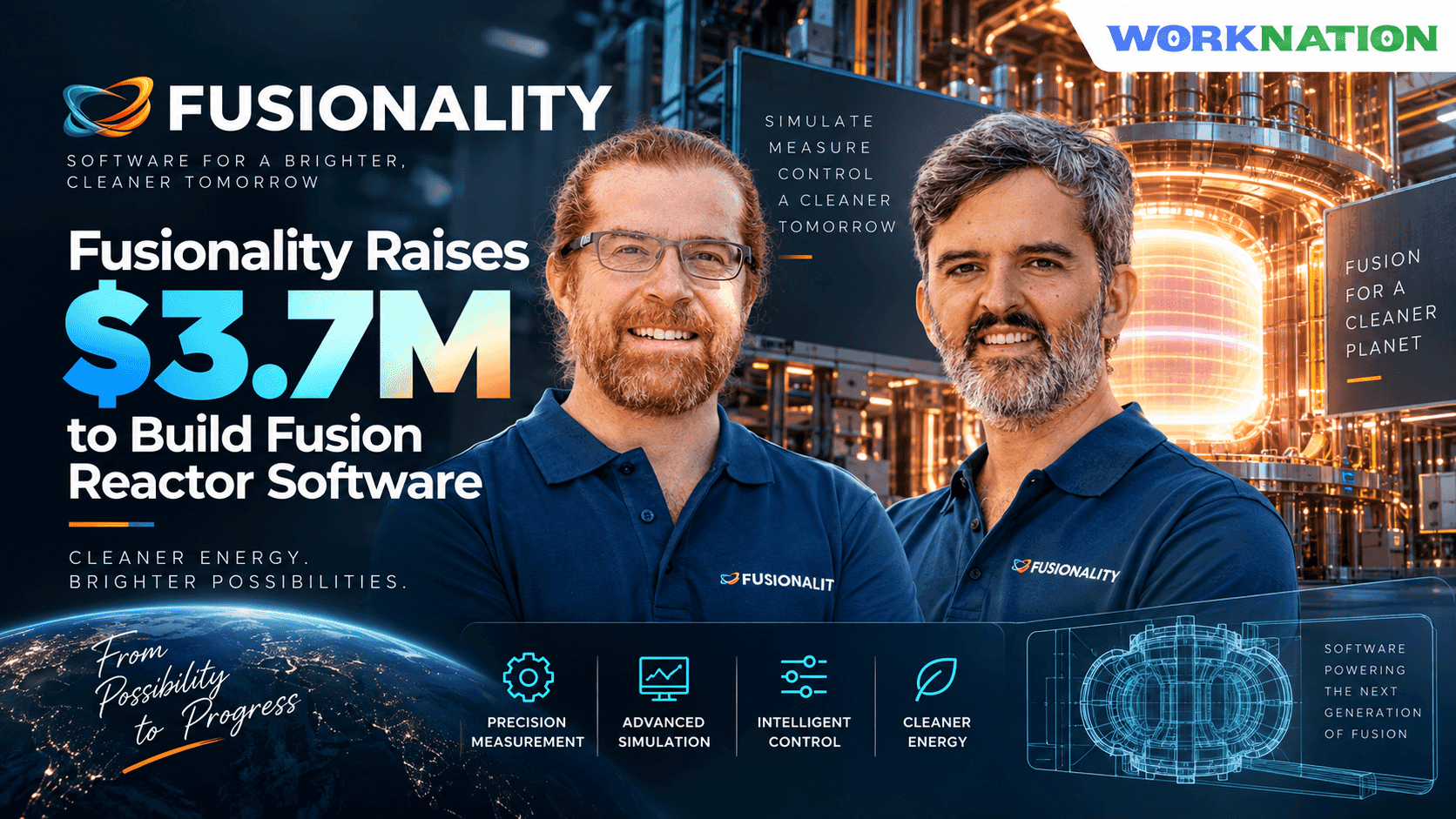
Fusionality Raises $3.7M to Build the Software Backbone for Fusion Reactors
Top Picks
Submit PR
Stay Ahead of the Market
Get the latest startup funding, hiring trends and global opportunities delivered to your inbox every week.
Lausanne-based fusion technology startup Fusionality has raised CHF 3 million, approximately $3.7 million, in pre-seed funding to develop software infrastructure for controlling and operating fusion reactors.
The round was led by Swiss venture capital firm Founderful and UK-based Playfair. The company plans to use the funding to build its team in Lausanne and secure its first paying customers.
Fusionality was founded by Federico Felici and Jonas Buchli, two engineers and researchers with backgrounds spanning fusion physics, robotics, reinforcement learning and artificial intelligence. Both previously worked at Google DeepMind after conducting research at EPFL's Swiss Plasma Center.
Building the software layer for fusion
Fusion reactors rely on extremely complex plasma systems. The plasma inside a fusion device can reach temperatures of around 100 million degrees Celsius, meaning operators must continuously control heating, fuelling and magnetic systems while preventing the plasma from damaging the reactor walls.
Fusionality is developing measurement, simulation and control systems designed to turn raw plasma measurements into control signals within milliseconds.
The company says more than 30 private fusion companies and government projects face similar software and control challenges as the industry moves toward commercial fusion.
Rather than every reactor developer building its own control infrastructure from scratch, Fusionality aims to provide a reusable software layer that can be adapted across different fusion devices.
Its platform combines measurement, software, control and data engineering, with a basic software layer intended to minimise customer integration and onboarding costs.
From DeepMind research to fusion startup
The company's origins trace back to research conducted at EPFL's Swiss Plasma Center.
Federico Felici, who holds a PhD in plasma physics and has worked on control systems for the TCV tokamak, later spent two and a half years at Google DeepMind.
Jonas Buchli, an electrical engineer from ETH Zürich, previously led robotics and reinforcement learning teams at DeepMind.
Together with colleagues, the researchers applied deep reinforcement learning to control the magnets shaping plasma inside the TCV tokamak. Their work was published in Nature in 2022.
That research forms part of the technical foundation behind Fusionality's commercial platform.
Fusion's infrastructure gap
The funding arrives as investment in commercial fusion reaches record levels.
According to the Fusion Industry Association, fusion companies attracted $4.48 billion during the 12 months ending July 2026, taking cumulative investment since 2021 above $14 billion across 56 companies.
However, the industry's rapid funding growth has not necessarily translated into shared infrastructure. Many reactor developers continue to develop their own control and operational systems.
That creates an opportunity for companies like Fusionality to become part of the underlying technology stack supporting the emerging fusion ecosystem.
The company will also compete with existing fusion software providers, while Google's DeepMind has itself entered the space through work with Commonwealth Fusion Systems and its open-source TORAX plasma simulator.
Building the fusion software backbone
Fusionality plans to use the new funding to hire control engineers, computational physicists, plasma measurement specialists and software engineers in Lausanne.
The company is also focused on securing its first paying customers and proving that its technology can operate across different fusion platforms.
The larger question is whether fusion developers will increasingly adopt shared software infrastructure or continue building proprietary systems internally.
If Fusionality succeeds, its technology could become a common software layer for an industry racing to turn fusion research into commercially viable energy.
Have a Funding Round or Exciting Update to Share?
Submit your press release to get featured on WorkNation and reach founders, investors, and tech leaders.