Ema Raises $77M Series B to Scale AI Employees for Enterprises
Top Picks
Submit PR
Stay Ahead of the Market
Get the latest startup funding, hiring trends and global opportunities delivered to your inbox every week.
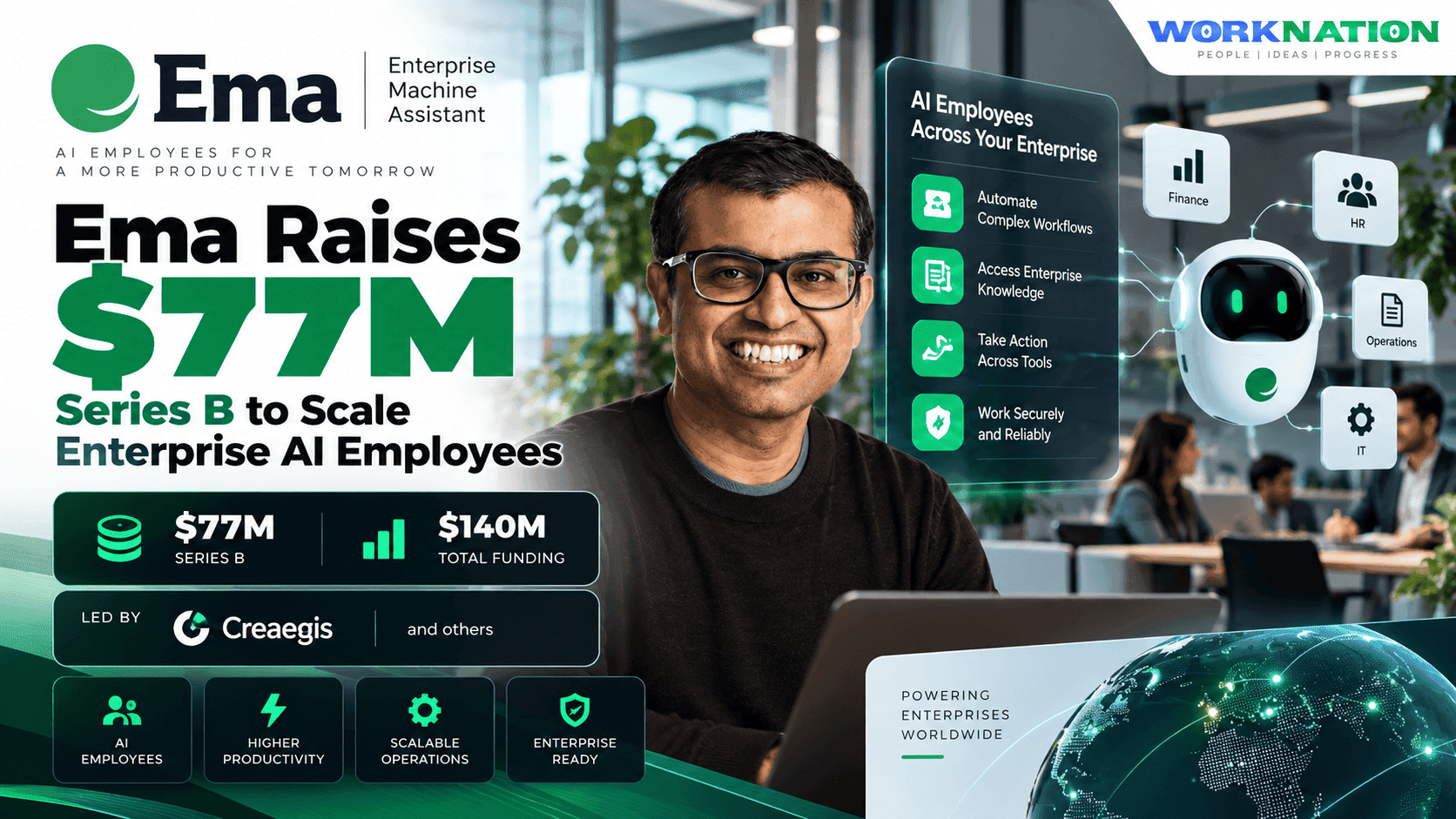
Enterprise AI startup Ema has raised $77 million in Series B funding as it looks to expand its AI employee platform across large organisations and additional business functions.
The round was led by Creaegis, with existing investors Accel, S32, Prosus Ventures, Hitachi Ventures, and Wipro Ventures also participating.
Founded in 2023 by former Google and Coinbase executive Surojit Chatterjee, Ema develops AI employees designed to perform business workflows across functions including human resources, information technology, and finance.
The company says its AI employees are already deployed across some of the world's largest organisations and handle millions of workflows every day.
With the latest financing, Ema has raised $140 million in total funding.
Building AI employees for enterprise workflows
Ema's central proposition is to move enterprise AI beyond tools that simply help employees complete tasks.
Instead, the company is developing AI employees that can perform workflows themselves.
The platform is designed for enterprise functions such as HR, IT, and finance, where employees often spend significant amounts of time moving information between multiple software systems, processing requests, and completing repetitive operational workflows.
Ema's approach is based on using AI agents to carry out those processes.
The company says its AI employees are already being used by some of the world's largest organisations and collectively handle millions of workflows every day.
This puts Ema within the rapidly developing enterprise AI agent market, where companies are experimenting with AI systems capable of operating across software applications rather than simply generating text or answering questions.
$77M Series B led by Creaegis
The latest Series B was led by Creaegis.
Existing investors Accel, S32, Prosus Ventures, Hitachi Ventures, and Wipro Ventures also participated.
The new financing follows Ema's previous $25 million funding round in March 2024.
That earlier round was led by Accel, S32, and Prosus Ventures, with Wipro Ventures, Venture Highway, AME Cloud Ventures, Frontier Ventures, Maum Group, and Firebolt Ventures also participating.
Following the Series B, Ema's total funding has reached $140 million.
The latest capital will be directed toward expanding the company's go-to-market operations, increasing adoption among large enterprises, and scaling its AI employee platform into additional business functions.
The funding gives Ema additional resources to move from individual enterprise deployments toward broader adoption across large organisations.
From enterprise software to AI agents
The enterprise software market has traditionally relied on applications that provide employees with tools to perform business processes.
Ema's thesis is that AI agents can increasingly take responsibility for the processes themselves.
For example, instead of an employee manually working through multiple applications to complete a workflow, an AI employee could potentially coordinate the required steps across those systems.
This is particularly relevant for functions such as HR, IT, and finance, where workflows often involve structured processes and multiple software platforms.
Ema says its platform is designed around this shift.
Surojit Chatterjee has described the company's strategy around the belief that AI agents will change how enterprises use software by performing tasks rather than simply enabling employees to perform them.
That represents a broader change in the way enterprise software could operate.
Instead of humans interacting with software for every step, software increasingly becomes an environment in which AI agents can execute defined business processes.
Enterprise adoption becomes the next challenge
The new funding arrives as large organisations increasingly explore AI agents and workflow automation.
However, enterprise adoption requires more than demonstrating that an AI model can perform an individual task.
Companies need systems that can operate within existing software environments and business processes.
They also need reliable execution across potentially complex workflows.
For Ema, the next stage will therefore involve expanding its enterprise customer base while increasing the number of workflows and business functions supported by its platform.
The company says its AI employees already handle millions of workflows daily, providing a foundation for further expansion.
The Series B funding is expected to support the company's go-to-market organisation as it targets greater adoption among large enterprises.
Expanding beyond HR, IT and finance
Ema currently focuses on enterprise functions including human resources, information technology, and finance.
The latest funding will also support expansion across additional business functions.
That gives the company an opportunity to increase the number of processes it can automate within individual enterprise customers.
Instead of deploying AI employees for a single workflow, enterprises could potentially use the platform across multiple departments.
This broader approach is central to Ema's growth strategy.
The company is competing in an increasingly active enterprise AI market, where startups and established technology companies are developing agentic systems for business processes.
Ema's focus is specifically on creating AI employees that can take responsibility for workflows rather than acting solely as assistants.
A $140M-funded enterprise AI company
The latest Series B takes Ema's total funding to $140 million since its founding in 2023.
The company has attracted investment from a group of technology and corporate investors, including Accel, S32, Prosus Ventures, Hitachi Ventures, and Wipro Ventures.
The participation of strategic investors such as Wipro Ventures and Hitachi Ventures also reflects the interest from established technology companies in enterprise AI automation.
For Ema, the next phase will be about converting that investor backing into wider enterprise adoption.
The company plans to scale its go-to-market operations, expand the use of its AI employees across large organisations, and introduce the platform to additional business functions.
As enterprises move from experimenting with generative AI toward deploying autonomous systems in everyday operations, companies such as Ema are positioning AI agents as a new layer of enterprise software.
The key test will be whether AI employees can reliably handle increasingly complex workflows at the scale and consistency required by large organisations.
Have a Funding Round or Exciting Update to Share?
Submit your press release to get featured on WorkNation and reach founders, investors, and tech leaders.