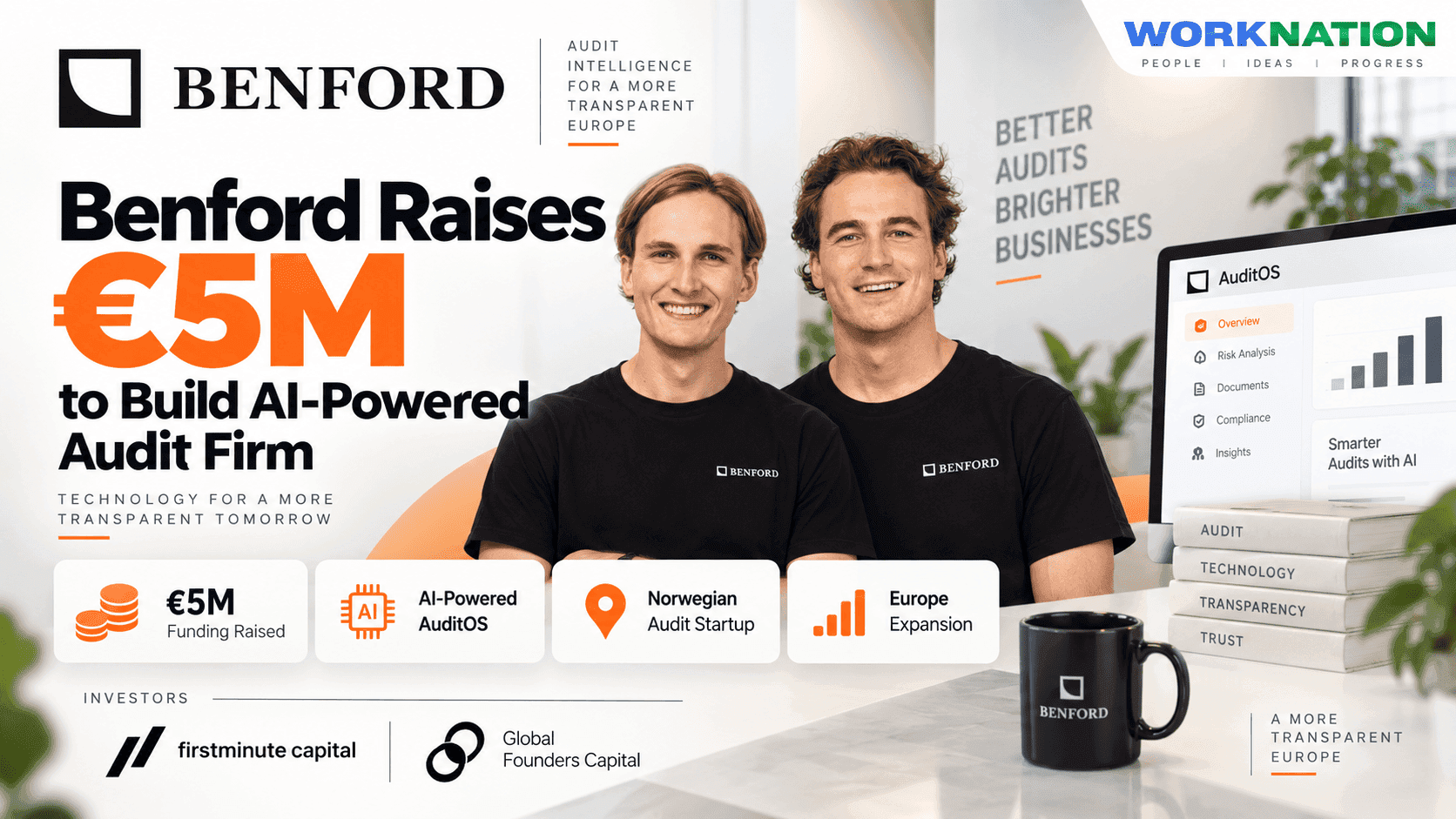
Benford Raises €5M to Build an AI-Native Audit Firm
Top Picks
Submit PR
Stay Ahead of the Market
Get the latest startup funding, hiring trends and global opportunities delivered to your inbox every week.
Benford, a Norwegian audit startup building an AI-powered approach to statutory auditing, has raised €5 million in pre-seed funding as it looks to reshape how audit services are delivered to small and mid-sized companies.
The round was led by firstminute capital and Global Founders Capital, with participation from Sondo and a group of prominent European technology founders and investors.
Investors include Arthur Waller and Quentin de Metz from Pennylane, Alexandre Prot from Qonto, Peter ter Maaten from HSO and the Spandow family from Amesto.
What makes Benford different from many audit-tech startups is that it is not simply selling software to existing accounting and audit firms. The company itself is registered as a licensed audit firm in Norway.
Founded in 2026 by Mads Bogen Øye, Thibault Mallion and Andreas Rystad, Benford is combining its own audit practice with an AI-powered software platform called AuditOS.
Building an audit firm around AI
For decades, much of the technology development in auditing has focused on helping existing firms automate parts of their workflow.
Benford is taking a different approach.
Instead of selling automation software to auditors, the company is operating as the auditor while using its own technology to automate work that traditionally requires significant manual effort.
Its AuditOS platform can connect to client ERP systems, subledgers, invoices and bank feeds.
The system is designed to automate parts of the groundwork that junior auditors would normally perform manually.
That includes gathering and organizing financial information, connecting different sources of evidence and preparing parts of the audit process for review.
Human judgment remains part of the model.
Benford holds the audit licence, employs the signing auditor and retains the client evidence.
The company argues that this combination of software automation and licensed human oversight can create a different operating model for audit services.
From consultants and technology companies to audit
The company's founding team combines experience across consulting, finance and technology.
Mads Bogen Øye, Thibault Mallion and Andreas Rystad founded Benford in 2026.
Rystad previously worked at Palantir, Goldman Sachs and One Peak.
The company currently has approximately 20 employees across London and Oslo.
Mallion, who serves as co-founder and co-CEO, argues that the audit industry has become increasingly expensive and administratively demanding for customers.
Benford's thesis is not to change the fundamental purpose of an audit, but to change the way the service is delivered.
This distinction is central to the company's strategy.
Rather than creating an AI tool that an auditor can optionally use, Benford is attempting to build the entire audit operation around software and automation from the beginning.
AuditOS and automated groundwork
Audit work involves collecting large amounts of financial evidence from different sources.
Companies may have information spread across enterprise resource planning systems, accounting subledgers, invoices and bank accounts.
Traditional audit processes can require significant manual work to collect, organize and review this information.
Benford's AuditOS is designed to connect directly to those systems and automate parts of the process.
The company's model is intended to reduce the amount of repetitive administrative work required from junior auditors.
The human auditor remains responsible for the audit opinion and professional judgment.
Benford therefore positions AI as an operational layer rather than a replacement for the licensed audit function itself.
Keeping audit evidence for future periods
Another part of Benford's model is the retention of client evidence.
Because Benford itself holds the audit licence and maintains the underlying evidence, subsequent audits can potentially build on information collected during previous engagements.
Traditional audits can require teams to repeat substantial information-gathering and verification work each year.
Benford's approach is designed to create continuity between audit periods.
The company can maintain historical evidence and use its technology to build upon previous work rather than starting the process from scratch every year.
This could potentially change the economics and workflow of recurring audits, particularly for smaller businesses.
Targeting the mid-market
Benford is concentrating on small and mid-sized companies.
The company believes this segment could represent an opportunity as larger audit firms focus more heavily on bigger clients and as audit work becomes increasingly consolidated.
Its strategy is therefore built around delivering statutory audit services at a scale and cost structure suited to smaller organizations.
The company is attempting to use automation to reduce the amount of manual work required per engagement while retaining the professional and regulatory requirements associated with statutory audits.
A different model from audit software companies
Benford's approach differs from companies that simply sell software to established audit firms.
DataSnipper, for example, has developed automation technology for auditors and has worked with major accounting firms including Deloitte, EY, KPMG and PwC.
Benford instead wants to operate the audit firm itself.
That means the company is responsible for the end-to-end service, including the audit licence, signing auditor and client evidence.
The distinction places Benford in a different category from traditional audit-tech software providers.
It is effectively combining a regulated professional-services business with an AI software company.
Emerging AI-native audit firms
Benford is not the only startup exploring this model.
The article highlights Repodo, a Copenhagen-based company founded by former Lunar executives, which raised €8.2 million in August to pursue a similar approach.
Repodo also combines an audit licence and human judgment with automated processes.
Other startups are approaching the market from different angles.
Berlin-based Cortea has raised €12 million and focuses on reviewing audit work using AI, while Belgium-based Auditstage has raised €750,000 and concentrates on audit-work review.
The emergence of these companies suggests that AI is being applied to different layers of the audit process, from individual workflows to the creation of entirely new audit firms.
Backing from European fintech founders
Benford's investor base includes founders from some of Europe's prominent accounting and fintech companies.
Arthur Waller and Quentin de Metz, founders of Pennylane, participated in the round.
Alexandre Prot, founder of Qonto, is also an investor.
The Spandow family behind Amesto participated as well.
These investors bring experience from accounting software, financial services and business technology, sectors closely connected to the processes Benford is attempting to automate.
The funding was led by firstminute capital and Global Founders Capital, with Sondo also participating.
Expanding beyond Norway
Benford plans to use the €5 million funding to expand beyond its initial Norwegian market.
The company's next planned market is Sweden, followed by other European countries.
It also plans to hire additional employees across both audit and engineering.
Expansion presents a significant operational challenge because audit is a regulated profession and requirements can differ between jurisdictions.
The company's ability to replicate its technology and operating model across different regulatory environments will therefore be an important part of its international strategy.
The regulatory question
AI adoption in auditing also raises questions around accountability and professional responsibility.
Benford's model retains a licensed audit firm and signing auditor, meaning the company is not presenting AI as an independent replacement for the statutory audit function.
However, the company is still relying on AI and automation for significant portions of the groundwork.
Whether regulators and clients will accept AI-assisted audit processes at the same level as more traditional approaches remains an open question.
The company will need to demonstrate that its technology can produce reliable evidence, maintain appropriate controls and support the professional judgment required for statutory audits.
A growing audit market
The audit industry represents a large established market.
According to the source, the global audit market is valued at approximately $58.68 billion in 2026 and is projected to reach $78.7 billion by 2030.
The size of the market creates an opportunity for technology companies attempting to improve productivity.
At the same time, auditing is subject to professional standards and regulatory requirements that can make transformation more complex than in less regulated software categories.
Benford's strategy combines those two realities.
It is using AI to automate operational work while maintaining the licensed structure of an audit firm.
What comes next for Benford
The €5 million pre-seed round gives Benford capital to expand its audit operations, develop AuditOS and enter additional European markets.
The company plans to expand from Norway into Sweden and subsequently other parts of Europe, while hiring across audit and engineering.
Founded by Mads Bogen Øye, Thibault Mallion and Andreas Rystad, Benford is betting that the next generation of audit firms could be built around AI from the beginning rather than retrofitting decades-old systems with new technology.
Its approach combines regulated professional services, AI automation and an in-house audit platform.
The key test ahead will be whether Benford can scale that model across different markets while maintaining the reliability, professional judgment and regulatory compliance expected from statutory auditors.
Have a Funding Round or Exciting Update to Share?
Submit your press release to get featured on WorkNation and reach founders, investors, and tech leaders.