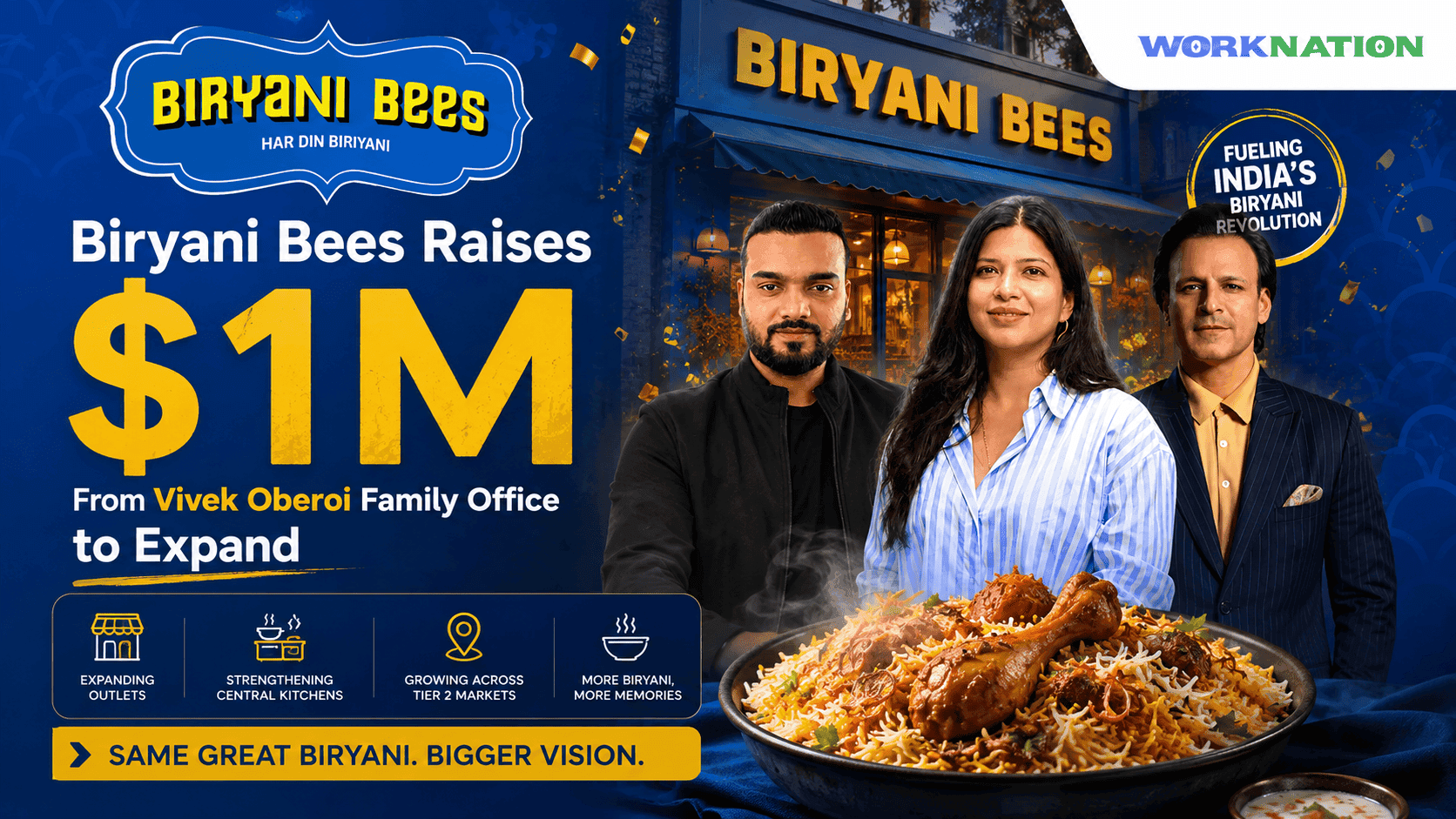
Biryani Bees Raises $1M From Vivek Oberoi Family Office
Top Picks
Submit PR
Stay Ahead of the Market
Get the latest startup funding, hiring trends and global opportunities delivered to your inbox every week.
Biryani Bees Raises $1M From Vivek Oberoi Family Office
Biryani Bees, a biryani and Indian meals brand incubated by Wolfpack Labs, has raised $1 million from the Vivek Oberoi Family Office as it looks to expand its presence across India’s tier 2 markets.
The company plans to use the fresh capital to expand its outlet network, strengthen its central kitchen infrastructure, grow its operations team, and develop a repeatable expansion model that can support growth across multiple states.
Building a Scalable Biryani Brand
Founded by Nitin Tiwari, Biryani Bees operates on a central-kitchen-led model designed to maintain consistency in food quality and pricing as the company expands into new markets.
The company currently operates three outlets in Uttar Pradesh and plans to increase this footprint to 10 outlets across Uttar Pradesh, Madhya Pradesh, and other tier 2 markets.
Biryani Bees is targeting a model that allows it to expand beyond individual restaurant locations while maintaining operational consistency. Its central kitchen infrastructure is intended to support food preparation and distribution as the company adds more outlets.
The company currently has an annual revenue run rate of around Rs 25 crore and says it is profitable.
Expanding Across Tier 2 Markets
The latest funding will initially be used to help Biryani Bees reach 10 outlets and validate its operating model across multiple states.
The company plans to focus on Uttar Pradesh, Madhya Pradesh, and other tier 2 markets, where it sees an opportunity to build a stronger presence for its biryani and Indian meals offerings.
Once the company establishes its model across these markets, Biryani Bees expects to raise a larger institutional funding round to support its next phase of national expansion.
The approach allows the company to focus first on proving that its operational model can be replicated across different markets before accelerating its expansion at a national level.
Strengthening Central Kitchens and Operations
A significant portion of the new capital will go towards strengthening Biryani Bees’ central kitchen infrastructure.
Centralised food preparation is a key part of the company’s expansion strategy, helping it maintain consistency while supporting multiple outlets. The company will also expand its operations team as it grows its physical footprint.
Biryani Bees intends to build a repeatable expansion model that can be deployed across different cities and states, with the aim of making future outlet launches more efficient.
Growing Through Food Delivery Platforms
Alongside its physical outlets, Biryani Bees has built a presence on major food delivery platforms including Zomato and Swiggy.
The company claims to have achieved a strong market share for biryani in the cities where it currently operates, giving it an additional channel for reaching customers beyond its physical restaurants.
The combination of physical outlets and food delivery is expected to remain an important part of the company’s growth strategy as it expands into new markets.
From Regional Expansion to National Ambitions
The $1 million investment marks an important step in Biryani Bees’ expansion plans.
The company’s immediate focus is on growing from three outlets to 10 while strengthening its underlying infrastructure and operations. Once that model has been established across multiple states, Biryani Bees plans to pursue institutional capital to accelerate its national footprint.
The company is positioning its central-kitchen-led model as the foundation for this expansion, with the latest funding providing capital for both physical growth and the operational capabilities required to support a larger network.
With its existing revenue run rate, profitability, and growing presence across food delivery platforms, Biryani Bees will now look to demonstrate that its regional model can be successfully replicated across a wider set of Indian markets.
Have a Funding Round or Exciting Update to Share?
Submit your press release to get featured on WorkNation and reach founders, investors, and tech leaders.