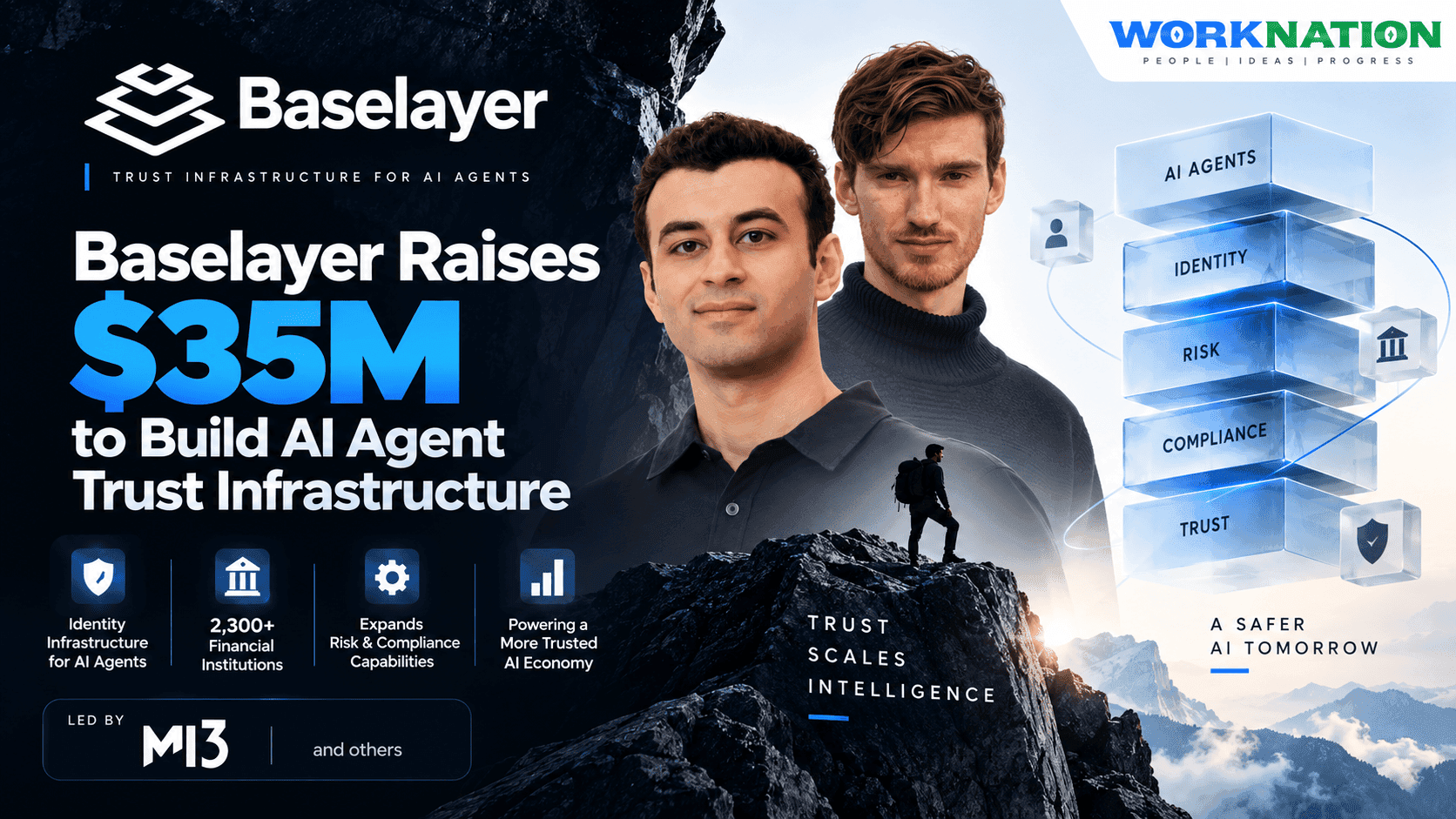
Baselayer Raises $35M Led by M13 to Build Trust Infrastructure for AI Agents
Top Picks
Submit PR
Stay Ahead of the Market
Get the latest startup funding, hiring trends and global opportunities delivered to your inbox every week.
New York-based identity and risk infrastructure company Baselayer has raised $35 million in a Series A funding round led by M13 as it expands from business verification into infrastructure designed to establish trust around AI agents conducting financial transactions.
The round includes participation from Torch Capital, Picus Ventures, Afore Capital and Matt Thompson of Socure.
The funding comes just seven weeks after Baselayer's previously reported $20 million Series A, according to the source. The latest capital will support the company's efforts to extend its existing identity and risk infrastructure to autonomous AI agents.
Baselayer's core proposition is centered on a growing challenge in financial services: determining whether an AI agent acting on behalf of a person or business is legitimate, who it represents and what it is authorized to do.
From Business Verification to AI Agent Identity
Baselayer was founded in 2023 by Jonathan Awad and Timothy Hyde.
The company already provides Know Your Business tools used by financial institutions and payments companies to verify whether businesses and counterparties are legitimate.
According to Baselayer, more than 2,300 financial institutions and payments companies currently use its tools.
The company also says its technology has helped customers prevent more than $1 billion in fraud losses.
Its latest strategy builds on that existing network.
Instead of limiting identity and risk checks to businesses, Baselayer is extending its infrastructure to AI agents that operate on behalf of those businesses.
The company wants financial institutions and other organizations to be able to establish three basic facts about an AI agent: whether the agent can be trusted, who it represents and what actions it is authorized to perform.
Why AI Agents Create a New Identity Challenge
Traditional fraud and identity systems were largely designed around people and businesses.
AI agents introduce another participant into the transaction.
An agent may be capable of opening an account, moving money, purchasing goods or interacting with financial infrastructure on behalf of another party.
However, an autonomous software system does not naturally carry the same identity documentation that conventional verification systems expect from humans or companies.
Baselayer CTO Timothy Hyde argues that existing infrastructure designed to verify people and businesses does not automatically recognize autonomous agents.
This creates a potential gap between the entity that owns or controls an agent and the software actually performing the transaction.
Baselayer is attempting to address that gap by extending its existing identity and risk data into the agent layer.
Building on an Existing Financial Network
One of Baselayer's main assets is its existing customer and data network.
The company says more than 2,300 financial institutions and payments companies already use its Know Your Business tools.
That existing infrastructure gives Baselayer a foundation for expanding into agent identity.
Instead of creating a completely new verification network for AI agents, the company can potentially connect agent-level identity with information it already maintains about businesses and counterparties.
M13 Managing Partner Karl Alomar highlighted Baselayer's existing network of more than 2,300 financial institutions, its risk data and infrastructure already operating in production as reasons for the firm's investment.
M13's investment represents its second stake in Baselayer within three months, according to the source.
The Growth of Agentic Commerce
The funding arrives as AI agents increasingly move from generating information toward performing actions.
Stripe has reported that approximately 70% of API requests developers used to make manually are now issued by agents, according to figures cited in the source.
Shopify has also introduced agentic sales channels for merchants, while major payments companies including Visa, Mastercard and American Express have been developing protocols for agent commerce.
These developments point toward a future in which software agents can increasingly interact with payment and commerce infrastructure.
But for those transactions to operate at scale, businesses need ways to distinguish authorized agents from potentially compromised or fraudulent ones.
Baselayer is positioning its technology as infrastructure for that verification layer.
A Potential Trust Layer for Agent Transactions
The company's long-term proposition goes beyond traditional fraud detection.
Baselayer wants to establish a framework in which an AI agent's identity can be connected to the business or individual it represents and the permissions it has been granted.
That could allow financial institutions and commerce platforms to determine whether an agent is authorized to perform a particular action before allowing a transaction to proceed.
For example, an agent acting for a business might be authorized to purchase certain goods but not move funds outside a defined limit.
A trust infrastructure layer could potentially provide downstream systems with information about the agent's identity and authorization before processing an action.
The source describes this as an extension of Baselayer's existing business verification graph to cover agents transacting on behalf of those businesses.
Working With Emerging Standards
Baselayer is also participating in emerging standards initiatives around authentication and agent identity.
The company is involved in the FIDO Alliance's authentication working group and the x402 identity effort alongside organizations including Cloudflare, Google, Visa and Mastercard.
These initiatives reflect the wider industry effort to establish common approaches for identifying and authenticating AI agents.
As agentic commerce develops, standardized identity mechanisms could become important for connecting agents with banks, payment providers, merchants and other services.
Baselayer is therefore positioning itself not only as a standalone identity and risk provider but also as a participant in the infrastructure being developed around agent-based transactions.
A Growing Competitive Category
Baselayer is entering a developing market where several startups are attempting to solve different aspects of trust and identity for AI-driven commerce.
Trustap has raised funding to develop infrastructure for AI shopping agents, while eComID is working on an AI commerce shopping passport.
Other startups are approaching adjacent areas of AI-enabled commerce and transactional communication.
The broader opportunity is driven by the possibility that AI agents will increasingly become intermediaries between consumers, businesses and digital services.
In such an environment, identity and authorization could become important infrastructure components.
Funding to Extend Baselayer's Infrastructure
The $35 million funding round gives Baselayer additional capital to extend its existing business verification infrastructure into AI-agent identity.
The company is already working with thousands of financial institutions and payments organizations, giving it an established base from which to develop its agent-focused offering.
Its new focus is on answering questions that traditional business verification systems were not designed to address: who an AI agent represents, whether it can be trusted and what it is permitted to do.
Baselayer's strategy is built around connecting those answers to the financial infrastructure already used by banks and payment companies.
The Next Stage of Agentic Commerce
AI agents are increasingly capable of carrying out tasks that previously required direct human interaction.
As those capabilities expand into commerce and financial services, the systems processing transactions need mechanisms for determining whether an agent is legitimate and properly authorized.
Baselayer is betting that identity and risk infrastructure will become a critical component of that ecosystem.
With $35 million in new funding, an existing network of more than 2,300 financial institutions and payments companies, and a platform that has already been used for business verification, the company is now extending its focus toward AI agents.
The next stage will depend on how quickly agent-based transactions expand and whether businesses, banks and payment networks adopt common approaches for verifying the software acting on their behalf.
Have a Funding Round or Exciting Update to Share?
Submit your press release to get featured on WorkNation and reach founders, investors, and tech leaders.