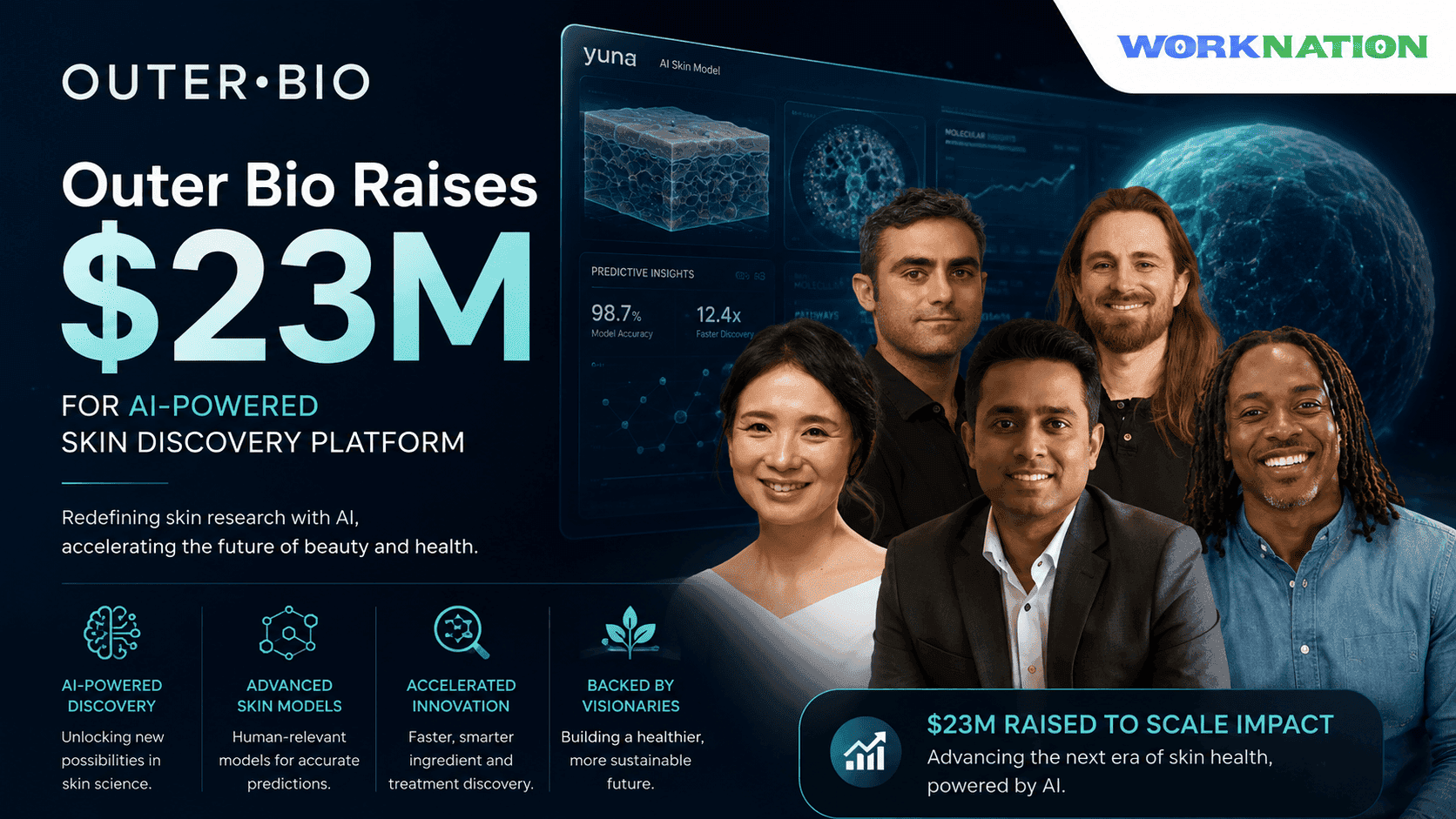
Lady Gaga-Backed Outer Bio Raises $23M to Advance AI-Powered Skin Discovery
Top Picks
Submit PR
Stay Ahead of the Market
Get the latest startup funding, hiring trends and global opportunities delivered to your inbox every week.
Outer Bio, a Massachusetts-based biotechnology startup focused on skin health, has raised approximately $23 million to develop an AI-powered discovery platform designed to identify new cosmetic ingredients and study how human skin responds to different compounds.
The company, legally known as Outer Biosciences, was co-founded in 2020 by Michael Polansky, Kyung-Jin Jang, Chris Hinojosa and Stanley King. Polansky serves as CEO, while singer and entrepreneur Lady Gaga, whose legal name is Stefani Germanotta, sits on the company's board.
The startup has largely operated quietly since its founding, with its work becoming more widely known after Lady Gaga publicly introduced Outer Bio and its Yuna platform in August 2026.
Keeping Human Skin Alive Outside the Body
Outer Bio's technology centers on Yuna, a platform designed to keep donated human skin tissue functioning outside the body, a process known as ex vivo research.
The tissue is primarily sourced from surgically discarded material, including tissue left over from plastic surgery procedures. The company works with biobanks operating under institutional review board oversight.
According to Outer Bio, skin removed from the body normally remains viable for approximately a week. Its proprietary support system is designed to extend that period to around four weeks while maintaining the tissue's original molecular structure.
This extended testing window allows researchers to observe biological processes that develop over longer periods, including inflammation, collagen remodeling, aging-related changes and skin barrier repair.
AI Screens Hundreds of Millions of Compounds
Artificial intelligence is a central component of Outer Bio's discovery platform.
The company says its machine-learning system can computationally screen approximately 750 million compounds each year. The system narrows the chemical possibilities down to a smaller group of candidates that can then be tested against living human tissue.
The results from those experiments are fed back into the AI system, allowing future predictions to be refined based on what worked and what did not.
Outer Bio says this process has significantly accelerated its discovery cycle. The company currently produces a new candidate approximately every six weeks, compared with only a few potential leads every 18 months when the team relied primarily on manual literature research.
Focused on Cosmetic Ingredients
Unlike pharmaceutical drug discovery companies, Outer Bio is primarily focused on cosmetic ingredients rather than developing medicines.
The company therefore does not need to pursue the FDA drug approval process for its cosmetic candidates. However, its ingredients still need to meet safety and regulatory requirements before they can be commercialized.
Potential ingredients must receive standardized industry names and pass relevant safety testing under guidelines established by the Organisation for Economic Co-operation and Development.
Once an ingredient completes the required process, cosmetic and beauty companies can potentially license or purchase it for use in consumer products such as skincare treatments.
Building a Business Through Research Partnerships
Outer Bio is already generating revenue through research collaborations.
The company has worked with partners on projects including research into why certain cancer treatments can cause severe skin reactions.
While many of its individual partners have not been publicly identified, Outer Bio says four of its six current leads are already progressing through the commercialization and regulatory process.
This partnership-driven model allows the startup to use its technology and biological data for research while developing potential ingredients that could eventually be licensed to consumer brands.
Lady Gaga's Role at Outer Bio
Lady Gaga's involvement has brought significant public attention to Outer Bio, but her role is primarily at the board level.
The singer and entrepreneur has been involved with the company for approximately six years and publicly introduced Outer Bio and its Yuna platform through social media in August 2026.
She is not listed among the company's four 2020 co-founders and is not involved in the day-to-day executive management of the business.
Her connection to the company reflects a broader trend of celebrities becoming involved in technology and biotechnology startups, but Outer Bio's business is primarily focused on scientific research rather than a consumer-facing celebrity product.
Backed by Venture Investors
Outer Bio has raised approximately $23 million from investors including Wing Ventures, Initialized Capital and Hawktail, the investment firm associated with Michael Polansky.
The startup currently employs 19 people, with most of its team based near Cambridge, Massachusetts.
The funding will support continued development of its tissue platform, AI-powered discovery system and research collaborations.
Competing in AI-Driven Biological Discovery
Outer Bio is part of a broader wave of startups using artificial intelligence to accelerate biological research.
However, its focus is narrower than many AI-driven drug discovery companies. Rather than targeting a broad range of therapeutic applications, Outer Bio is concentrating on skin biology and cosmetic ingredient discovery.
The company also faces competition from businesses developing alternative approaches to human tissue research.
One example is Vivodyne, which develops lab-grown human tissues for biological research and has raised significant venture funding.
Outer Bio's potential advantage lies in the proprietary dataset it is building through repeated experiments on donated human skin. The company believes years of tissue-response data could provide an important foundation for its AI models.
The Challenge of Proving the Technology
Despite its progress, Outer Bio still has important questions to answer.
The company has demonstrated its ability to maintain donated human skin outside the body for extended periods and has developed an AI system for screening potential compounds.
However, the company's AI discovery engine still needs broader validation.
A Yuna preprint published earlier in 2026 provided validation for the underlying tissue platform but did not fully validate the AI discovery system itself.
That distinction will be important as Outer Bio moves from promising research toward commercially successful cosmetic ingredients.
What Comes Next for Outer Bio
With approximately $23 million raised and a growing portfolio of potential ingredients, Outer Bio is preparing to expand its research and commercialization efforts.
The company plans to continue developing its Yuna platform, increase the amount of biological data available to its AI systems and work with additional partners across the beauty, cosmetics and life sciences industries.
Its long-term opportunity is to create a new approach to skin research where living human tissue and artificial intelligence work together to identify potential ingredients faster than traditional laboratory methods.
For now, Outer Bio remains a relatively small and science-focused startup. But with Lady Gaga's involvement bringing attention to the company and AI accelerating its discovery process, the startup is positioning itself at the intersection of biotechnology, artificial intelligence and the global beauty industry.
Have a Funding Round or Exciting Update to Share?
Submit your press release to get featured on WorkNation and reach founders, investors, and tech leaders.