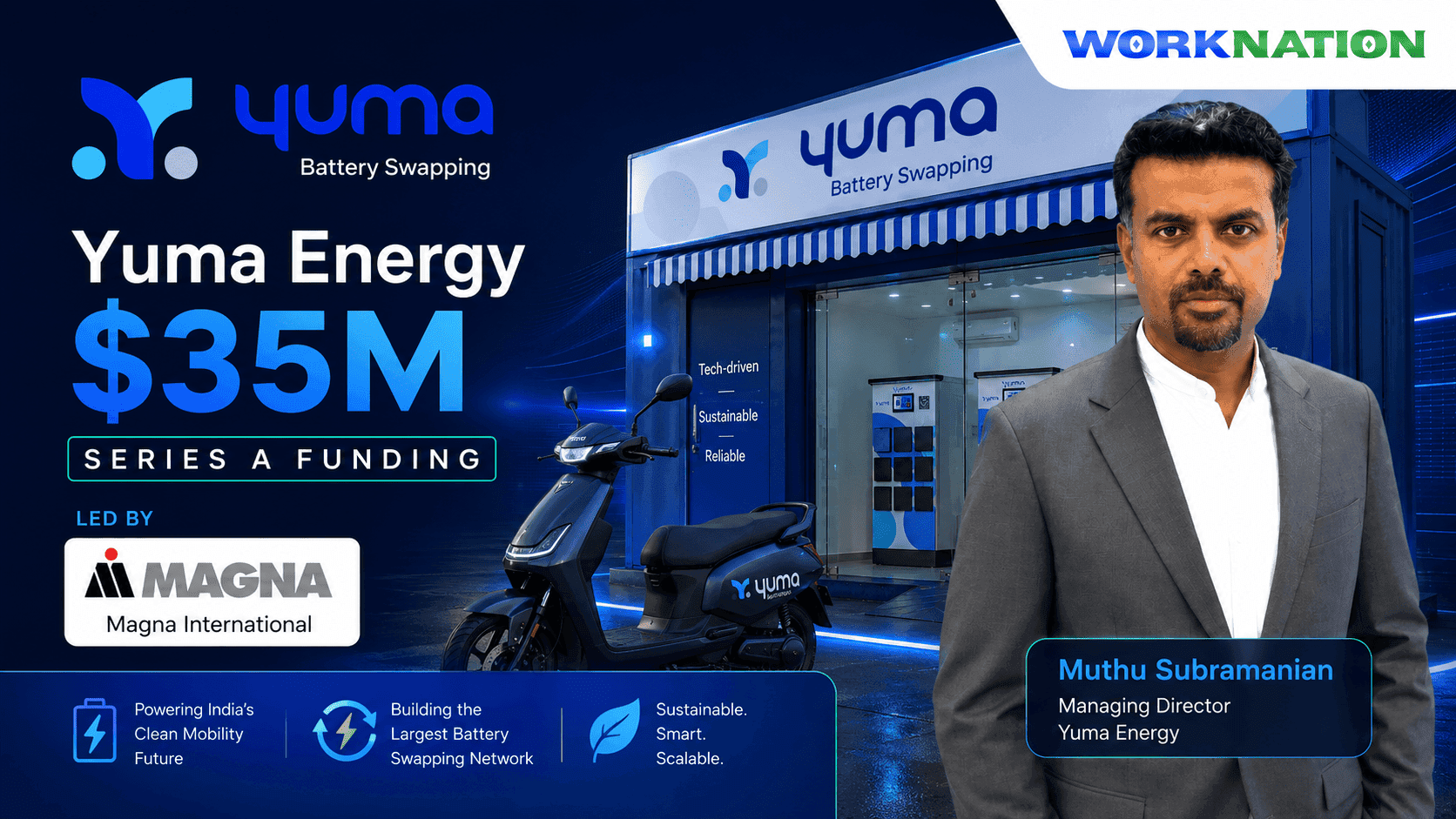
Yuma Energy Raises $35M from Magna International to Scale Battery Swapping
Top Picks
Submit PR
Stay Ahead of the Market
Get the latest startup funding, hiring trends and global opportunities delivered to your inbox every week.
Bengaluru-based battery-as-a-service (BaaS) provider Yuma Energy has raised $35 million in a Series A funding round led by Magna International Inc.
Alongside the funding, Yuma Energy has acquired battery technology company Grinntech as it looks to strengthen its battery technology and manufacturing capabilities.
The fresh capital will be used to expand Yuma Energy's battery-swapping infrastructure across India and grow its customer base among electric vehicle users, fleet operators and original equipment manufacturers (OEMs).
Building India's Battery-Swapping Infrastructure
Founded in 2023, Yuma Energy operates a battery-swapping network designed to support electric mobility.
The company says its network has completed more than 60 million battery swaps and includes over 100,000 batteries, more than 2,500 charging units and over 400 touch points across 18 cities.
The network is designed to provide EV users with access to charged batteries without requiring them to wait for conventional charging.
Yuma Energy currently powers Yulu's electric fleet while also providing open-access battery-swapping services to third-party OEMs and last-mile delivery operators.
Making EV Adoption More Convenient
Battery swapping is emerging as an alternative to traditional EV charging, particularly for commercial and high-utilisation vehicles.
Under a Battery-as-a-Service model, the battery is separated from the vehicle itself. Users can access charged batteries through subscription or pay-per-use models rather than owning and charging the battery themselves.
The approach can reduce the upfront cost of an electric vehicle while also reducing charging downtime.
For fleet operators and last-mile delivery businesses, faster battery replacement can be particularly valuable because vehicles can return to operations quickly instead of remaining idle while batteries charge.
Strengthening Battery Technology Through Grinntech
Yuma Energy's acquisition of Grinntech adds battery technology and manufacturing capabilities to its existing swapping infrastructure business.
The combination gives Yuma an opportunity to strengthen the technology behind its battery ecosystem while expanding its physical network across India.
The company plans to continue developing its infrastructure and technology platform to serve individual riders, fleet operators and OEM partners.
Expanding Across India's EV Market
The new funding comes as India's electric mobility market continues to develop across two-wheelers, commercial fleets and last-mile delivery.
Yuma Energy is targeting multiple segments of this market through its open-access approach, allowing third-party vehicle manufacturers and operators to use its battery-swapping infrastructure.
The company expects its expanding network to help make electric mobility more practical for users who require frequent vehicle usage and predictable turnaround times.
Competing in a Growing Battery-Swapping Market
Yuma Energy operates in an increasingly competitive battery-swapping and energy infrastructure market.
Companies including Battery Smart and Sun Mobility are also developing battery-swapping networks in India, while international players such as Gogoro have built battery-swapping ecosystems in other markets.
Yuma's network scale, its relationship with Yulu and its focus on supporting third-party OEMs provide the company with a foundation for further expansion.
Scaling Battery-as-a-Service
With $35 million in new funding from Magna International and the acquisition of Grinntech, Yuma Energy is preparing for its next stage of growth.
The company plans to expand its swapping infrastructure, strengthen battery technology and reach more EV riders, fleet operators and OEMs across India.
As electric mobility expands, battery-as-a-service could become an important part of the charging ecosystem, particularly for commercial vehicles and high-frequency urban mobility.
Have a Funding Round or Exciting Update to Share?
Submit your press release to get featured on WorkNation and reach founders, investors, and tech leaders.