Ex-Northvolt Engineers Raise $4.6M to Turn Retired EV Batteries Into Energy Storage
Top Picks
Submit PR
Stay Ahead of the Market
Get the latest startup funding, hiring trends and global opportunities delivered to your inbox every week.
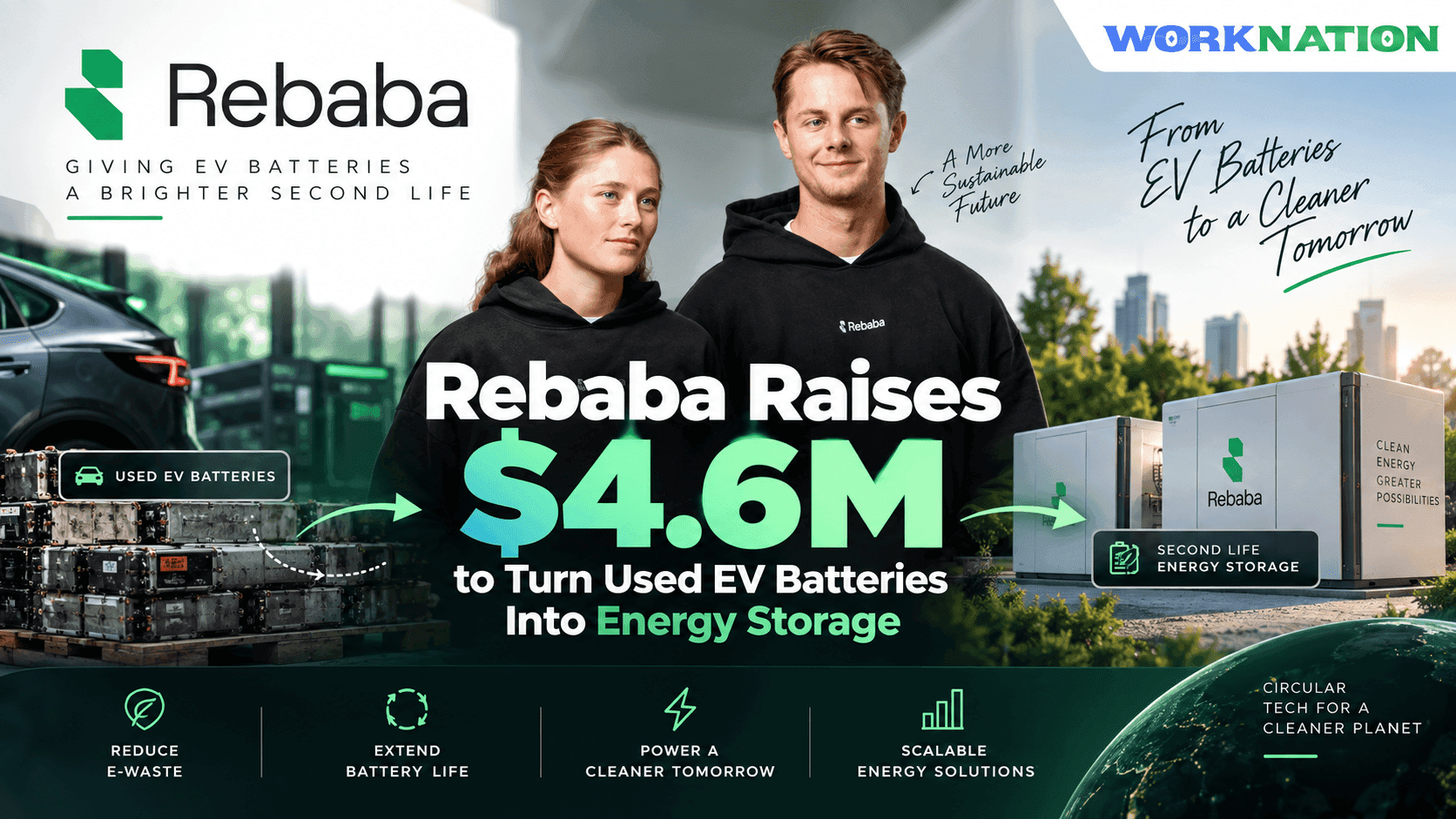
Swedish energy storage startup Rebaba has raised $4.6 million in seed funding to transform retired electric vehicle batteries into stationary energy storage systems for homes, businesses, industrial facilities, and EV charging infrastructure.
The Stockholm-based company was founded in 2023 by former Northvolt engineers Paula Runsten and Felix Kruse. Its approach challenges the conventional battery manufacturing model by reusing existing EV battery packs rather than manufacturing new cells specifically for stationary storage.
The latest financing was led by Sistafund and EIT Urban Mobility, with participation from existing shareholders and new European investors. Rebaba plans to use the capital to expand production and grow its team.
Reusing batteries instead of building new ones
Electric vehicle batteries do not necessarily become unusable once they are retired from vehicles. Rebaba focuses on batteries that retain approximately 70% to 80% of their original capacity.
The company integrates these battery packs into stationary storage systems that can be connected to electricity grids, solar installations, or EV chargers through an inverter.
Its control software is designed to work with different battery types, allowing Rebaba to build storage systems without manufacturing entirely new battery cells.
The company says its systems can help customers reduce peak electricity demand, store excess solar energy, provide backup power for EV charging, and participate in energy markets.
From Northvolt to a different battery model
Co-founder and CEO Paula Runsten spent several years at Northvolt, working across battery development and production digitalisation. She also gained experience in electric vehicles through work involving Tesla and an autonomous carbon-fibre electric Formula car.
At Northvolt, Runsten and co-founder Felix Kruse identified a gap between the growing number of retired EV batteries and the increasing demand for stationary energy storage.
Instead of starting with a large manufacturing facility, the founders initially focused on proving that existing batteries could be repurposed into commercially viable storage systems.
Their early work included approaching bus operators in Indonesia with proposals to convert retired electric bus batteries into storage systems for islands and remote communities with unreliable grid access.
That philosophy remains central to Rebaba's strategy.
"We don't need gigafactories"
Rebaba's business model differs from companies that manufacture new battery cells at enormous industrial facilities.
The company takes used battery packs, integrates them into cabinets or containers, rewires them with its own control software, and connects them to energy infrastructure.
The result is a system that can potentially be deployed using existing battery resources while reducing demand for newly manufactured cells and raw materials.
Rebaba believes this can help it compete directly with new battery storage systems on price and performance rather than relying on a premium for being a circular or sustainable product.
The company does not see other second-life battery companies as its primary competition. Instead, Runsten argues that the larger challenge is the declining cost of new battery cells, particularly those manufactured in China.
Scaling beyond the workshop
Rebaba moved into its current production facility at the beginning of 2025 and now handles manufacturing in-house.
The company says every system it has installed so far has proven profitable, while demand is currently exceeding its production capacity.
Rebaba currently employs 16 people and plans to hire four additional employees following the latest funding round.
Its systems are already being deployed across industrial and commercial facilities, EV charging locations, and an expanding residential customer base.
The timing could prove significant as several trends converge: EV adoption is creating a growing pool of retired batteries, renewable energy requires more storage capacity, and EV charging infrastructure is increasing electricity demand.
Rebaba's next challenge will be proving that its no-gigafactory approach can scale quickly enough to meet this growing demand while remaining competitive with increasingly inexpensive new batteries.
Have a Funding Round or Exciting Update to Share?
Submit your press release to get featured on WorkNation and reach founders, investors, and tech leaders.