Bird Raises $450M in Debt as It Builds Infrastructure for AI Agents
Top Picks
Submit PR
Stay Ahead of the Market
Get the latest startup funding, hiring trends and global opportunities delivered to your inbox every week.
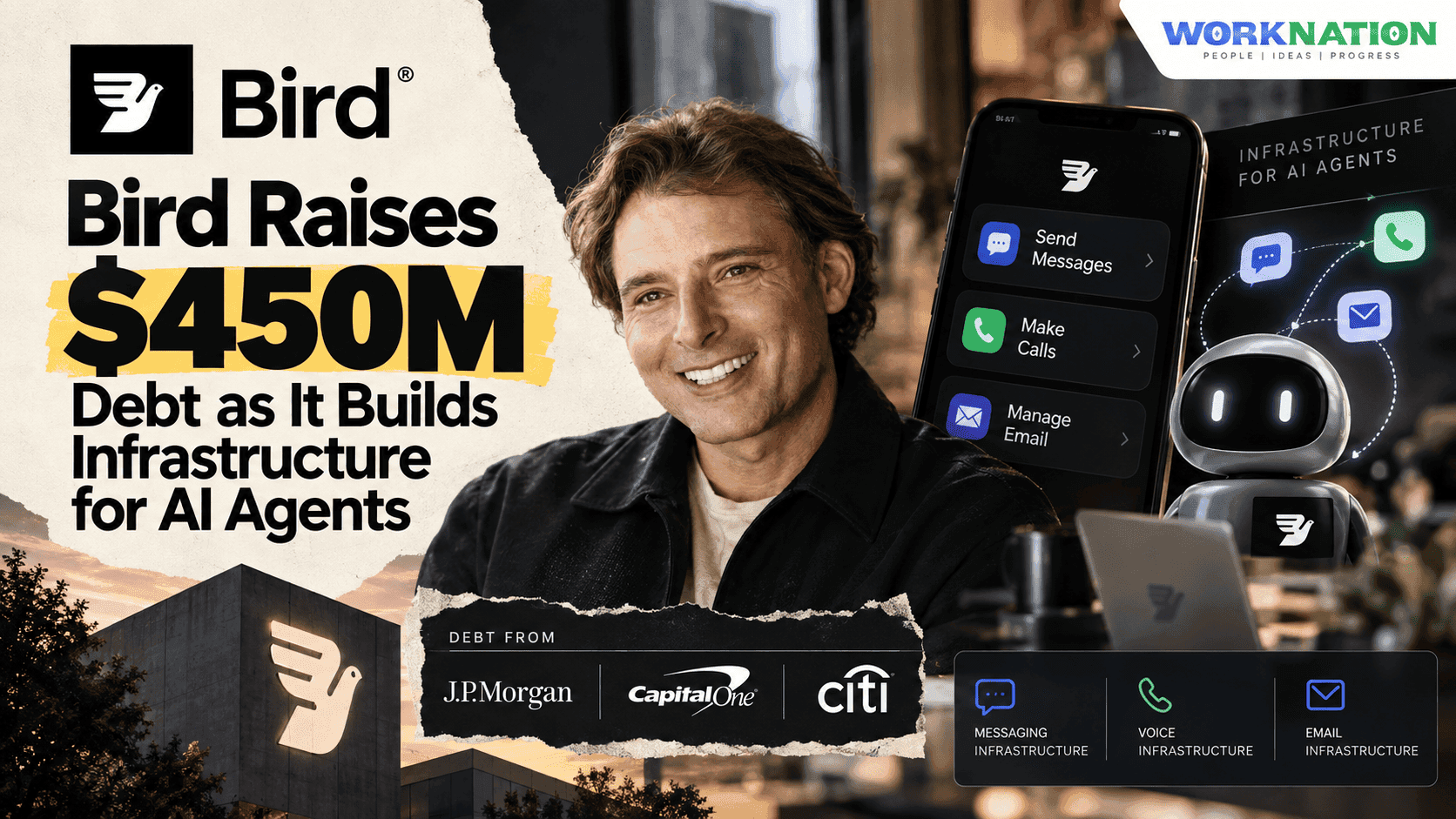
Bird, a communications infrastructure company founded by Robert Vis, has secured $450 million in debt financing from a seven-bank lender syndicate as it prepares for its next phase of growth around the emerging AI agent economy.
The financing was led by J.P. Morgan alongside Capital One and Citi and consists of a $400 million term loan and a $50 million revolving credit facility. Silicon Valley Bank, Mitsubishi UFJ Financial Group, Flagstar and Huntington also participated in the lender group.
Unlike a conventional growth financing, however, Bird says the new capital is being used for a dividend recapitalisation. The proceeds will fund a dividend to existing shareholders, including current and former employees who hold equity in the company.
At the same time, Bird is introducing new infrastructure designed to allow AI agents to communicate and transact with the outside world.
From messaging infrastructure to AI agent infrastructure
Founded in 2011, Bird provides communications infrastructure that businesses use to reach customers through email, SMS, WhatsApp, voice and RCS.
The company operates across more than 150 countries and serves customers including Meta, PayPal and Klarna.
Bird's business has undergone a significant transformation in recent years.
The company's headcount has fallen from more than 1,000 employees at its peak to approximately 120 today. According to CEO Robert Vis, the reduction has been driven by extensive automation and multiple rounds of layoffs, while the company has continued operating and growing its profitability.
Bird generated $165 million in EBITDA in 2025.
Vis describes the transformation as an example of how automation can change the economics of a software company. Rather than simply adding more employees as the business grows, Bird has increasingly used automation to handle internal processes and operations.
The result is a much smaller workforce alongside a substantial level of profitability.
The $450M financing is not traditional growth capital
The structure of Bird's latest financing is particularly notable.
The company raised $400 million through a term loan and another $50 million through a revolving credit facility. The money is not primarily being deployed toward hiring, acquisitions or building out a conventional growth organisation.
Instead, it is being used for a dividend recapitalisation.
That means Bird is using debt financing to provide liquidity to existing shareholders, including employees and former employees who hold equity.
The transaction allows shareholders to receive part of the value of their holdings without the company pursuing a conventional equity financing or sale.
The debt comes from a broad group of financial institutions, led by J.P. Morgan, Capital One and Citi.
J.P. Morgan managing director Shikha Goyal-Allain said the bank expects growth in agentic AI to accelerate as AI agents increasingly communicate and transact on behalf of people and businesses.
Bird launches an AI agent communications layer
Alongside the financing, Bird unveiled a revamped version of its Agentic Harness.
The product is designed to allow AI agents to perform real-world communications actions through Bird's infrastructure.
According to the company, AI agents can send messages, place calls, manage email and use an eSIM phone plan on Bird's network without requiring a human to execute each action.
This represents a shift from AI systems that primarily generate text or provide recommendations toward agents that can interact with customers and external systems.
Bird is positioning its infrastructure as a communications layer for AI agents built on platforms such as Claude, ChatGPT and Cursor.
The company's argument is that AI agents need more than a capable language model to become useful in real-world business environments.
They need infrastructure that allows them to communicate, make calls and take actions.
The infrastructure layer beneath AI agents
The emergence of agentic AI has created demand for a new category of infrastructure.
Large language models can reason, generate content and interact with tools, but businesses still need systems that connect those models to communications, software applications and real-world workflows.
Bird is attempting to occupy one part of that infrastructure stack.
Its existing communications business already provides access to channels such as SMS, WhatsApp, voice, email and RCS.
The Agentic Harness extends those capabilities to AI agents.
Instead of a human customer-service representative manually sending a message or making a phone call, an AI agent could potentially perform those tasks through Bird's infrastructure.
That could support use cases ranging from customer service and sales to notifications, scheduling and automated transactions.
A growing market for agent infrastructure
Bird is entering a market where multiple companies are building different layers of the infrastructure required for AI agents.
Deepgram, for example, has built real-time voice AI infrastructure. Coval focuses on testing voice AI agents before deployment, while Rime is developing speech-to-speech technology for enterprise communications.
These companies operate at different layers of the technology stack, but they address a similar underlying requirement.
AI agents need capabilities beyond language generation.
They need to hear, speak, communicate and take actions.
Bird's existing communications infrastructure gives it an established position from which to pursue this market.
The company's challenge will be determining whether communications infrastructure remains a distinct layer in the agent ecosystem or becomes increasingly integrated into the AI platforms themselves.
A dramatically leaner operating model
Bird's transformation is also notable from an operational perspective.
The company has reduced its workforce from more than 1,000 employees to around 120 while generating $165 million in EBITDA in 2025.
Vis attributes the change primarily to automation and increased productivity.
The company's approach illustrates how AI and automation can affect the economics of software businesses from within the organisation, not just through customer-facing products.
Bird is now attempting to apply a similar philosophy to its external infrastructure.
Instead of simply using AI to automate internal work, it wants to provide infrastructure that enables its customers' AI agents to perform work on their behalf.
What comes next for Bird
Bird now has two connected stories developing at the same time.
The first is an established communications infrastructure business that has become significantly leaner and more profitable.
The second is its emerging strategy around agentic AI, where Bird wants to provide the communications infrastructure that allows autonomous software agents to interact with the outside world.
The $450 million debt financing provides liquidity to existing shareholders rather than directly funding the AI product expansion.
Meanwhile, the launch of the Agentic Harness gives Bird a new product direction that builds on its existing communications infrastructure.
The key question for the company is whether AI agents will create a large and durable demand for dedicated communication infrastructure.
Bird is betting that they will, positioning its network as a layer between AI agents and the people, businesses and systems those agents need to communicate with.
Have a Funding Round or Exciting Update to Share?
Submit your press release to get featured on WorkNation and reach founders, investors, and tech leaders.