AIR Raises $50M to Secure the Growing AI Agent Software Supply Chain
Top Picks
Submit PR
Stay Ahead of the Market
Get the latest startup funding, hiring trends and global opportunities delivered to your inbox every week.
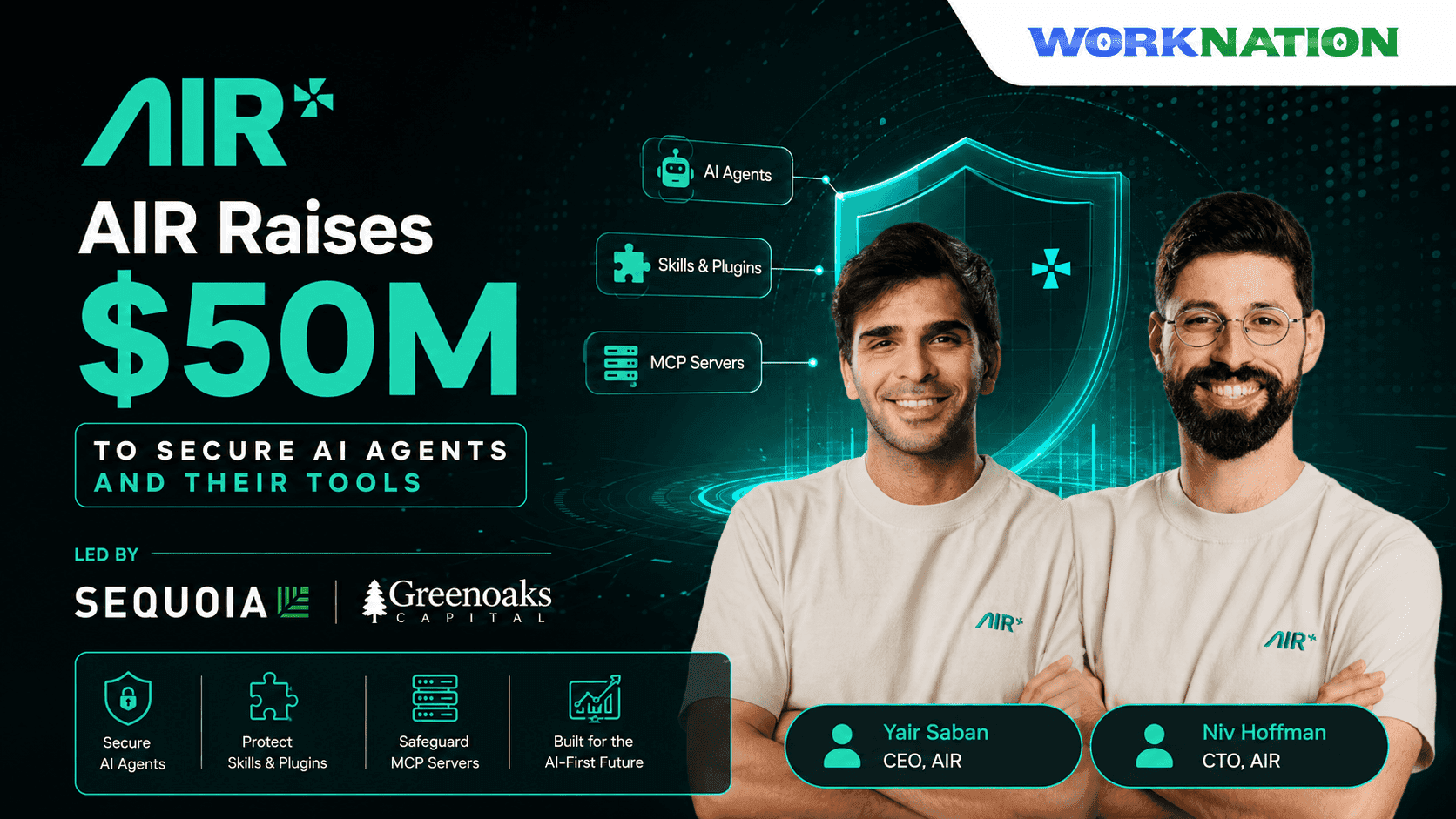
AIR, an AI security startup focused on protecting enterprise AI agents, has emerged from stealth with $50 million raised across two seed funding rounds as companies increasingly deploy autonomous AI agents across their software environments.
The company was founded by Yair Saban, CEO, and Niv Hoffman, CTO, both veterans of Israel's Unit 8200 intelligence corps. AIR is building a security platform designed to help enterprises discover the AI agents operating across their environments, assess the tools and add-ons those agents use, and prevent potentially risky interactions.
AIR Raises $50M Across Two Seed Rounds
AIR raised $10 million in its first seed round, led by Sequoia Capital, followed by a $40 million round led by Greenoaks. The two rounds closed within weeks of each other.
The funding also attracted participation from Swish, Netz and a group of notable angel investors, including Zach Frankel, president of Cognition; Yinon Costica, co-founder of Wiz; Ofir Ehrlich, co-founder of Eon; former U.S. National Security Council official Anne Neuberger; Omer Adam; and Varun Anand, co-founder of Clay.
The company plans to use the new capital primarily to expand its research team and accelerate go-to-market efforts in the United States and Europe.
Securing the AI Agent Supply Chain
As enterprises give AI agents access to databases, internal software and internet-connected tools, a new software ecosystem is emerging around them.
AI agents can increasingly use skills, plug-ins, MCP servers and other add-ons to perform tasks and interact with external systems. AIR argues that these components require continuous security oversight because they can change over time and potentially introduce malicious behavior.
The company's platform is designed to discover agents operating inside an organisation and identify employees using AI tools that may not have been approved by IT teams.
Continuous Verification of AI Tools
AIR combines visibility and enforcement capabilities to monitor how AI agents interact with external software and content.
Its enforcement layer can intercept and analyse actions such as loading a skill or retrieving information from the internet. The platform then evaluates the tools and add-ons an agent wants to use against a security whitelist maintained by AIR.
The startup says the whitelist is continuously updated by evaluating publicly available skills and add-ons for changes or malicious behaviour.
According to AIR, around 27% of the add-ons and skills it currently finds online are filtered out by its security system.
Protecting Autonomous AI Agents
AIR's founders argue that AI agents introduce a different security challenge because attackers may not need to directly compromise an agent.
Instead, malicious actors could manipulate content or software that an agent consumes. If the agent has access to enterprise systems, databases or external services, compromised components could potentially influence its actions.
AIR therefore positions its technology around continuous re-verification rather than a one-time security scan.
Demand From Regulated Industries
AIR currently has more than 20 customers, with approximately one-quarter classified as large enterprises, according to the company.
The strongest demand so far has come from heavily regulated industries, particularly financial services and pharmaceutical companies, where organisations face stricter requirements around software access, data security and governance.
The startup currently has around 40 employees and plans to expand its research and commercial teams with the latest funding.
A Competitive AI Security Market
AIR is entering a rapidly developing market with several competitors already building security and governance solutions for AI agents and their associated infrastructure.
Companies such as Noma Security, Zenity, Astrix Security and Operant AI are developing products covering agent discovery, access controls, runtime monitoring and MCP security.
The category is also attracting significant venture capital. Zenity raised $125 million in a Series C round in August 2026, while Noma Security previously raised $100 million in Series B funding.
AIR believes its differentiation lies in continuously evaluating the growing ecosystem of skills, plug-ins and other components used by AI agents.
As enterprises deploy AI agents across more critical workflows, the ability to continuously verify what those agents can access and interact with could become an increasingly important layer of enterprise security.
Have a Funding Round or Exciting Update to Share?
Submit your press release to get featured on WorkNation and reach founders, investors, and tech leaders.