Priyal Maru
Lvl. 1Entrepreneur In Residence at XTechBuzz
About
Business Analyst with experience in startup evaluation, market research, and business strategy, adept at identifying growth opportunities and synthesizing insights into actionable recommendations. Possesses a strong foundation in product management, including ...
Community Pulse
2026 ActivityActivity

The Startup Skill Nobody Talks About: Operating Without a Playbook
At a big company, there's usually a process.
At a startup, someone says:
“We need to figure this out.” And that's the job.
No SOP.
No playbook.
No five-person team.
No historical data.
Just a problem and a deadline.
Some people find that stressful.
Some people find it addictive.
That's usually the difference between someone who likes startups and someone who likes the idea of startups.
#Startups #StartupLife #Hiring #FounderMindset #Entrepreneurship #Leadership #CareerGrowth #WorkCulture #StartupJobs

Stop Consuming Startup Advice. Start Building
Startup advice has become its own industry.
Build in public.
Don't build in public.
Talk to customers.
Don't listen to customers too much.
Raise funding.
Stay bootstrapped.
Hire fast.
Stay lean.
Build an MVP.
Build something defensible.
At some point you have to stop consuming startup advice and actually build the thing.
There is no perfect playbook. There is just the problem in front of you.
#Startups #Entrepreneurship #FounderMindset #StartupAdvice #BuildingInPublic #ProductManagement #BusinessGrowth #EntrepreneurLife #StartupJourney #WorkNation
Stop Asking “What Do You Do?” at Networking Events
“So, what do you do?” is probably the worst opening question at a networking event.
Because now someone has 30 seconds to explain their entire professional identity to a stranger.
Try:
“What brought you here?”
Much better
Suddenly you're talking about why they're interested in the event, what they're working on, what they want to learn or who they came with.
Good conversations start with better questions.
#Meetups #Networking #NetworkingTips #CommunicationSkills #ProfessionalNetworking #CareerAdvice #PersonalBranding #Confidence
Go Alone. You’ll Be Surprised Who You Meet
Going to an event alone is probably one of the best things you can do for yourself.
The first 10 minutes will be uncomfortable.
You don't know where to stand. You don't know who to talk to. You check your phone more than you normally would.
Then you talk to one person who introduces you to someone else.
Someone asks what you do.
You end up discussing something completely unrelated to work.
And suddenly you're glad you came.
Sometimes the hardest part of networking is simply walking through the door.
#Meetups #Networking #CareerGrowth #PersonalGrowth #ProfessionalNetworking #Confidence #CareerAdvice #SelfDevelopment #YoungProfessionals
Financial Security Is Having Enough Money Not to Panic
The best thing about having an emergency fund is that you hope you never need it.
You don't get excited about it.
You can't show it off.
Nobody knows you have it.
It just sits there.
Until your company suddenly restructures.
Your laptop dies.
Your family needs help.
Or life decides to send you an expense you didn't budget for.
That's when six months of boring savings becomes six months of breathing room.
Sometimes financial security is simply having enough money to not panic.
#PersonalFinance #EmergencyFund #FinancialSecurity #MoneyManagement #FinancialPlanning #SavingMoney #MoneyMindset #FinancialFreedom #Money
The Problem Isn’t Access to Information. It’s Knowing What to Ignore.
YouTube might be one of the best learning platforms ever created.
You can learn Excel from someone in Mumbai.
Design from someone in Seoul.
Marketing from someone in New York.
Coding from someone who built the thing you're trying to build.
And most of it is free.
The problem isn't access to information anymore.
The problem is knowing what to ignore.
#Learning #YouTubeLearning #SelfLearning #CareerGrowth #SkillDevelopment #ContinuousLearning #ProfessionalGrowth #LearningJourney #CareerAdvice #WorkNation
The Most Underrated Skill at Work: Asking Better Questions
One of the most underrated skills at work is knowing how to ask a good question.
Not I don't understand this.
But:
“I tried A and B. A didn't work because of X. I think B might work, but I'm stuck at Y.”
The second phrase is much easier to help.
And more importantly, they usually learn faster.
A lot of people think learning means collecting more information.
Sometimes it just means getting better at figuring out what exactly you don't know.
#CareerGrowth #WorkplaceSkills #ProfessionalGrowth #CommunicationSkills #LearningAtWork #CareerAdvice #GrowthMindset #WorkLife #YoungProfessionals #WorkNation#Learning
What do you think?
I don't think most people hate working. They hate feeling like their work doesn't matter. You can work long hours when you understand why you're doing it, get through a difficult week when your team appreciates the effort and even accept a tough deadline when someone takes the time to explain why it matters.
What becomes exhausting is doing everything you're asked to do and still feeling invisible - no context, no feedback, no recognition, just another task appearing in your inbox. That's when even a reasonable workload can start to feel unbearable. Sometimes the biggest workplace problem isn't the amount of work; it's the feeling that nobody would notice if you stopped doing it.
The Side of Adult Friendships
One of the weirdest parts of growing up is realizing that friendships need maintenance.
In school, you became friends because you sat next to someone.
In college, you became friends because you had the same classes, hostel, societies, or late-night plans.
Then work starts.
People move cities.
Someone gets married.
Someone changes jobs.
Someone becomes busy.
Someone just… disappears.
And suddenly, staying friends requires effort.
A random “how have you been?”
A 20-minute call between meetings.
Planning something three weeks in advance.
Remembering someone's birthday without Instagram reminding you.
You eventually realize that some of the people you still have in your life aren't there because life keeps putting you together.
They're there because both of you keep choosing the friendship.
#Adulting
Stop Comparing

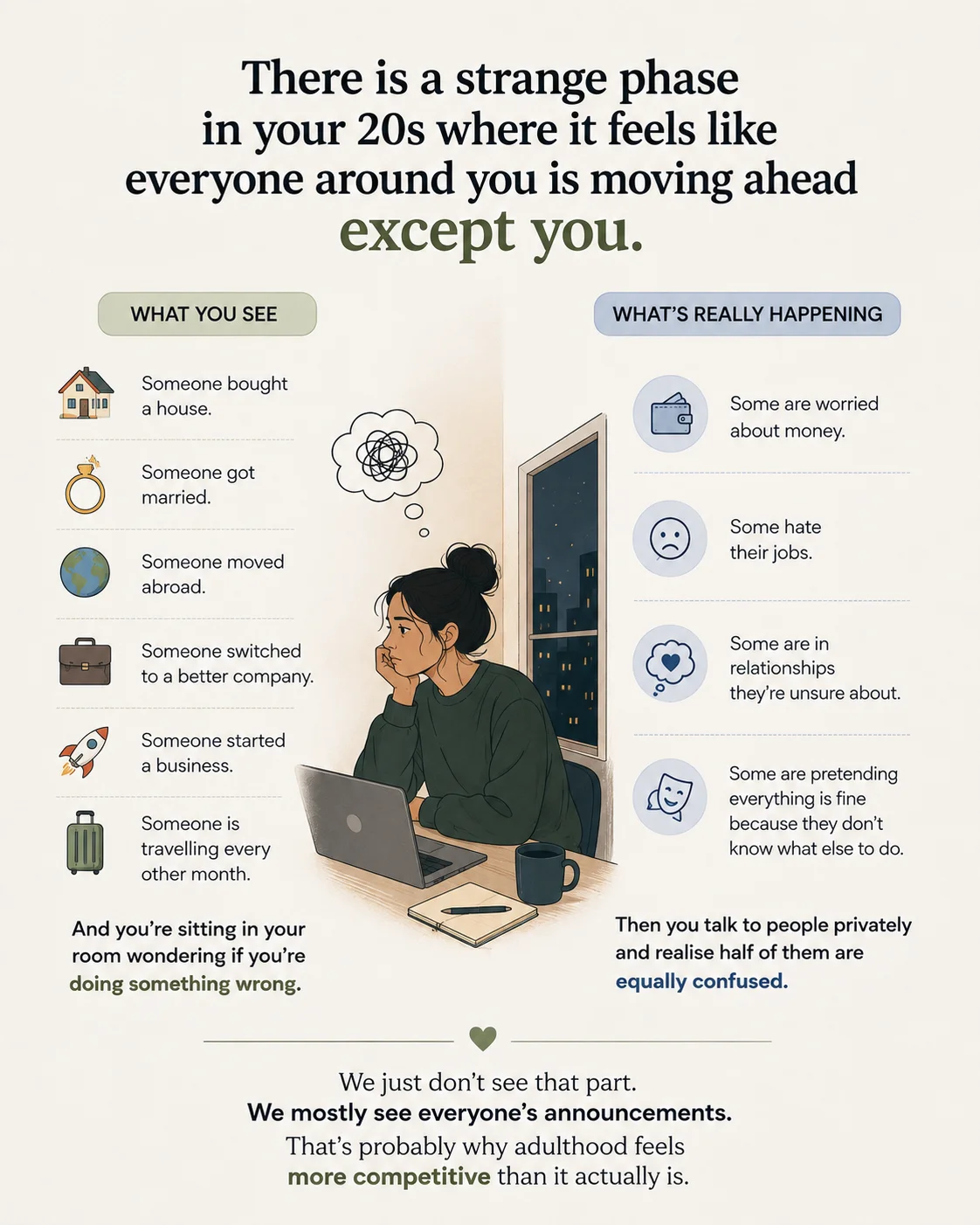
There is a strange phase in your 20s where it feels like everyone around you is moving ahead except you.
Someone bought a house.
Someone got married.
Someone moved abroad.
Someone switched to a better company.
Someone started a business.
Someone is travelling every other month.
And you're sitting in your room wondering if you're doing something wrong.
Then you talk to people privately and realize half of them are equally confused.
Some are worried about money. Some hate their jobs. Some are in relationships they're unsure about. Some are pretending everything is fine because they don't know what else to do.
We just don't see that part. We mostly see everyone's announcements. That's probably why adulthood feels more competitive than it actually is.
What’s something you wish someone had told you in your first 2 years of working?
Mine would be:
You don't need to say yes to everything just to prove you're hardworking.
You can be ambitious without being available 24/7.
You can ask questions without looking inexperienced.
And honestly, doing good work is only part of the game and learning how to communicate, manage expectations and build relationships matters too.
#Career #CareerAdvice
Work Life Balance
Company: “We strongly believe in work-life balance.”
Also company:
“Just one small thing before you log off…
#Funny #Workplace #WorkLifeBalance #CorporateLife #OfficeLife #WorkHumor #CorporateHumor #Funny #WorkNation
One thing I tolerate about corporate culture
One thing I tolerate about corporate culture: pretending everything is urgent.
ASAP
High priority
Urgent
Need this today
And then you find out the thing has been sitting in someone's inbox for three weeks. If everything is urgent, nothing is urgent.
And eventually people stop believing you when something actually matters.
I don't understand why being busy is treated like a personality trait at work.
Someone asks how you're doing and the answer is always crazy busy.
Calendar full.
Slack notifications on.
Three tabs open.
Back-to-back meetings.
But being busy doesn't necessarily mean you're doing important work.
Sometimes it just means nobody knows how to prioritize.
I've started thinking that the most productive person in the room might actually be the one who says, "We don't need to do this."
The ₹500 problem
Most people don't go broke because of one huge purchase.
It's the tiny things that stop feeling like spending.
₹300 coffee.
₹500 delivery.
₹800 cab.
₹1,200 dinner.
Another subscription.
Another online order.
None of these feel serious individually.
But add them up for a month and suddenly you're looking at a number that would have made you think twice before spending it.
Small expenses aren't dangerous because they're small. They're dangerous because they're easy to ignore.
Career Reality Check

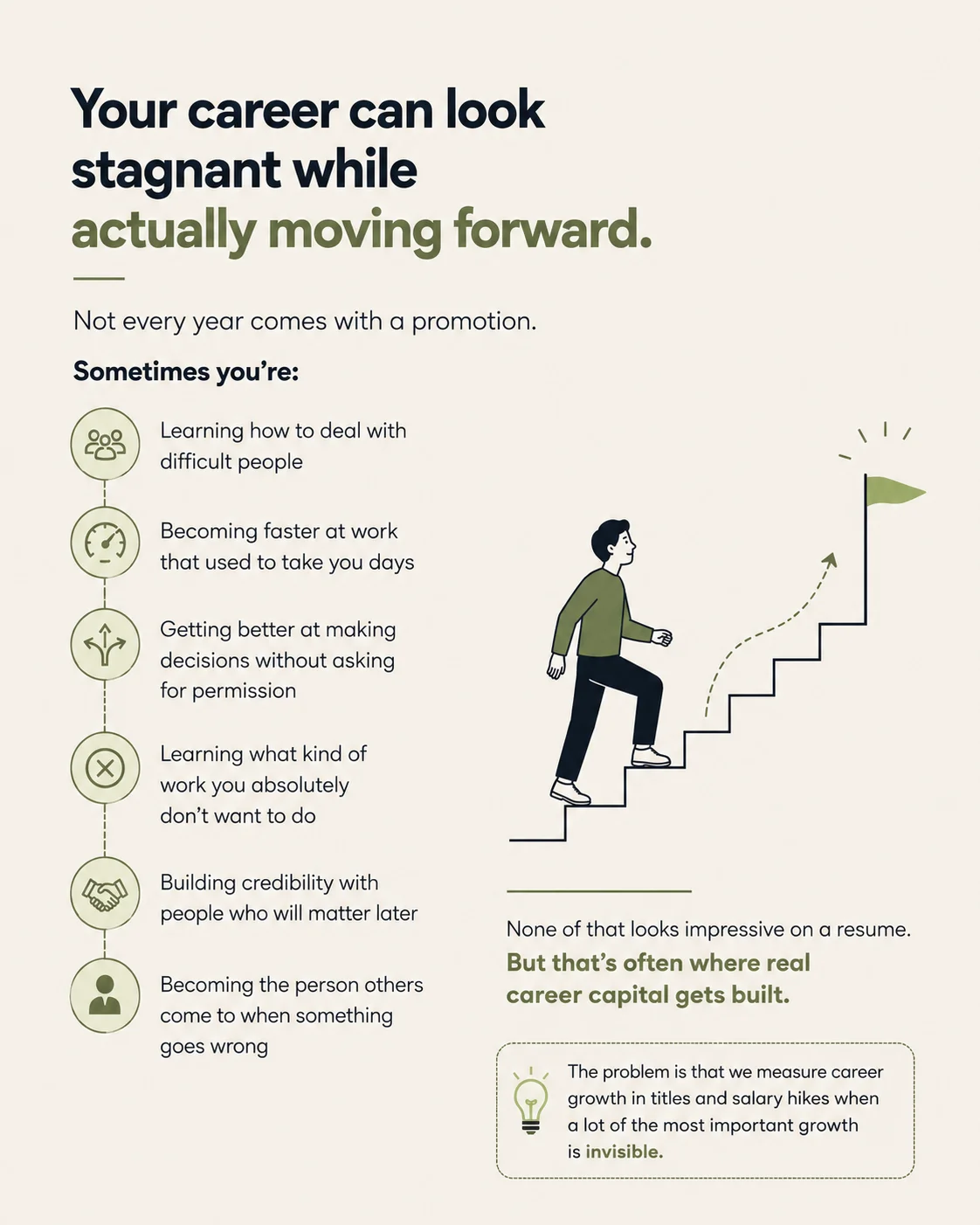
Your career can look stagnant while actually moving forward.
Not every year comes with a promotion.
Sometimes you're:
• Learning how to deal with difficult people
• Becoming faster at work that used to take you days
• Getting better at making decisions without asking for permission
• Learning what kind of work you absolutely don't want to do
• Building credibility with people who will matter later
• Becoming the person others come to when something goes wrong
None of that looks impressive on a resume.
But that's often where real career capital gets built.
The problem is that we measure career growth in titles and salary hikes when a lot of the most important growth is invisible.
Performance Review
Performance review season:
Manager: You need to show more ownership
Employee: Okay
Manager: Also, don't make decisions without checking with me first
The PM Interview Test no one prepares for
Most PM candidates spend weeks memorizing frameworks.
CIRCLES.
AARRR.
RICE.
North Star Metrics.
But interviewers are usually testing something else.
They’re seeing whether this person make product decisions with incomplete information.
Here’s a simple test.
Imagine you join a startup and the founder says:
> “User growth has stalled. Fix it.”
What do you do in the first 7 days?
A PM starts with questions:
* Where exactly did growth stall?
* Which acquisition channel changed?
* What does activation look like?
* Did retention change?
* What user segment is affected?
Frameworks don’t get you hired. Product thinking does.
A practical way to prepare:
Pick any app you use daily (LinkedIn, Swiggy, Notion, Spotify).
Every day, answer one question:
1. What problem is this feature solving?
2. How would you measure success?
3. What tradeoff did the PM make?
4. What data would you ask for before changing it?
Do this for 30 days.
You’ll think more like a PM than someone who has memorized 20 interview frameworks.
Priyal Maru
Entrepreneur In Residence at XTechBuzz