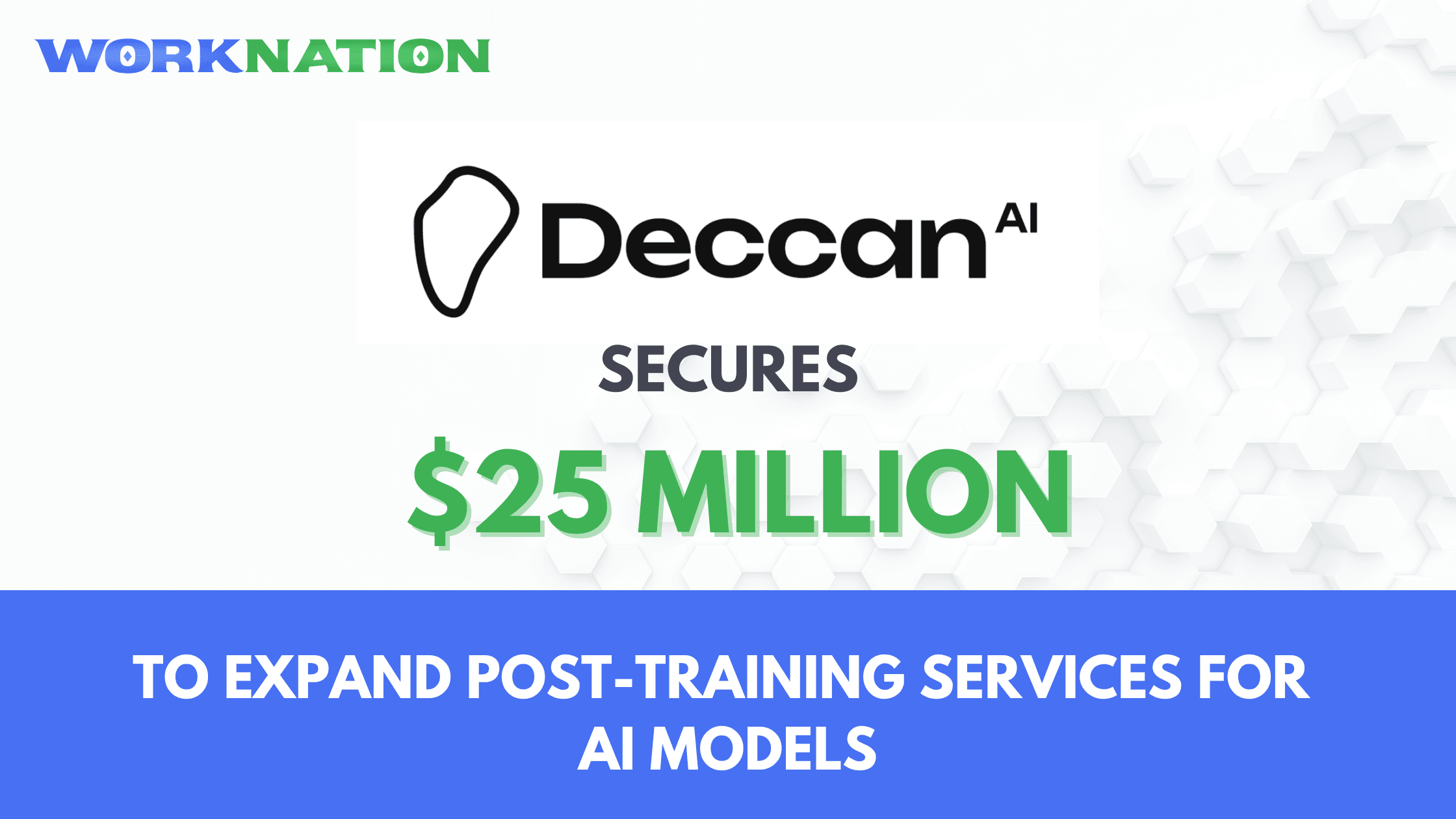
Deccan AI Raises $25 Million to Expand Post-Training Services for AI Models
Top Picks
Submit PR
Stay Ahead of the Market
Get the latest startup funding, hiring trends and global opportunities delivered to your inbox every week.
As artificial intelligence adoption expands, demand for post-training services is increasing. These services help improve model accuracy and reliability after initial development.
Deccan AI, a startup focused on post-training data and evaluation, has raised $25 million in its first major funding round. The company relies heavily on an India-based network of experts to deliver these services.
The all-equity Series A round was led by A91 Partners. Other investors include Susquehanna International Group and Prosus Ventures.
Shift toward outsourcing post-training work
Large AI labs such as OpenAI and Anthropic continue to build core models internally. However, companies are increasingly outsourcing post-training tasks.
These tasks include data generation, evaluation, and reinforcement learning. As a result, startups like Deccan AI are entering this segment to support real-world deployment needs.
Services and product offerings
Founded in October 2024, Deccan AI provides a range of services. These include improving coding capabilities and enabling AI agents to interact with external tools such as application programming interfaces (APIs).
In addition, the company works with AI labs on tasks like expert feedback generation and evaluation processes. It also builds reinforcement learning environments for model improvement.
Deccan offers enterprise products such as its evaluation suite, Helix, and an operations automation platform. Furthermore, its work is evolving as AI systems move beyond text into “world models,” which include robotics and vision-based applications.
Customer base and operations
The company serves clients including Google DeepMind and Snowflake.
According to founder Rukesh Reddy, Deccan has onboarded around 10 customers. At any given time, it manages a few dozen active projects.
Deccan is headquartered in the San Francisco Bay Area. At the same time, it operates a large team in Hyderabad. The company employs about 125 people and works with a contributor network of over one million individuals.
Typically, between 5,000 and 10,000 contributors are active each month. Around 10% of contributors hold advanced degrees such as master’s or PhDs, although this share varies by project.
Market competition and quality challenges
The AI training services market has grown alongside large language models. Companies such as Scale AI, Surge AI, Turing, and Mercor are competing in this space.
“Quality remains an unsolved problem,” Reddy said. He added that tolerance for errors in post-training is “close to zero,” as mistakes can directly affect production performance.
Therefore, post-training requires highly accurate and domain-specific data. In addition, timelines are often tight. AI labs may require large volumes of data within days, making it difficult to balance speed and quality.
Workforce model and compensation
The sector has faced criticism regarding working conditions and compensation. Many companies rely on gig workers for data-related tasks.
Reddy said contributors on Deccan’s platform earn between $10 and $700 per hour. Top contributors can earn up to $7,000 per month.
India’s role in AI talent supply
Although most of Deccan’s clients are based in the United States, a majority of its contributors are located in India.
Competitors like Turing and Mercor also source talent from India. However, they typically operate across multiple countries.
Deccan has chosen to concentrate its workforce in India to maintain quality control. “Many of our competitors go to 100-plus countries to find the experts,” Reddy said. “If you have operations in just one country, it becomes far easier to maintain quality.”
This approach reflects India’s role in the global AI ecosystem. The country currently serves as a major supplier of talent and training data, while frontier model development remains concentrated in the U.S. and parts of China.
At the same time, Deccan has started sourcing niche expertise from other markets, including the U.S., for areas such as geospatial data and semiconductor design.
Growth and revenue concentration
Reddy described Deccan as a “born GenAI” company. Unlike traditional data labeling firms, it has focused on higher-skill work from the beginning.
The company reported 10x growth over the past year. It is now operating at a double-digit million-dollar revenue run rate, although exact figures were not disclosed.
Around 80% of its revenue comes from its top five customers. This reflects the concentrated nature of the frontier AI market.
Have a Funding Round or Exciting Update to Share?
Submit your press release to get featured on WorkNation and reach founders, investors, and tech leaders.