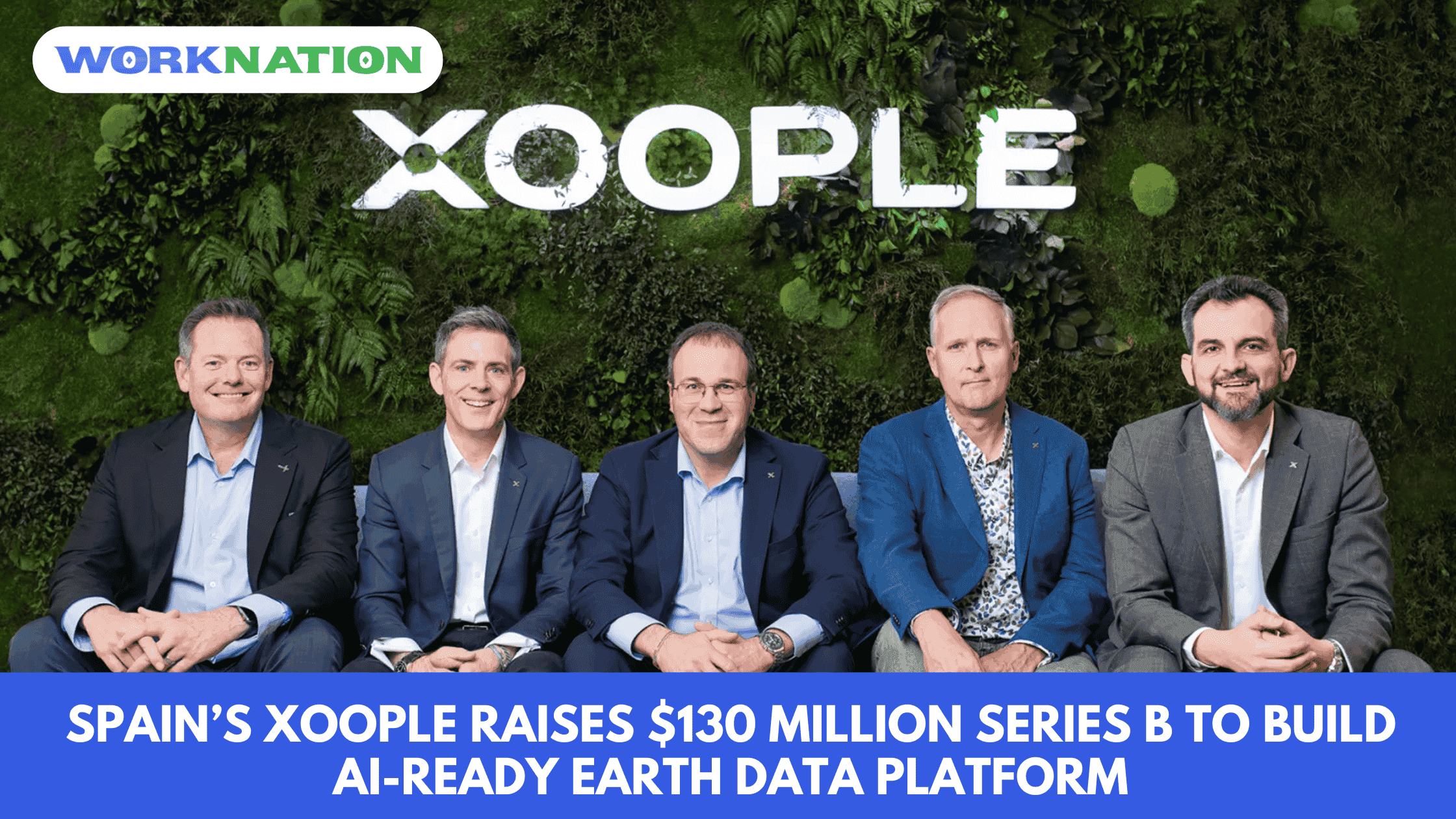
Spain’s Xoople Raises $130 Million Series B to Build AI-Ready Earth Data Platform
Top Picks
Submit PR
Stay Ahead of the Market
Get the latest startup funding, hiring trends and global opportunities delivered to your inbox every week.
Space data companies have long relied on government contracts for revenue. However, enterprise demand is now rising, driven by the growing use of artificial intelligence. As a result, startups are beginning to position themselves as data providers for AI-driven applications.
Spain-based Xoople is one such company. It aims to build a reliable source of Earth data for businesses that depend on accurate inputs for machine learning models.
Funding round and investors
Xoople has raised $130 million in a Series B funding round. Nazca Capital led the round, while MCH Private Equity, CDTI, Buenavista Equity Partners, and Endeavor Catalyst also participated.
With this round, the company’s total funding has reached $225 million. Although the company did not disclose its valuation, it indicated that it has crossed the $1 billion mark.
Building a satellite-driven data ecosystem
Founded in 2019, Xoople is developing a satellite constellation designed to collect high-precision optical data. This data is intended to support deep learning models across industries.
In addition, the company has partnered with L3Harris Technologies to develop sensors for its spacecraft. These sensors are expected to improve data quality significantly compared to existing monitoring systems.
However, the company has not shared details about the number of satellites or deployment timelines. This suggests that the project is still in a development phase and will require continued investment.
Focus on data quality and enterprise integration
Xoople is focusing on delivering high-quality data rather than simply increasing data volume. This approach could help differentiate it in a competitive market.
At the same time, the company is working to integrate its data directly into enterprise platforms. Instead of selling standalone datasets, it plans to embed its solutions into existing ecosystems used by businesses and governments.
Use cases across industries
The company is targeting multiple sectors where real-time Earth data can support decision-making. These include:
Government agencies tracking infrastructure and disaster impact
Agribusiness firms monitoring crop health
Enterprises managing supply chains and large-scale projects
Because these sectors rely on accurate and timely data, demand for such solutions is expected to grow.
Early distribution strategy before proprietary data
Interestingly, Xoople has already built its distribution network before launching its own satellite data. Currently, it uses publicly available datasets, including those from the European Space Agency.
Moreover, the company has integrated with platforms like Microsoft and Esri. These platforms are widely used by enterprises and GIS professionals, which could help Xoople scale faster once its own data becomes available.
Competitive landscape and future plans
Xoople operates in a crowded market. Established players such as Planet, BlackSky, Airbus, and others already provide satellite-based data and analytics.
Even so, Xoople’s enterprise-first approach and focus on integration may offer a different path to growth.
Looking ahead, the company aims to build what it calls an “Earth system of record.” This vision includes developing AI-driven models that represent real-world conditions in detail. To achieve this, Xoople plans to collaborate with partners across the technology ecosystem.
Have a Funding Round or Exciting Update to Share?
Submit your press release to get featured on WorkNation and reach founders, investors, and tech leaders.