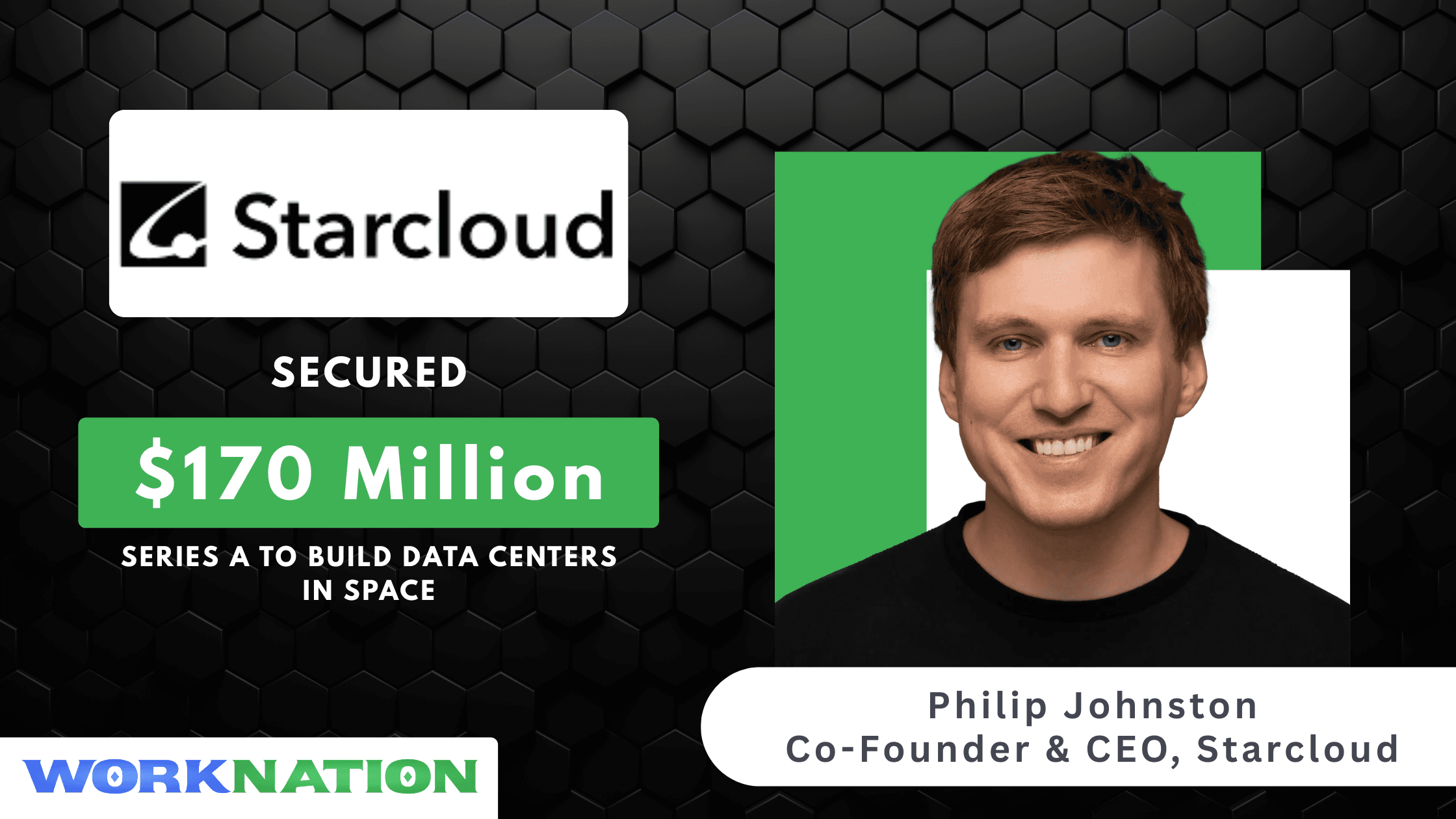
Starcloud Raises $170 Million Series A to Build Data Centers in Space
Top Picks
Submit PR
Stay Ahead of the Market
Get the latest startup funding, hiring trends and global opportunities delivered to your inbox every week.
Space compute startup Starcloud has raised $170 million in a Series A round, reaching a valuation of $1.1 billion. As a result, the company has joined the list of startups that achieved unicorn status shortly after participating in Y Combinator.
The round was led by Benchmark and EQT Ventures. This investment reflects rising interest in moving data infrastructure beyond Earth. However, the model still depends on untested technology and high upfront costs.
Early Progress in Space-Based Infrastructure
So far, Starcloud has raised a total of $200 million. In November 2025, it launched its first satellite equipped with an Nvidia H100 GPU.
Later this year, the company plans to deploy Starcloud 2. This upgraded system will include multiple processors, such as an Nvidia Blackwell chip, an Amazon Web Services server blade, and a bitcoin mining unit.
In addition, the company is developing Starcloud 3, a larger data center spacecraft. It is designed to launch aboard SpaceX Starship, the heavy-lift rocket under development by SpaceX.
Dependence on Future Launch Economics
Starcloud’s long-term plan depends on reducing launch costs. CEO Philip Johnston estimates that orbital data centers could become cost-competitive with terrestrial ones at around $0.05 per kWh. However, this assumes launch costs drop to roughly $500 per kilogram.
At present, Starship has not yet begun commercial operations. Johnston expects access between 2028 and 2029. Until then, the company plans to continue launching smaller systems using Falcon 9.
Consequently, large-scale deployment may take time. Many industry participants expect meaningful cost reductions only in the next decade.
Business Model Still Evolving
Currently, Starcloud is exploring two main revenue models. First, it offers computing power to satellites already in orbit. For instance, its initial satellite processes data from spacecraft operated by Capella Space.
Over time, the company aims to build distributed data centers that can handle workloads from Earth. However, this shift will depend on lower launch costs and improved infrastructure.
Limited Deployment of Space GPUs
Despite growing interest, the number of advanced GPUs in orbit remains small. In contrast, Nvidia supplied millions of GPUs to terrestrial data centers in 2025.
At a recent industry event, CEO Jensen Huang introduced new space-focused chip modules. However, these systems have not yet been widely deployed.
Similarly, satellite networks still operate at smaller energy scales. For example, Starlink generates significantly less power compared to large data centers under development on Earth.
Technical Challenges Remain
Running data centers in space presents several engineering challenges. These include power generation, thermal management, and system reliability.
To address this, Starcloud plans to equip Starcloud 2 with a large deployable radiator. This system will help manage heat generated by high-performance chips.
Moreover, scaling workloads in orbit remains complex. Training large AI models requires hundreds or thousands of GPUs working together. Achieving this in space may require either larger spacecraft or high-speed communication links between satellites.
Competition and Market Landscape
Starcloud is not alone in this segment. Companies such as Aetherflux and Aethero are also working on similar technologies. In parallel, Google has explored related initiatives through internal projects.
At the same time, SpaceX has proposed a large-scale satellite network for distributed computing. This could create direct competition in the long run.
Still, Johnston believes the markets may differ. While SpaceX may focus on internal workloads linked to projects like Grok and Tesla, Starcloud is positioning itself as an infrastructure provider.
Have a Funding Round or Exciting Update to Share?
Submit your press release to get featured on WorkNation and reach founders, investors, and tech leaders.