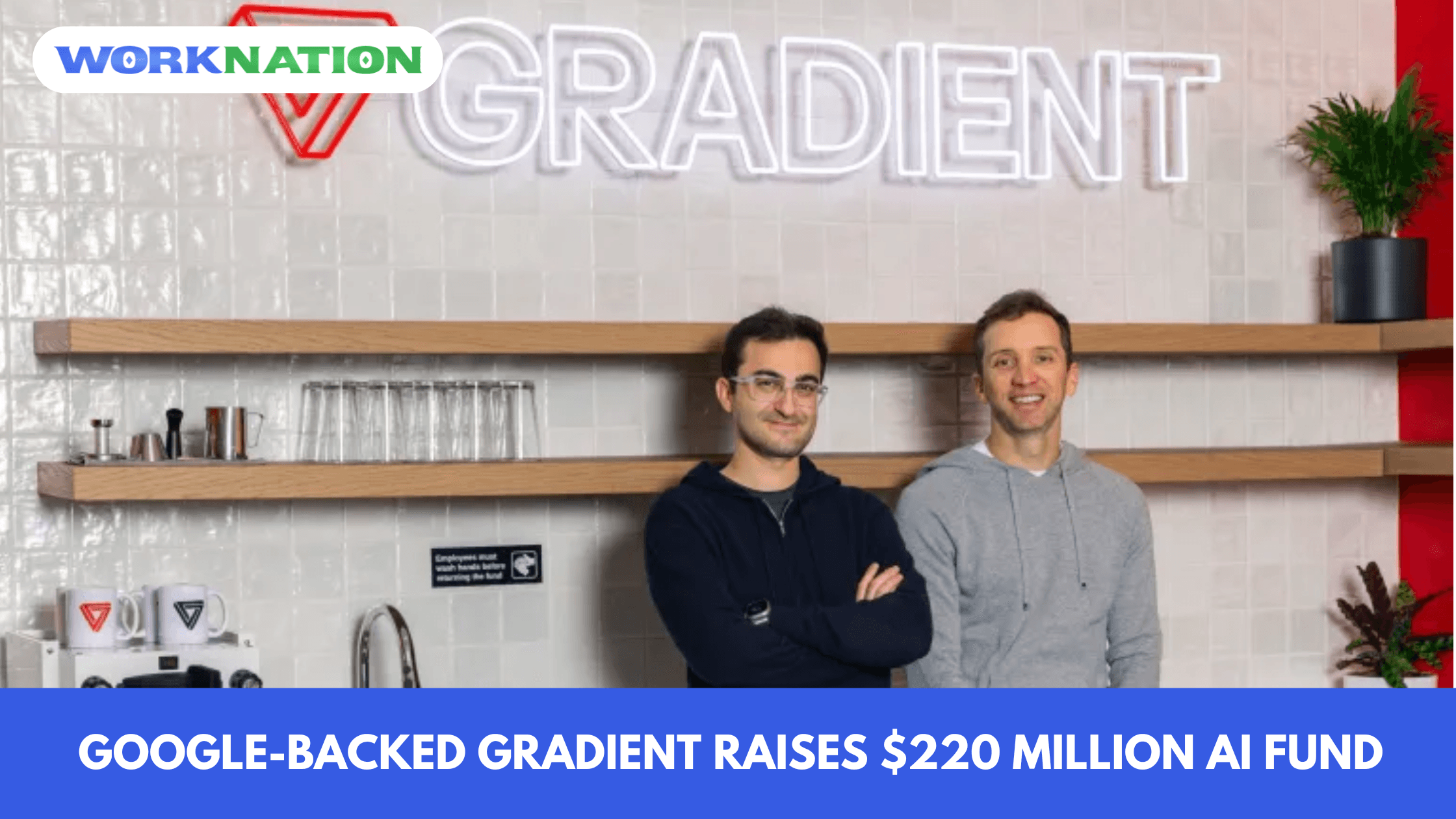
The Google-Backed AI Fund Once Overlooked Raises $220 Million
Top Picks
Submit PR
Stay Ahead of the Market
Get the latest startup funding, hiring trends and global opportunities delivered to your inbox every week.
In 2017, Darian Shirazi and Zach Bratun-Glennon were not working on what many considered a popular idea. At the time, the broader startup ecosystem showed limited interest in artificial intelligence.
“I remember going to happy hours with other startup investors and pre-seed founders,” said Shirazi. “I’d say I was at Gradient, and people would say ‘oh, the AI thing. I haven’t done that. Are there AI startups? I certainly don’t see them and AI doesn’t seem that interesting.’”
The two founders, both engineers, joined Gradient at its inception. Google launched the fund in 2017 to support early-stage AI startups. Notably, this came shortly after the release of the “Attention Is All You Need” paper, which later shaped modern AI systems.
At that stage, however, AI remained a limited business use case. While the technology showed promise, it had not yet reached mainstream adoption.
“You really had to be a nerd to actually realize that this was a big deal,” said Shirazi. “Everyone was talking about crypto and ICOs at the time.”
Investor Skepticism in the Early Years
Despite its backing, Gradient struggled to gain wider investor confidence. Many limited partners outside Google remained cautious.
Bratun-Glennon noted that the idea did not resonate immediately. Even though the fund had strong internal support, external perception remained uncertain.
“I think people thought we sounded like the quantum computing people, and no one wanted to do a dedicated quantum fund,” he said.
As a result, Gradient operated in a relatively narrow segment during its early years.
Shift in Market Dynamics
Over time, the AI landscape changed significantly. The rise of generative AI and tools like ChatGPT increased interest across the ecosystem. Consequently, more startups began building AI-first products.
Against this backdrop, Gradient has now closed a $220 million fifth fund. The firm focuses on seed and pre-seed AI investments.
Its portfolio includes companies such as Lambda, Oura, Sona, Writer, Airspace Intelligence, and Krea. In addition, the firm has recorded several exits. These include CentML, Prepared, and Streamlit.
The increase in startup activity has been notable. According to Shirazi, the number of relevant companies has grown sharply.
“From 2017 to 2021, we saw 100 companies a year that fit our thesis,” he said. “And post-ChatGPT, we started to see 1,500 to 2,000, which is now consistently the number of companies we see per year.”
Changing Approach to Due Diligence
As deal flow increased, Gradient adjusted its evaluation process. The team now relies more on technical validation.
Specifically, they write code to test whether products function as claimed. This approach helps assess early-stage startups more effectively.
At the same time, the firm remains cautious about certain trends. For instance, it avoids investing in foundational model companies. It also questions the sustainability of large seed rounds.
“Large seed rounds that are $100 million-plus or one billion-plus… I’ve never seen a startup raise more than, say, $10 million in a seed round and be successful,” said Shirazi.
A New Phase for Gradient
With its fifth fund, Gradient is entering a new phase. While Google continues as a key limited partner, the firm has started onboarding external investors.
This shift follows growing inbound interest from institutions. In addition, Shirazi and Bratun-Glennon now own the management company.
The move reflects both current demand and long-term planning.
“I do believe this is the largest platform shift in history, and the biggest value creation event in technology ever,” said Bratun-Glennon. “Is there an intervening two or three year air gap? There’s a risk to that, but on a ten-year horizon it’s an amazing place to be.”
From Skepticism to Scale
The firm’s journey reflects a broader shift in how AI is perceived. What once appeared niche has now become central to startup innovation.
This marks a contrast from earlier years, when even the existence of AI startups was questioned.
Have a Funding Round or Exciting Update to Share?
Submit your press release to get featured on WorkNation and reach founders, investors, and tech leaders.