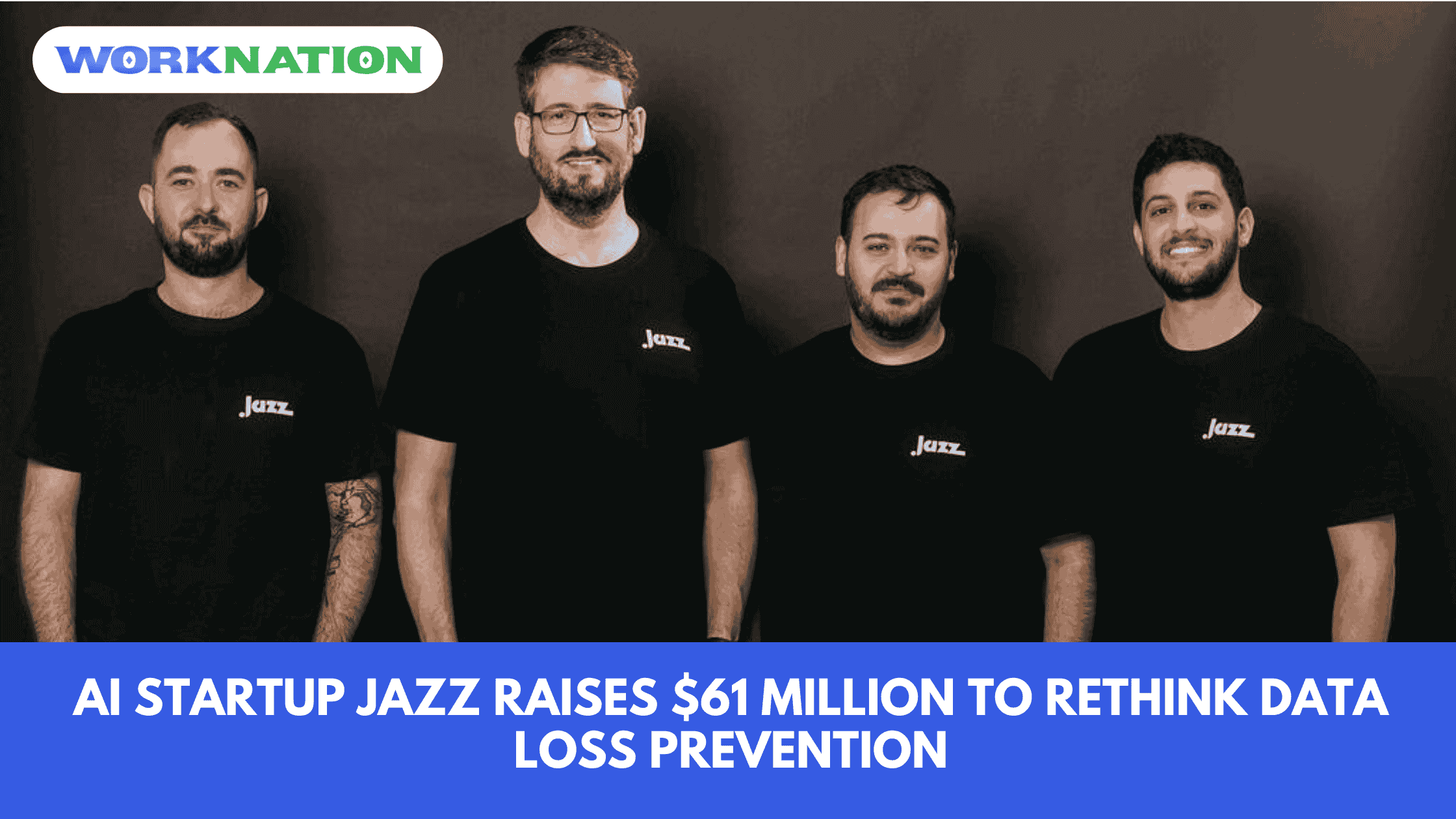
AI Startup Jazz Raises $61 Million to Rethink Data Loss Prevention
Top Picks
Submit PR
Stay Ahead of the Market
Get the latest startup funding, hiring trends and global opportunities delivered to your inbox every week.
Cybersecurity startup Jazz has raised $61 million in Seed and Series A funding to build a new approach to data loss prevention (DLP). The funding round was led by Glilot Capital Partners and Team8.
The New York–based company aims to analyze every data transaction across systems, users, and business workflows. By doing so, it hopes to help organizations understand how sensitive data moves inside and outside their environments.
Jazz was founded in 2024 and currently employs 44 people. The company emerged from stealth alongside the funding announcement.
Founder Background and Previous Experience
Jazz is led by co-founder and CEO Ido Livneh, who previously worked in senior product roles at cybersecurity startups.
Before launching Jazz, Livneh spent eight months as Vice President of Product at Axonius, an asset intelligence company. Prior to that, he worked for nearly three years as Vice President of Product at Laminar, a data security posture management startup.
Laminar was acquired by Rubrik in August 2023 for $104.9 million.
Limitations of Traditional DLP Systems
Data loss prevention has long been a concern for enterprises. However, many security teams struggle to rely on existing solutions.
Traditional DLP tools usually depend on pattern matching, keyword rules, and regular expressions. These methods can detect some cases of sensitive data exposure. However, they often lack the context required to determine whether data movement represents an actual security risk.
As a result, rule-based systems frequently generate large volumes of false positives, which makes them difficult for security teams to manage.
"DLP is not a new problem. Every board, every security organization knows about the risk of DLP," Livneh told Information Security Media Group. "But the fact of the matter is that the existing solutions don't work, and when you talk about DLP with CISOs it's really hard to find anybody that loves it. Everybody hates their DLP, to be honest, because they still get hit again and again and again."
Livneh added that only a portion of organizations attempt to run full DLP programs.
"The way we see the market, about 30% even tries to implement and run a DLP program, and even they know that what they have in place is best effort at best," Livneh said.
Jazz Uses AI Agents to Analyze Data Movement
Jazz is building a system that examines each data transaction from multiple perspectives.
According to Livneh, the platform uses multiple artificial intelligence agents that analyze different parts of the event. These agents evaluate the data itself, the systems involved, the people accessing it, and the surrounding business processes.
The system also collects signals from endpoints to reconstruct the sequence of events around data access and transfer.
"What we've built is a DLP investigator that does that work automatically for you in autonomy and it's deployed at scale," Livneh said. "It investigates in-depth every data transaction there is. It understands what happened at the level of the data, the systems, the people and the business process, and alerts your organization so you understand what happened, why it happened and the intent of the actor."
Natural Language Policies for Security Controls
Jazz also introduces a natural language policy engine. This system allows organizations to describe acceptable data behavior using plain language rather than complex rule structures.
The approach helps the platform interpret the intent behind security policies. It can also reason about activities that were not explicitly defined in policy documents.
"We have a natural language policy engine that helps describe what's acceptable and what's not acceptable in the company," Livneh said. "That allows Melody to run a human-like assessment of the situation and make decisions on situations that are probably not even explicitly mentioned in the policy. It bridges the gap between day-to-day practices and the policies written in the company."
AI Tools and SaaS Expand Data Leakage Risks
The growth of generative AI tools and SaaS applications has created new pathways for data leakage.
Many employees now use AI assistants, productivity software, and cloud platforms that require uploading documents, code, or internal data. These tools can unintentionally become channels for sensitive information to leave the organization.
"Every week we hear about new tools being deployed, especially in the AI and GenAI world, and employees are adopting them even without the approval of the company," Livneh said. "These are new ways in which data could be shared outside the organization and security teams have a really hard time keeping track and securing all these vectors."
In some cases, engineers upload proprietary code or internal documentation to personal AI accounts to improve or rewrite software. Similarly, sales teams may store customer data in personal tools that sync to private cloud accounts.
"We've seen stories about engineers taking the entire code base of the company and a few strategic documents, putting that into a personal account in Claude Code and asking it to rebuild the company's product," Livneh said. "We've seen sales people managing shadow CRMs and having all the accounts they're managing on their personal Apple Notes that sync to their personal iCloud account."
Human Oversight Remains Part of the System
Despite automation, Jazz keeps humans involved in security decisions.
The platform allows administrators to review alerts, evaluate uncertain situations, and clarify policy interpretations. Critical actions, such as disconnecting devices from networks, remain under human control.
"There is always a human involved," Livneh said. "Nobody is disconnecting a computer from the network without somebody making that decision. Melody shows the admin situations that it thinks are outside of policy or that it is not sure of, and they have a discussion about it. Over time, within a few weeks of working with it and talking with it, it feels like it's molding itself around your specific business."
Have a Funding Round or Exciting Update to Share?
Submit your press release to get featured on WorkNation and reach founders, investors, and tech leaders.